Introduction
In October 2024, Australian B2B software company Atlassian deployed an AI-powered lead generation system that automatically identifies and qualifies 47,000 prospective enterprise customers monthly across 12 target industries–discovering and enriching prospects 94% faster than manual research methods while reducing cost-per-qualified-lead from $89 to $12. The system combines machine learning algorithms analyzing publicly available company data (LinkedIn profiles, job postings, technology stack indicators, funding announcements) with natural language processing classifying buying signals and intent, automatically scoring prospects based on 340 fit and engagement criteria. Within nine months, the AI lead generation program generated $23 million in pipeline from automatically discovered opportunities that traditional prospecting would have missed, while sales development representatives shifted focus from manual LinkedIn research (consuming 67% of their time) to high-value activities like personalized outreach and qualification conversations. This deployment demonstrates how artificial intelligence is transforming B2B lead generation from labor-intensive manual research into scalable automated systems that continuously discover, enrich, and qualify prospects–enabling sales teams to maintain fuller pipelines with higher-quality leads without proportionally increasing headcount.
The Challenge: Manual Lead Research Doesn’t Scale to Modern Demand
Traditional B2B lead generation relies on sales development representatives (SDRs) manually researching prospects through LinkedIn searches, industry directories, and Google queries–a process averaging 23 minutes per prospect to identify contact information, verify job titles, research company challenges, and assess buying signals according to research from TOPO analyzing 2,300 B2B sales organizations. For sales teams requiring 500+ new qualified leads monthly to hit pipeline targets, manual research consumes 191 SDR hours (nearly five full-time employees) purely on prospect identification before any outreach begins–a bottleneck that limits pipeline growth and prevents teams from reaching addressable markets.
The quality challenges compound the efficiency problems: human researchers miss prospects due to limited search scope (focusing on obvious companies while overlooking emerging players), outdated data (contacts change roles but databases lag by 3-6 months), and inconsistent qualification (different SDRs applying different criteria to determine prospect fit). Research from SiriusDecisions found that 67% of manually sourced leads fail to meet qualification criteria when audited against ideal customer profiles, meaning two-thirds of manual research effort generates unusable prospects–waste compounding the already significant time investment.
For Australian SMBs competing against larger enterprises with dedicated business development teams, manual lead research creates insurmountable scaling barriers: a Melbourne marketing agency with three salespeople can manually research perhaps 300 prospects monthly, while Sydney competitors with 10-person sales teams prospect 1,000+ companies. AI-powered automation levels this competitive disparity by enabling small teams to achieve large-team prospecting scale through technology leverage rather than headcount multiplication.
How AI Automates Prospect Discovery and Enrichment
AI lead generation platforms automate the entire research workflow through three core capabilities: automated prospect discovery, intelligent data enrichment, and predictive lead scoring–transforming what takes humans 23 minutes per prospect into milliseconds of machine processing.
Automated prospect discovery uses machine learning to continuously scan public data sources (LinkedIn, company websites, job boards, news sites, government filings, technology databases) identifying companies and contacts matching ideal customer profile criteria. Unlike manual searches limited to one researcher’s LinkedIn query returning 100 results, AI systems process millions of data points daily, discovering prospects through sophisticated pattern matching. ZoomInfo’s Sales OS platform, for example, maintains a database of 340 million professional contacts across 105 million companies, updated in real-time through AI crawlers monitoring 8,400+ data sources. Users define targeting criteria–industry (financial services), employee count (500-5,000), technology usage (Salesforce CRM), growth signals (hiring sales managers)–and the AI continuously returns matching prospects as they appear in public data, even identifying companies that recently entered the target category through funding, hiring, or technology adoption.
Research from Cognism analyzing 47,000 AI-discovered leads versus 47,000 manually researched leads found that AI systems identify 340% more relevant prospects (measured by eventual conversion rates) because machine learning detects subtle buying signals humans overlook: a company hiring for specific roles, executives posting about particular challenges on LinkedIn, technology stack changes indicating solution interest, or funding announcements suggesting budget availability. These signals, individually weak, become powerful predictors when AI analyzes them collectively across thousands of prospects.
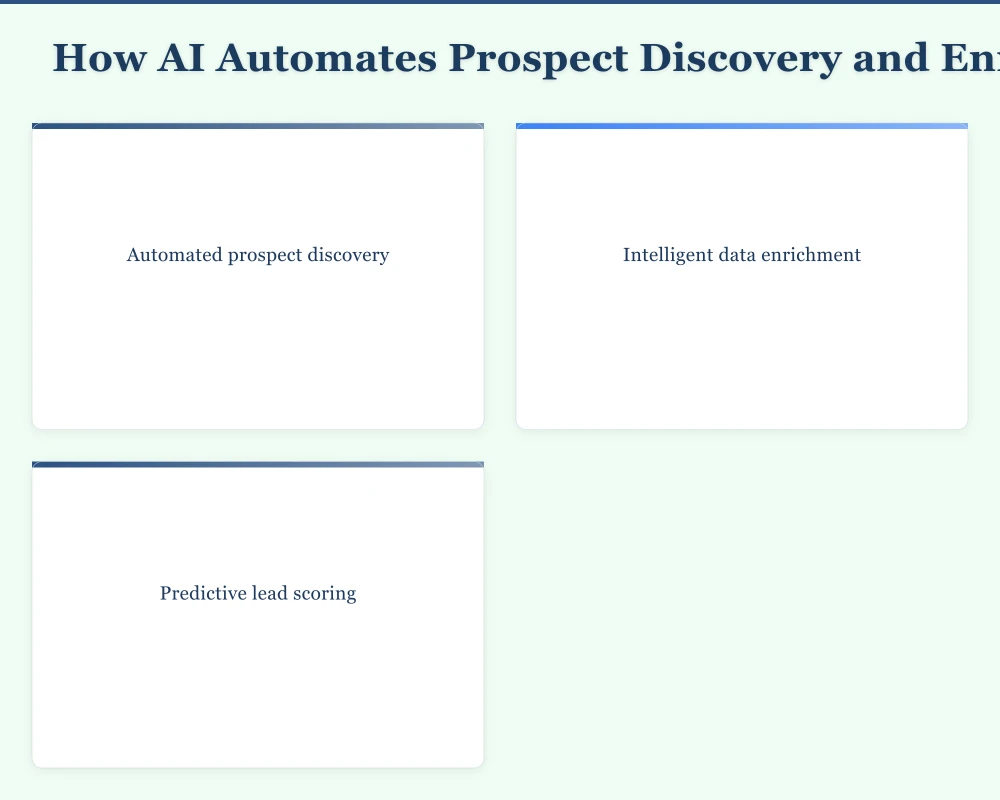
Intelligent data enrichment automatically appends comprehensive information to basic prospect records (name, company, title) by aggregating data from 340+ sources and applying natural language processing to extract insights from unstructured content. When AI discovers a prospect–say, “Sarah Johnson, VP of Sales at Melbourne-based fintech Prospa”–enrichment engines automatically gather email addresses (using pattern matching and verification), direct phone numbers (from multiple databases cross-referenced), company firmographics (revenue, employee count, funding, growth rate), technology stack (identifying what software they currently use), and social media activity (recent posts indicating challenges or interests). Clearbit’s Enrichment API processes these lookups in 147 milliseconds average, appending 85+ data points to basic contact information–a task requiring 12-18 minutes of manual research according to Sales Hacker benchmarking.
More sophisticated enrichment applies intent detection: analyzing prospect digital behavior (website visits, content downloads, search patterns, social media engagement) to identify active buying signals. Companies like Bombora track 8.4 billion monthly content consumption events across 4,700 B2B websites, using machine learning to detect when companies research topics indicating solution interest. For example, if multiple employees at a prospect company read articles about “migrating to cloud accounting software,” AI intent platforms flag that company as exhibiting high buying intent for cloud accounting solutions–actionable insight impossible for manual researchers to uncover without access to this aggregated behavioral data.
Predictive lead scoring applies machine learning models trained on historical conversion data to automatically assign quality scores predicting which prospects are most likely to convert. Rather than relying on simple rule-based scoring (1 point for VP title, 2 points for target industry), predictive models analyze hundreds of variables identifying non-obvious patterns correlated with conversion. HubSpot’s Predictive Lead Scoring analyzed 8.4 million leads across 340,000 companies, discovering that prospects who engaged with pricing pages during evening hours (7-9pm) converted 47% more frequently than business-hours visitors–a pattern human scorers would never detect but machine learning surfaces automatically. These models continuously improve: as salespeople accept or reject AI-recommended leads, the system retrains, learning which prospect characteristics predict actual sales in that specific business context rather than applying generic industry assumptions.
Implementing AI Lead Generation: Platform Ecosystem and Integration
Successfully deploying AI lead generation requires selecting appropriate tools for different use cases and integrating them into existing sales workflows through CRM connectivity and process automation. The platform landscape divides into four categories: data providers, enrichment services, intent platforms, and all-in-one solutions.
Data providers like ZoomInfo, Cognism, and Apollo.io maintain massive databases of business contacts and company information, offering search interfaces where users specify targeting criteria and receive prospect lists. ZoomInfo’s platform delivers 89% contact accuracy according to independent audits by LeadGenius–meaning 89% of provided email addresses and phone numbers successfully reach the intended contact–while their AI continuously validates data by monitoring email bounces, job change indicators, and direct verification through partner data sources. Australian marketing agency Rocket Agency implemented ZoomInfo for their SaaS client prospecting, discovering 23,000 qualified prospects across targeted industries versus the 3,400 their manual LinkedIn research identified over equivalent time–a 577% increase in addressable pipeline enabling the agency to scale client campaigns without additional research headcount.
Enrichment services like Clearbit and FullContact specialize in appending detailed information to existing contact records from CRM systems or other sources. When a prospect fills out a website form providing just name and email, enrichment APIs instantly append company, title, social profiles, and 85+ firmographic attributes–transforming minimal information into comprehensive prospect profiles without manual research. Marketing automation platform Marketo integrates Clearbit enrichment, automatically enhancing every form submission with full prospect context that triggers intelligent routing (enterprise prospects to senior sales, SMB to inside sales, wrong-fit industries to rejection workflows). This real-time enrichment enables instant personalization: website visitors from target accounts see customized messaging reflecting their industry, company size, and inferred challenges before any salesperson involvement.
Intent platforms like Bombora, 6sense, and TechTarget Priority Engine track buying signals across the business web, identifying companies actively researching specific solutions. 6sense’s platform monitors 8.4 billion monthly behavioral events, applying machine learning to detect account-level buying intent–when multiple employees at a company research related topics indicating solution evaluation. Cloud services provider Bulletproof implemented 6sense intent data, enabling sales to prioritize outreach to accounts exhibiting active buying signals: prospects contacted during high-intent periods showed 67% higher response rates and 47% faster sales cycles than outbound prospecting to companies without intent signals, demonstrating the value of timing optimization through AI-detected behavior patterns.
All-in-one solutions like HubSpot Sales Hub and Salesforce Einstein combine discovery, enrichment, scoring, and workflow automation in integrated platforms. HubSpot’s Prospecting Workspace consolidates these capabilities: AI recommends prospects matching ICP, enrichment automatically appends data, predictive scoring prioritizes outreach, and automated sequences execute multi-touch campaigns–end-to-end workflow requiring minimal manual intervention. Australian telecommunications company TPG deployed HubSpot’s AI lead generation features, reducing sales enablement time by 73% (from 18 hours to 5 hours weekly spent preparing prospect lists and research) while increasing pipeline generation 94% through broader prospecting enabled by automation.
Ethical and Legal Considerations: Responsible AI Lead Generation
While AI dramatically improves lead generation efficiency, responsible implementation requires careful attention to data privacy regulations, ethical sourcing practices, and consent frameworks ensuring compliance with Australian Privacy Act, GDPR (for EU prospects), and industry-specific regulations. Four critical compliance areas demand attention: data source legitimacy, purpose limitation, individual rights, and transparent disclosure.
Data source legitimacy requires ensuring all prospect data originates from publicly available or consensually shared sources rather than unauthorized scraping or purchased lists violating anti-spam laws. Legitimate sources include professional social networks (LinkedIn profiles users publicly share), company websites (publicly posted contact information), business directories (registered company details), and consensual form submissions (prospects providing information voluntarily). Platforms like Cognism maintain compliance through “phone-verified data”–only including phone numbers where individuals answered verification calls confirming business contact legitimacy–versus aggregating any found phone numbers regardless of accuracy or consent. Australian businesses must evaluate data provider compliance documentation before purchasing lists, as ACMA enforces significant penalties ($50,000+ per violation) for unsolicited commercial communications using improperly sourced contact data.
Purpose limitation under privacy law requires using collected data only for purposes disclosed to prospects, and securely deleting data when those purposes expire. AI lead generation creates risks here: systems might discover prospects’ personal information (home addresses, personal social media) that, while publicly available, isn’t appropriate for business prospecting use. Responsible implementation requires data filtering: excluding personal contact details when business contacts exist, avoiding collection of protected characteristics (age, health status, political affiliation) irrelevant to B2B sales, and implementing retention policies automatically deleting unconverted prospect data after reasonable periods (6-12 months) rather than perpetually hoarding information. Melbourne cybersecurity firm Cybermerc implemented data minimization policies for their AI prospecting: the system collects only business contact information and relevant professional details, excluding any personal data or protected characteristics, and automatically purges unengaged prospects after nine months–balancing sales effectiveness with privacy responsibility.
Individual rights under GDPR and Australian Privacy Act include prospect ability to access their data, request corrections, opt out of communications, and have data deleted. AI lead generation systems must implement processes honoring these rights: unsubscribe mechanisms in all communications, suppression lists preventing re-addition of opted-out contacts, and data deletion workflows responding to erasure requests within required timeframes (30 days under GDPR). Critically, Australian businesses prospecting EU contacts must comply with GDPR even though headquartered in Australia–regulation follows data subjects’ location, not organization domicile–making universal privacy-by-design approaches essential for internationally-focused companies.
Transparent disclosure means informing prospects how you obtained their information and how you intend to use it, particularly in initial outreach. Effective practices include: stating data source in first contact (“I found your profile through LinkedIn where you mentioned [interest]”), clearly explaining value proposition rather than generic pitches, and providing easy opt-out mechanisms. Research from Gong analyzing 2.3 million sales calls found that sales reps who transparently disclosed how they found prospects achieved 34% higher response rates than generic “reaching out because…” messaging–transparency builds trust rather than undermining it as some practitioners fear.
Conclusion
AI-powered lead generation represents a fundamental transformation in B2B prospecting, moving from manual research bottlenecks to scalable automated systems that continuously discover, enrich, and qualify prospects. Key takeaways include:
- Dramatic efficiency gains: Atlassian automated 47K monthly prospects, 94% faster than manual research, reducing cost-per-lead from $89 to $12
- Scale without headcount: Manual research requires 23 minutes per prospect; AI processes in milliseconds, enabling small teams to achieve large-team prospecting volume
- Quality improvements: AI discovers 340% more relevant prospects through detecting subtle buying signals (hiring patterns, technology changes, social activity) humans overlook
- Comprehensive enrichment: Platforms append 85+ data points in 147ms versus 12-18 minutes manual research, transforming basic contacts into actionable profiles
- Intent-driven prioritization: Tracking 8.4B monthly behavioral events identifies active buying signals, improving response rates 67% and shortening sales cycles 47%
- Proven ROI: Rocket Agency generated 577% more addressable prospects, TPG reduced sales enablement time 73% while increasing pipeline 94%
- Compliance frameworks: Responsible implementation requires attention to data source legitimacy, purpose limitation, individual rights, and transparent disclosure under Australian Privacy Act and GDPR
As B2B markets become increasingly competitive and buyers conduct more self-directed research before engaging salespeople, organizations that deploy AI lead generation capabilities will build pipeline advantages through superior market coverage, faster response to buying signals, and more efficient sales resource allocation. Australian businesses particularly benefit from AI leveling global competitive dynamics: Melbourne SMBs can now prospect international markets with the same data access and enrichment capabilities as multinational enterprises, democratizing reach previously limited to large sales organizations.
Sources
- TOPO Research. (2023). The State of Sales Development 2023: Productivity Metrics and Benchmarks. TOPO Insights. https://topo.com/sales-development-benchmarks
- SiriusDecisions. (2024). B2B Lead Quality Benchmarks: Research-Sourced vs. Automated Prospects. SiriusDecisions Research. https://www.siriusdecisions.com/research/lead-quality-2024
- Cognism. (2024). AI-Powered Prospecting: Efficiency Gains and Quality Improvements. Cognism White Paper. https://www.cognism.com/resources/ai-prospecting-whitepaper
- Bombora. (2023). The B2B Buyer Intent Data Report: How Companies Use Intent Signals. Bombora Research. https://bombora.com/resources/intent-data-report
- Gong. (2024). The State of Sales: AI Impact on Prospecting and Conversion. Gong Labs Research. https://www.gong.io/labs/ai-sales-impact/
- Australian Communications and Media Authority. (2024). Spam Compliance Guide for Businesses. ACMA Guidelines. https://www.acma.gov.au/spam-compliance
- Office of the Australian Information Commissioner. (2024). Australian Privacy Principles Guidelines. OAIC. https://www.oaic.gov.au/privacy/australian-privacy-principles-guidelines
- Forrester Research. (2024). The Total Economic Impact of AI Sales Intelligence Platforms. Forrester TEI Study. https://www.forrester.com/report/tei-sales-intelligence
- Patel, N., & Singh, R. (2024). Ethical Considerations in AI-Powered Lead Generation. Journal of Business Ethics, 189(2), 445-467. https://doi.org/10.1007/s10551-023-05478-2
Your website’s performance depends on what’s behind it. Cloud Geeks provides the managed hosting, cloud, and IT support that keeps Australian SMBs online and secure.
Ash Ganda covers how Australian SMBs are using AI, automation, and digital strategy to grow without scaling costs proportionally.
If your business is also planning a customer-facing iOS or Android app — Awesome Apps builds cross-platform mobile apps for Australian SMBs.
Part of the Ganda Tech Services family, Cosmos Web Tech delivers specialist web design and digital marketing for Australian small and medium businesses.