Australian Small Business Guide to Online Directories
Before the internet, getting listed in the Yellow Pages was a standard part of running a business. Today, the concept is the same but the landscape has changed dramatically. Online directories are the modern Yellow Pages, and being listed in the right ones can significantly boost your local visibility and SEO.
For Australian small businesses, online directory listings (also called citations) serve two important purposes: they help customers find you directly, and they signal to Google that your business is legitimate and established. Both of these contribute to better search rankings and more customer enquiries.
This guide covers which directories matter, how to create effective listings, and how to manage them efficiently.
Why Online Directories Still Matter
They Help Customers Find You
Many people still use directories to search for local businesses. Yellow Pages, True Local, and industry-specific platforms all drive real traffic and enquiries.
They Boost Your Local SEO
Google uses directory listings as a signal of business legitimacy. Consistent, accurate listings across multiple directories strengthen your local search presence.
They Build Trust
When a potential customer searches for your business and finds consistent information across multiple platforms, it reinforces trust. Conversely, inconsistent or missing information raises doubts.
They Provide Backlinks
Most directory listings include a link to your website. While individual directory links are not hugely powerful, having links from multiple trusted directories adds up.
The Essential Australian Directories
Here are the directories every Australian small business should be listed in, ranked by importance.
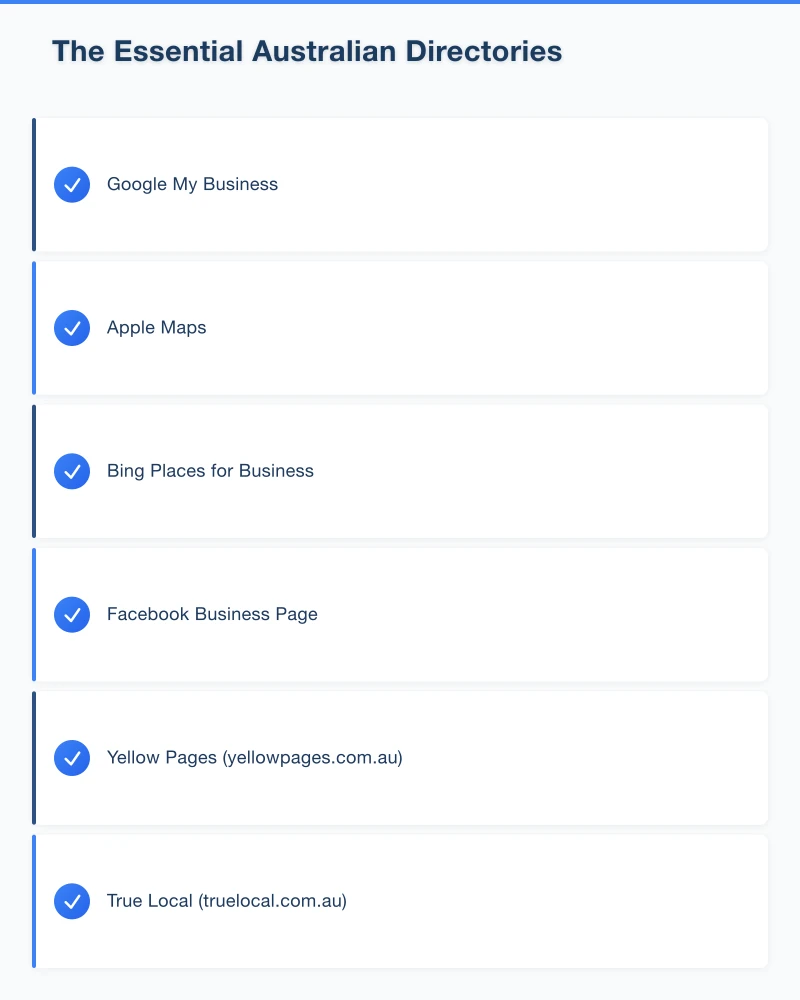
Tier 1: Must-Have Listings
Google My Business The most important listing of all. Your GMB profile appears directly in Google search results and Google Maps. If you only do one thing, do this.
Apple Maps List your business through Apple Maps Connect. iPhone users rely on Apple Maps for local searches, and Siri uses Apple Maps data.
Bing Places for Business While Google dominates search in Australia, Bing still has a meaningful user base, particularly among older demographics and corporate users whose computers default to Bing.
Facebook Business Page Facebook functions as a directory in its own right. Many people search for local businesses on Facebook before going to Google.
Tier 2: Major Australian Directories
Yellow Pages (yellowpages.com.au) The digital version of the classic Yellow Pages. Still widely used and trusted in Australia. Free basic listing available.
True Local (truelocal.com.au) A popular Australian business directory with strong search engine presence. Free listing with options for paid upgrades.
Yelp Australia (yelp.com.au) Particularly important for hospitality, retail, and service businesses. Free listing with review functionality.
Hotfrog (hotfrog.com.au) An Australian-founded directory with a good online presence. Free basic listing.
Local Search (localsearch.com.au) Growing Australian directory with both free and paid options.
StartLocal (startlocal.com.au) Free Australian business directory with decent domain authority.
Tier 3: Industry-Specific Directories
Depending on your industry, these specialised directories can be very valuable:
Trades and Home Services:
- hipages.com.au
- ServiceSeeking.com.au
- oneflare.com.au
Health and Medical:
- HealthEngine.com.au
- HotDoc.com.au
Hospitality:
- TripAdvisor.com.au
- Zomato (formerly Urbanspoon)
- OpenTable (for restaurants)
Legal:
- LawPath.com.au
- FindLaw.com.au
Real Estate:
- RealEstate.com.au
- Domain.com.au
Automotive:
- AutoGuru.com.au
Accommodation:
- Booking.com
- Stayz.com.au
Tier 4: General Directories Worth Listing In
- AussieWeb (aussieweb.com.au)
- dLook (dlook.com.au)
- EnrollBusiness (enrollbusiness.com)
- Cylex (cylex.com.au)
- Tuugo (tuugo.info)
Creating Effective Directory Listings
A listing is only as good as the information it contains. Here is how to make yours count.
NAP Consistency Is Critical
NAP stands for Name, Address, and Phone number. These three pieces of information must be identical across every directory listing.
Pick one format and use it everywhere:
- Business name: “Cosmo Web Tech” (not sometimes “CosmoWebTech” or “Cosmo Web Technology”)
- Address: “Suite 1, 42 Victoria Ave, Castle Hill NSW 2154” (the exact same format everywhere)
- Phone: “(02) 1234 5678” (not sometimes “02 1234 5678” or “+61 2 1234 5678”)
Inconsistencies confuse search engines and can hurt your local SEO.
Write a Compelling Business Description
Most directories let you write a description of your business. Do not waste this:
- Clearly state what you do
- Mention your location and service areas
- Include relevant keywords naturally
- Highlight what makes you different
- Keep it professional and factual
Write a master description of about 200 words that you can adapt for each directory (some have different character limits).
Choose the Right Categories
Select the most specific and accurate categories available. “Plumber” is better than “Home Services.” If the directory allows multiple categories, add relevant secondary categories.
Add Photos
Directories that allow photos get more engagement. Upload:
- Your logo
- Photos of your work
- Photos of your team or premises
- Product photos if applicable
Include Your Website URL
Always add your website link. This drives traffic and provides a backlink.
Keep Business Hours Accurate
If the directory shows business hours, keep them updated, including public holiday hours.
Managing Your Listings Efficiently
Use a Spreadsheet
Create a spreadsheet tracking:
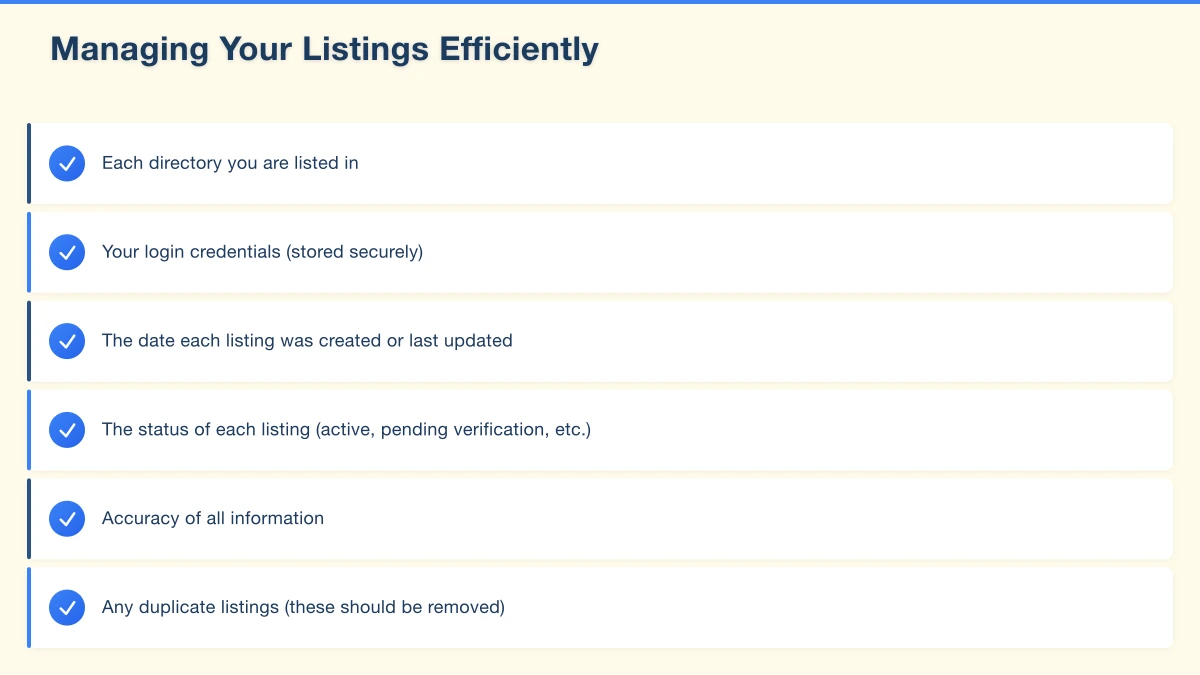
- Each directory you are listed in
- Your login credentials (stored securely)
- The date each listing was created or last updated
- The status of each listing (active, pending verification, etc.)
Audit Quarterly
Every three months, check your listings for:
- Accuracy of all information
- Any duplicate listings (these should be removed)
- New reviews that need responses
- Directories you have not yet listed in
Claim Existing Listings
Some directories automatically create listings from public data. Search for your business on each directory to see if a listing already exists. If it does, claim it so you can control the information.
Handle Duplicates
Duplicate listings on the same directory confuse search engines and customers. If you find duplicates:
- Claim the most complete listing
- Request removal of the duplicate through the directory’s support
- Merge information if the directory offers that option
Local and Community Directories
Do not overlook local directories specific to your area:
- Local council business directories: The Hills Shire Council and other Western Sydney councils often maintain business directories
- Chamber of commerce listings: Your local business chamber (Hills District, Parramatta, Blacktown) typically offers online directories for members
- Local community websites: Neighbourhood websites and Facebook groups sometimes maintain business lists
- Shopping centre directories: If you operate in or near a shopping centre, ensure you are listed on their website
These local listings are particularly valuable because they are highly relevant to your geographic area.
Common Directory Listing Mistakes
- Inconsistent NAP information: The most damaging mistake for local SEO. Check and standardise everything.
- Incomplete listings: Empty fields and missing photos make your listing less effective and less trustworthy.
- Ignoring reviews on directories: Some directories (Yelp, True Local) have review features. Monitor and respond to them.
- Duplicate listings: Multiple listings on the same directory cause confusion. Consolidate them.
- Set and forget: Listings need periodic updates, especially when your information changes.
- Wrong categories: Incorrect categories mean you appear in irrelevant searches.
Your Directory Listing Action Plan
This Week
- Verify your Google My Business listing is complete and accurate
- List your business on Yellow Pages and True Local
- Claim any existing listings that were created without your input
This Month
- Work through the Tier 2 and Tier 3 directories relevant to your industry
- Create your master business description and NAP format
- Set up a tracking spreadsheet
Ongoing
- Add one to two new directory listings per month
- Audit all listings quarterly for accuracy
- Respond to reviews on directory platforms
- Update listings whenever your business information changes
The Cumulative Effect
No single directory listing will transform your business. But together, a consistent presence across 15 to 20 quality directories creates a powerful foundation for your local SEO. It tells Google and your customers that your business is established, legitimate, and easy to find.
For Western Sydney businesses competing in local search, directory listings are one of the most straightforward and cost-effective ways to improve your visibility. Most listings are free and take only 10 to 15 minutes each.
If you need help auditing or managing your online directory listings, our team handles local SEO for businesses across Western Sydney. We can make sure your business is listed correctly everywhere that matters.
Your website’s performance depends on what’s behind it. Cloud Geeks provides the managed hosting, cloud, and IT support that keeps Australian SMBs online and secure.
Ash Ganda covers how Australian SMBs are using AI, automation, and digital strategy to grow without scaling costs proportionally.
If your business is also planning a customer-facing iOS or Android app — Awesome Apps builds cross-platform mobile apps for Australian SMBs.
Part of the Ganda Tech Services family, Cosmos Web Tech delivers specialist web design and digital marketing for Australian small and medium businesses.