Before and After: Small Business Website Redesign Success Stories
A website redesign can feel like a big investment for a small business. It is natural to wonder whether it is really worth the time and money. The best way to answer that question is to look at real-world examples of what happens when businesses upgrade their online presence.
Here are common scenarios we see with small businesses across Western Sydney, along with the typical transformations that occur when their websites are rebuilt with a modern approach.
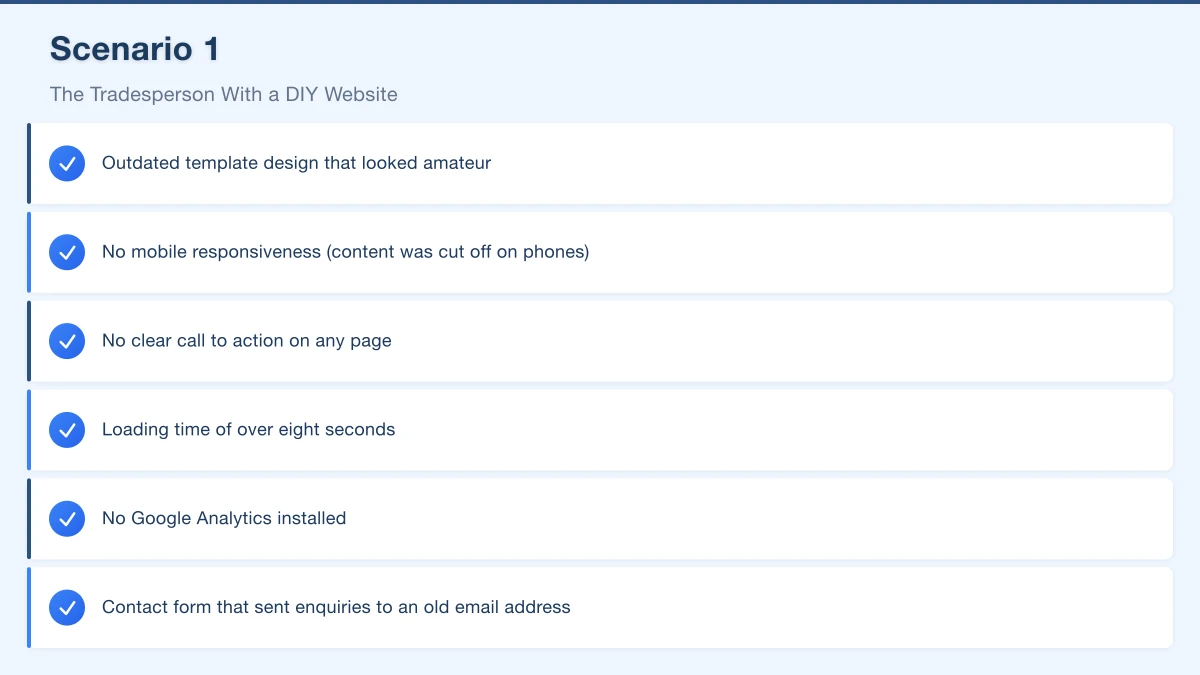
Scenario 1: The Tradesperson With a DIY Website
Before
A local plumbing business had a website built using a free website builder several years ago. The site had basic information but suffered from multiple issues:
- Outdated template design that looked amateur
- No mobile responsiveness (content was cut off on phones)
- No clear call to action on any page
- Loading time of over eight seconds
- No Google Analytics installed
- Contact form that sent enquiries to an old email address
- No customer reviews or testimonials displayed
The business owner relied entirely on word-of-mouth and Yellow Pages for new customers. The website existed but contributed almost nothing to the business.
After
A professionally redesigned website addressed every issue:
- Modern, clean design that communicated professionalism
- Fully responsive, working perfectly on all devices
- Prominent “Call Now” and “Get a Free Quote” buttons on every page
- Loading time reduced to under two seconds
- Google Analytics and conversion tracking installed
- Working contact form with email and phone notifications
- Google reviews integrated directly onto the homepage
The Impact
Within three months, the business saw a noticeable increase in phone calls and form enquiries from the website. The owner was able to trace new customers specifically to the website for the first time. The professional design also gave the owner more confidence when handing out business cards, knowing potential customers would see a polished online presence.
Scenario 2: The Retail Shop Going Online
Before
A boutique retail shop in the Hills District had a basic five-page website that served as little more than an online business card. It listed the address and opening hours but offered no ability to browse or purchase products online.
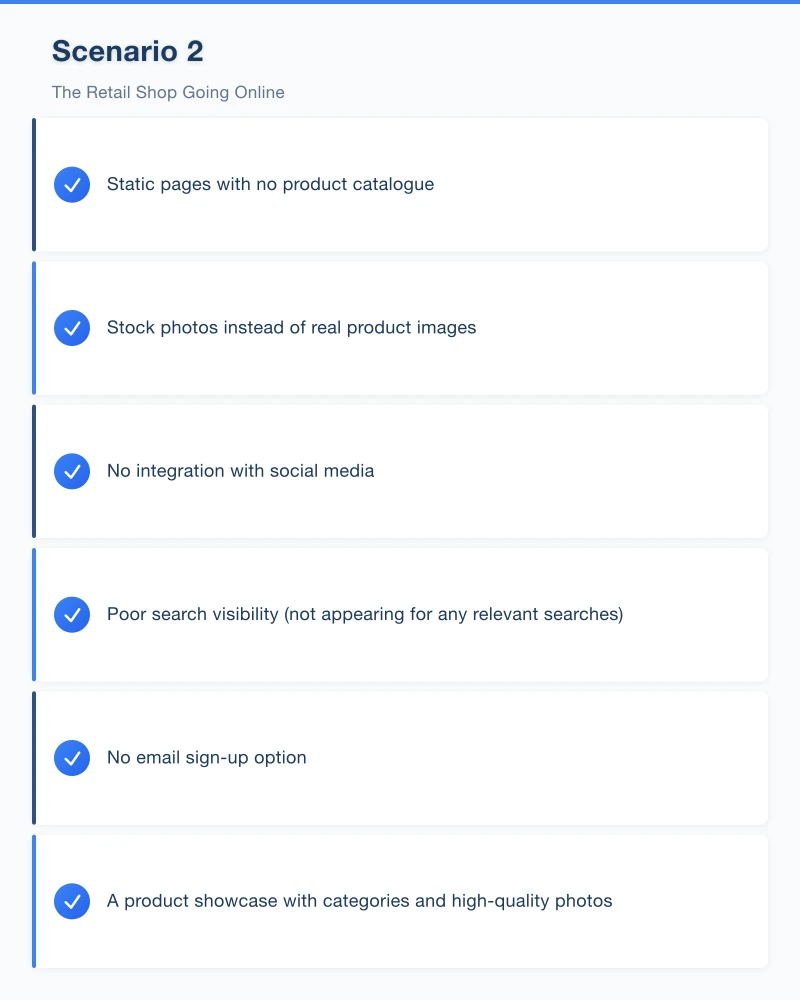
- Static pages with no product catalogue
- Stock photos instead of real product images
- No integration with social media
- Poor search visibility (not appearing for any relevant searches)
- No email sign-up option
After
The redesigned website included:
- A product showcase with categories and high-quality photos
- An integrated Instagram feed showing the latest arrivals
- Email newsletter sign-up with a first-purchase discount offer
- Local SEO optimisation targeting Hills District shopping searches
- Customer testimonials and a Google review widget
- Blog section for style tips and new arrival announcements
The Impact
The website became a genuine extension of the physical shop. Customers started visiting the store after seeing products on the website. The email list grew steadily, providing a direct marketing channel. The blog content improved search rankings, bringing in visitors who had never heard of the shop before.
Scenario 3: The Professional Services Firm
Before
An accounting firm had a website that was built around 2015 and had not been meaningfully updated since. While it contained detailed information about services, the presentation was outdated and ineffective:
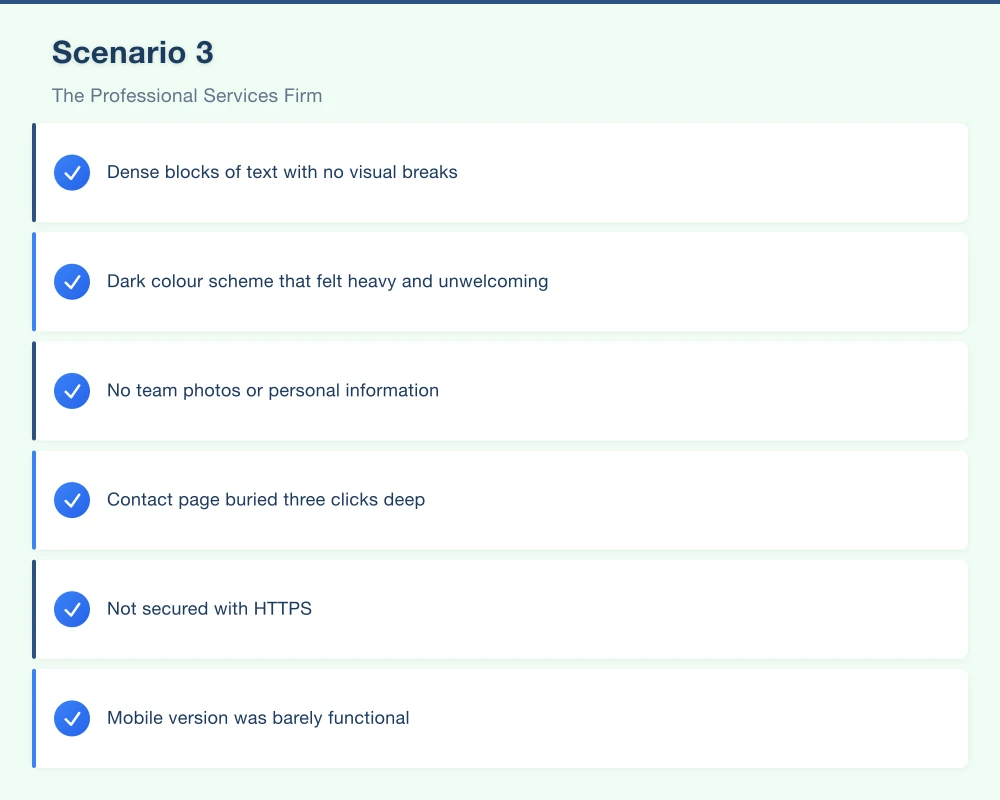
- Dense blocks of text with no visual breaks
- Dark colour scheme that felt heavy and unwelcoming
- No team photos or personal information
- Contact page buried three clicks deep
- Not secured with HTTPS
- Mobile version was barely functional
- No blog or educational content
After
The redesigned website took a completely different approach:
- Clean, light design with plenty of white space
- Professional team photos and bios on the About page
- Service pages rewritten to focus on client benefits rather than technical details
- Contact information visible on every page with a clickable phone number
- HTTPS security certificate installed
- Fully responsive mobile experience
- Blog with regular tax tips and business advice articles
- FAQ page addressing common client questions
The Impact
The firm reported a significant improvement in the quality of enquiries. Potential clients who found the website were better informed about services and more likely to convert. The blog content attracted search traffic for questions like “tax deductions for small business Australia” and “BAS lodgement deadlines,” bringing in prospects who might not have found the firm otherwise.
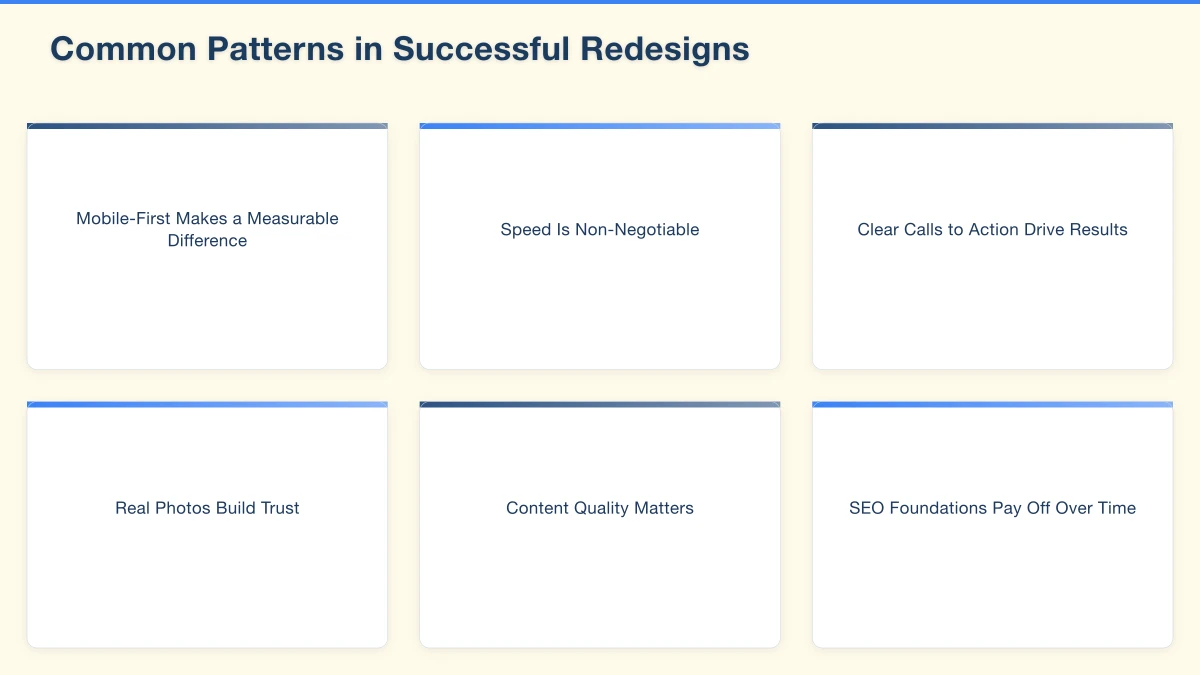
Common Patterns in Successful Redesigns
Looking across these scenarios and dozens of similar projects, several patterns emerge:
Mobile-First Makes a Measurable Difference
Every successful redesign prioritises the mobile experience. Given that more than half of website visits come from mobile devices, this alone can dramatically improve engagement and enquiries.
Speed Is Non-Negotiable
Slow websites lose visitors. Reducing load time from five or more seconds to under two seconds consistently leads to lower bounce rates and more time spent on site.
Clear Calls to Action Drive Results
The single biggest change in many redesigns is simply making it obvious what the visitor should do next. A prominent phone number, a clear “Get a Quote” button, or a simple contact form can transform a website from a brochure into a lead generator.
Real Photos Build Trust
Replacing generic stock photos with real images of the business, team, and work product creates an immediate improvement in trust and engagement. People want to see who they will be dealing with.
Content Quality Matters
Rewriting content to focus on customer benefits rather than business features makes a noticeable difference. Pages that answer the question “What is in it for me?” perform better than pages that simply describe what the business does.
SEO Foundations Pay Off Over Time
Proper title tags, meta descriptions, heading structure, and local keywords take time to show results, but within three to six months, redesigned websites with proper SEO foundations consistently see improved search visibility.
How to Know If Your Website Needs a Redesign
Ask yourself these questions:
- Was your website built more than three to four years ago?
- Does it work well on mobile devices?
- Does it load quickly?
- Are you getting enquiries from your website?
- Does the design reflect the quality of your business?
- Is your contact information easy to find?
- Do you have customer testimonials displayed?
- Is the content up to date?
- Does it have SSL security (HTTPS)?
If you answered “no” to three or more of these questions, a redesign is likely overdue.
What a Redesign Involves
A typical small business website redesign includes:
- Discovery: Understanding your business, customers, and goals
- Content planning: Deciding what pages you need and what each should say
- Design: Creating the visual layout and user experience
- Development: Building the website on a modern platform
- Content creation: Writing copy and sourcing or taking photos
- SEO setup: Title tags, meta descriptions, schema markup, and keyword optimisation
- Testing: Checking every page on multiple devices and browsers
- Launch: Going live and submitting to search engines
- Training: Showing you how to update and manage the site
The process typically takes four to eight weeks from start to finish, depending on the complexity.
Making the Investment Decision
A website redesign is an investment, and like any investment, you want to know the return. For most small businesses, a well-designed website pays for itself within the first year through increased enquiries, improved credibility, and better search visibility.
The question is not really “Can I afford a new website?” It is “Can I afford to keep losing potential customers to a website that does not represent my business well?”
Ready to Transform Your Website?
At Cosmo Web Tech, we have helped businesses across Western Sydney transform their online presence with websites that look professional, work on every device, and generate real business results. If you think your website might be holding your business back, get in touch for a free website review. We will show you exactly where the opportunities are.
Your website’s performance depends on what’s behind it. Cloud Geeks provides the managed hosting, cloud, and IT support that keeps Australian SMBs online and secure.
Ash Ganda covers how Australian SMBs are using AI, automation, and digital strategy to grow without scaling costs proportionally.
If your business is also planning a customer-facing iOS or Android app — Awesome Apps builds cross-platform mobile apps for Australian SMBs.
Part of the Ganda Tech Services family, Cosmos Web Tech delivers specialist web design and digital marketing for Australian small and medium businesses.