
Building a Brand Identity for Your Western Sydney Business
Your brand is more than your logo. It is the complete impression people have of your business – how you look, how you sound, what you stand for, and how you make people feel. A strong brand identity helps you stand out, builds trust, and creates loyalty.
For small businesses in Western Sydney, strong branding can be the difference between being just another option and being the obvious choice. You might be competing with dozens of businesses offering similar products or services. Your brand is what makes you memorable.
The good news is that building a brand identity does not require a massive budget. It requires clarity about who you are, who you serve, and how you want to be perceived.
What Is Brand Identity?
Brand identity encompasses all the visual and verbal elements that represent your business:
- Visual elements: Logo, colours, typography, imagery style, design patterns
- Verbal elements: Business name, tagline, tone of voice, key messages
- Values and personality: What you stand for, how you behave, what your customers can expect
Together, these elements create a consistent experience that people associate with your business.
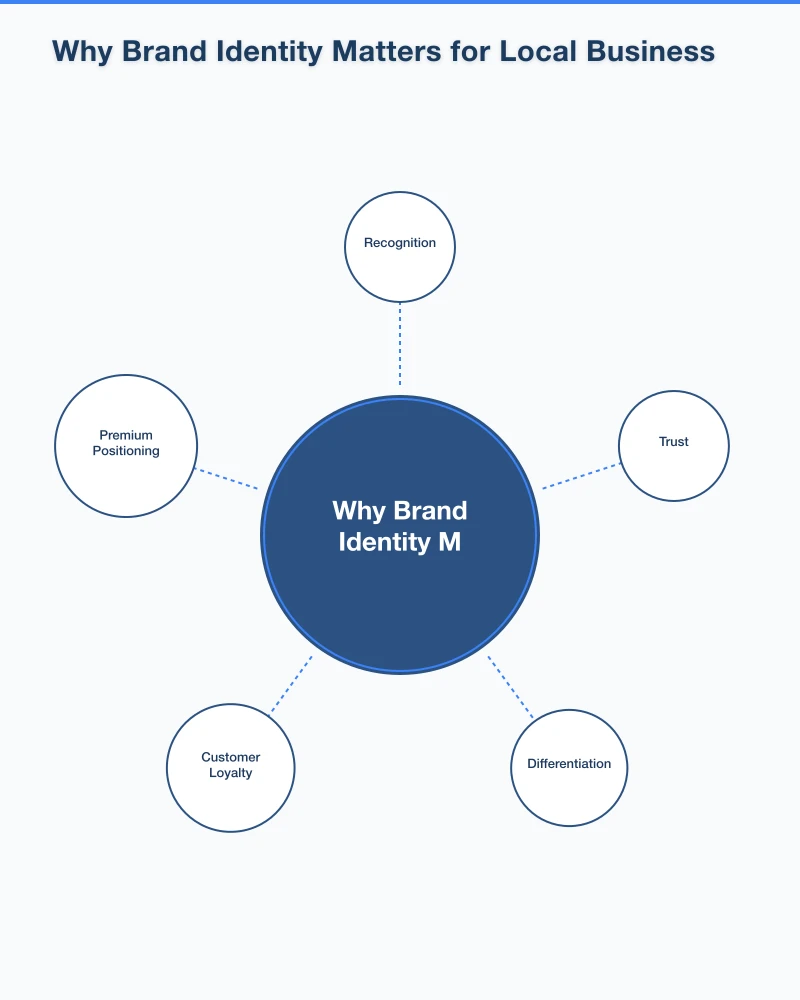
Why Brand Identity Matters for Local Business
Recognition
Consistent branding makes your business recognisable. When someone sees your colours, your logo, or your van driving through Castle Hill, they should immediately know it is you.
Trust
Professional, consistent branding signals a reliable, established business. Inconsistent or amateur branding raises doubts about quality.
Differentiation
In a competitive local market, your brand helps you stand apart. Two plumbers might offer similar services at similar prices, but the one with a professional brand presence feels like a safer choice.
Customer Loyalty
People connect with brands that have personality and values they relate to. A local business that genuinely embodies its community builds deeper customer relationships.
Premium Positioning
Strong branding allows you to charge what you are worth. Businesses with professional brand identities are perceived as more valuable, even if their underlying services are similar to competitors.
Step 1: Define Your Brand Foundation
Before designing anything, answer these fundamental questions:
Who Are You?
- What does your business do?
- What is your story? Why did you start this business?
- What are your core values?
- What makes you different from competitors?
Who Do You Serve?
- Who is your ideal customer?
- What do they care about?
- What problems do they need solved?
- Where are they located?
What Is Your Personality?
If your business were a person, how would you describe them? Pick three to five personality traits:
- Professional, reliable, straightforward
- Friendly, approachable, warm
- Bold, innovative, energetic
- Knowledgeable, trustworthy, thorough
These traits should inform every aspect of your brand, from your website design to how you answer the phone.
What Do You Want People to Feel?
When someone interacts with your business, what emotion should they walk away with?
- Confidence that the job will be done right
- Relief that they found someone they can trust
- Excitement about the possibilities
- Comfort that they are in good hands
Step 2: Design Your Visual Identity
Logo
Your logo is the most visible element of your brand. It appears on your website, business cards, vehicles, uniforms, and social media.
Tips for a good logo:
- Keep it simple. The best logos work at any size, from a website favicon to a vehicle wrap.
- Make it versatile. It should work in colour, black and white, and on both light and dark backgrounds.
- Make it timeless. Avoid trendy design elements that will look dated in a few years.
- Make it relevant. It should give a sense of what you do or at least feel appropriate for your industry.
Getting your logo designed:
- Professional designer: $500 to $3,000 depending on the designer. Worth the investment for a logo you will use for years.
- Design platform: Services like 99designs allow you to run a design competition. You receive multiple concepts and choose your favourite.
- DIY tools: Canva and similar tools offer logo makers, but the results are often generic. Use these only as a temporary solution.
Colour Palette
Colours evoke emotions and associations. Choose colours that match your brand personality.
- Blue: Trust, professionalism, reliability (popular for trades, finance, healthcare)
- Green: Nature, growth, health (popular for environment, wellness, organic)
- Red/Orange: Energy, urgency, warmth (popular for food, retail, entertainment)
- Black/Grey: Sophistication, luxury, strength (popular for premium services)
- Yellow: Optimism, friendliness, warmth
Your palette should include:
- Primary colour (your main brand colour)
- Secondary colour (a complementary accent)
- Neutral colours (for backgrounds and text)
Limit yourself to two or three main colours. Too many colours create visual chaos.
Typography
Choose one or two fonts that represent your brand:
- A heading font that has personality
- A body font that is clean and easy to read
Use the same fonts consistently across your website, marketing materials, and social media.
Imagery Style
Define a consistent style for the photos and images you use:
- Do you prefer bright, natural photography or moody, atmospheric shots?
- Do you use illustrations or photography?
- Are images of people, places, products, or abstract concepts?
- What feeling should your imagery convey?
Step 3: Develop Your Brand Voice
Your brand voice is how you communicate in writing and speech. It should be consistent whether someone reads your website, receives an email from you, or talks to you on the phone.
Define Your Tone
Based on your brand personality, establish guidelines for your tone:
- Formal or casual? Most local businesses benefit from a friendly, approachable tone rather than corporate formality.
- Technical or plain language? For most small businesses, plain language that avoids jargon works best.
- Serious or lighthearted? This depends on your industry. A funeral home and a cafe will have very different tones.
Write Down Key Messages
Create three to five key messages that capture what your brand communicates:
Example for a local building company:
- We deliver quality renovations on time and on budget
- We treat your home like our own
- We are a local Hills District team you can trust
- No surprises, no hidden costs
- Our work speaks for itself
Use these messages consistently across your marketing.
Create a Tagline
A good tagline is short, memorable, and communicates your brand promise:
- “Your local renovation experts”
- “Websites that work as hard as you do”
- “Quality you can count on”
Keep it simple and genuine. Avoid generic statements like “Excellence in everything we do.”
Step 4: Apply Your Brand Consistently
Consistency is what turns a collection of design elements into a recognisable brand. Apply your brand identity to:
Website
Your website is often the first place people encounter your brand. Make sure your colours, fonts, imagery, and tone of voice are consistent throughout.
Business Cards and Stationery
Business cards, letterheads, invoices, and quotes should all use your brand colours, logo, and fonts.
Social Media
Use your logo as your profile photo across all platforms. Create social media templates using your brand colours and fonts for a consistent look.
Signage and Vehicles
If you have a physical location or work vehicles, your branding should be visible and consistent.
Uniforms and Workwear
Branded uniforms or polo shirts reinforce your brand in person.
Email Signatures
Create a branded email signature with your logo, contact details, and consistent formatting.
Step 5: Document Your Brand Guidelines
Even for a small business, having a simple brand guide ensures consistency, especially as you grow and involve others in creating content or marketing.
Your brand guide should include:
- Your logo and how to use it (minimum sizes, spacing, what not to do)
- Your colour palette with exact colour codes (hex codes for digital, Pantone for print)
- Your fonts and how to use them
- Your tone of voice guidelines
- Examples of on-brand and off-brand communication
- Your key messages and tagline
This does not need to be a lengthy document. Even a single page covering the basics helps.
Common Branding Mistakes
- Inconsistency: Using different colours, fonts, or logos across different platforms confuses people and weakens your brand.
- Copying competitors: Your brand should differentiate you, not blend you in.
- Changing too often: Brands build recognition through consistency over time. Do not rebrand every year.
- Over-designing: A cluttered logo or too many colours looks unprofessional. Simplicity is powerful.
- Ignoring your audience: Your brand should resonate with your customers, not just with you.
- No brand voice: A beautiful visual identity with inconsistent communication feels disconnected.
Your Brand Building Action Plan
- This week: Write down your brand foundation – who you are, who you serve, and your personality traits
- This month: Invest in a professional logo and define your colour palette and fonts
- Next month: Apply your brand to your website, social media, and business materials
- Ongoing: Use your brand consistently in everything you do
Building a brand takes time, but the investment pays off. A strong, consistent brand identity makes every other aspect of your marketing more effective. It helps people recognise you, trust you, and choose you.
For Western Sydney businesses looking to build or refresh their brand, our team can help with everything from logo design to complete brand identity packages. Get in touch and let us help you build a brand that stands out.
Your website’s performance depends on what’s behind it. Cloud Geeks provides the managed hosting, cloud, and IT support that keeps Australian SMBs online and secure.
Ash Ganda covers how Australian SMBs are using AI, automation, and digital strategy to grow without scaling costs proportionally.
If your business is also planning a customer-facing iOS or Android app — Awesome Apps builds cross-platform mobile apps for Australian SMBs.
Part of the Ganda Tech Services family, Cosmos Web Tech delivers specialist web design and digital marketing for Australian small and medium businesses.