
Building a Referral Program for Your Australian Business
Word-of-mouth has always been the most powerful form of marketing for local businesses. When a friend or neighbour recommends a tradie, a restaurant, or a service provider, that recommendation carries far more weight than any advertisement.
A referral program formalises this process. Instead of hoping your customers tell their friends about you, you actively encourage and reward them for doing so. Done well, it can become your most cost-effective customer acquisition channel.
Why Referral Programs Work
The numbers behind referral marketing are compelling. Referred customers tend to have a higher lifetime value than customers acquired through other channels. They also tend to be more loyal and more likely to refer others themselves, creating a virtuous cycle.
The reason is trust. When someone you know recommends a business, you trust that recommendation because the person has nothing to gain from misleading you (or in the case of a referral program, the incentive aligns with genuine satisfaction).
For local businesses in Western Sydney, where community connections are strong, referral programs tap into the natural way people already share recommendations.
Types of Referral Programs
Give-Get Programs
Both the referrer and the new customer receive a reward. This is the most popular structure because it motivates both parties.
Example: “Refer a friend and you both get $25 off your next service.”
Referrer-Only Programs
Only the person making the referral receives a reward. Simpler to manage but gives the new customer less incentive to act.
Example: “Refer a friend and receive a $50 credit on your next visit.”
Tiered Programs
Rewards increase as customers refer more people. This encourages your best advocates to keep referring.
Example: “Refer 1 friend: $20 credit. Refer 3 friends: $75 credit. Refer 5 friends: free service.”
Points-Based Programs
Referrals earn points that can be redeemed for rewards. This works well when combined with a broader loyalty program.
Community or Charity-Based Programs
Instead of personal rewards, referrals trigger a donation to a local cause. This appeals to customers who are motivated by community impact.
Example: “For every referral, we donate $10 to a Western Sydney community organisation.”
Designing Your Referral Program
Step 1: Choose Your Reward
Your reward needs to be valuable enough to motivate action but sustainable for your business.
Popular reward types:
- Discounts or credits on future purchases
- Free products or services
- Cash rewards
- Gift cards
- Exclusive perks or upgrades
Calculating your reward value: Start by working out your customer acquisition cost through other channels. If you typically spend $100 in advertising to acquire a new customer, you could comfortably offer a $30 to $50 referral reward and still save money.
Step 2: Keep It Simple
The more complicated your program, the fewer people will participate. Your referral program should be explainable in one or two sentences.
Good: “Refer a friend. When they book, you both get $25 off.”
Too complex: “Refer a friend who spends a minimum of $200 within 90 days of their first purchase, and receive points redeemable for rewards from our catalogue, subject to terms and conditions.”
Step 3: Make It Easy to Refer
Remove friction from the referral process. The easier it is to refer, the more referrals you will get.
Options:
- A unique referral link or code customers can share
- A simple referral form on your website
- Referral cards to hand out in person
- A text message or email that customers can forward
- Social media sharing buttons
Step 4: Promote Relentlessly
The biggest reason referral programs fail is not poor design but poor promotion. You need to remind customers about the program regularly.
Promotion channels:
- Mention it at the end of every service or sale
- Include it in your email signature
- Feature it on your website (homepage, contact page, thank-you page)
- Post about it on social media regularly
- Include referral cards with invoices and receipts
- Add it to your email newsletter
- Train your team to mention it to every customer
Step 5: Track Everything
You need to know who referred whom and whether the referral converted. This can be as simple as:
- A spreadsheet tracking referrer name, referred person, and outcome
- A unique referral code for each customer
- A CRM or loyalty platform with referral tracking
Digital tools like ReferralCandy, InviteReferrals, or your point-of-sale system’s built-in referral features can automate tracking.
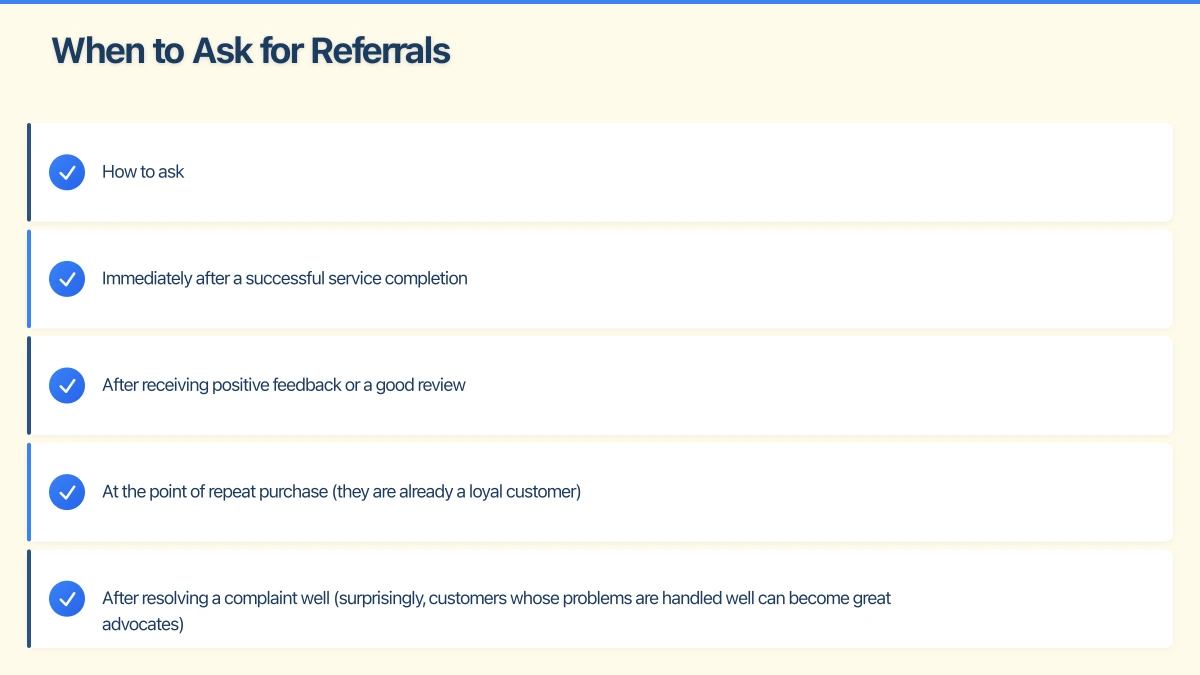
When to Ask for Referrals
Timing matters. The best moments to ask for a referral are when a customer is most satisfied:
- Immediately after a successful service completion
- After receiving positive feedback or a good review
- At the point of repeat purchase (they are already a loyal customer)
- After resolving a complaint well (surprisingly, customers whose problems are handled well can become great advocates)
How to ask:
Keep it natural and low-pressure. “We are glad you are happy with the result. If you know anyone who might need similar work, we would love for you to pass along our details. We have a referral program where you both save $25.”
Legal Considerations in Australia
When running a referral program in Australia, keep these points in mind:
Australian Consumer Law: Your referral program is a promotion and must comply with Australian Consumer Law. Ensure your terms are clear, transparent, and not misleading.
Privacy: If you are collecting personal information (names, emails, phone numbers) as part of the referral process, you must comply with the Australian Privacy Principles. Get consent before contacting referred individuals.
Spam Act: You cannot send marketing emails or texts to referred individuals without their consent. The referral should come from the existing customer, not from your business directly contacting the referred person without permission.
Terms and conditions: Have clear, simple terms and conditions that explain how the program works, what the rewards are, any limitations, and how disputes are handled.
Real-World Examples for Local Businesses
Trades business: “Refer a mate and you both get $50 off your next job.” Include a simple referral card with every completed job.
Cafe or restaurant: “Refer a friend with this card. When they visit and spend over $30, you both get a free coffee and cake on your next visit.”
Beauty salon: “Love your results? Share the love. Refer a friend and you both receive 20% off your next appointment.”
Professional services: “Thank you for choosing us. If you know a business owner who could benefit from our services, we offer a $100 credit for successful referrals.”
Measuring Success
Track these metrics to evaluate your referral program:
- Number of referrals made: How many customers are participating?
- Conversion rate: What percentage of referrals become customers?
- Cost per acquisition: How does the cost of acquiring a customer through referrals compare to other channels?
- Lifetime value of referred customers: Are referred customers spending more over time?
- Program awareness: What percentage of your customers know about the program?
Getting Started
- Decide on your reward structure (give-get is recommended for most businesses)
- Calculate a reward amount that is motivating but sustainable
- Create a simple referral mechanism (cards, codes, or links)
- Write clear terms and conditions
- Train your team on how and when to mention the program
- Promote the program across all your marketing channels
- Track referrals and rewards diligently
- Review and adjust quarterly based on results
The best referral programs grow organically as more customers experience them and share. Start simple, measure results, and refine over time.
Need Help Growing Your Business?
At Cosmo Web Tech, we help Western Sydney businesses build digital marketing strategies that drive growth, including referral programs integrated with your website and email marketing. Get in touch for a free consultation about how to turn your happy customers into your best source of new business.
Your website’s performance depends on what’s behind it. Cloud Geeks provides the managed hosting, cloud, and IT support that keeps Australian SMBs online and secure.
Ash Ganda covers how Australian SMBs are using AI, automation, and digital strategy to grow without scaling costs proportionally.
If your business is also planning a customer-facing iOS or Android app — Awesome Apps builds cross-platform mobile apps for Australian SMBs.
Part of the Ganda Tech Services family, Cosmos Web Tech delivers specialist web design and digital marketing for Australian small and medium businesses.