Building Trust Online: Website Elements That Win Customers
When someone visits your website for the first time, they are making a judgement. Can I trust this business? Are they legitimate? Will they deliver on their promises? These questions happen subconsciously within seconds of landing on your page.
For local businesses in Western Sydney and across Australia, your website needs to quickly establish credibility and trust. Here are the specific elements that make the difference between a visitor who becomes a customer and one who clicks away to a competitor.
Why Trust Matters Online
In person, trust is built through handshakes, eye contact, and conversation. Online, you do not have those cues. Visitors cannot see your workshop, meet your team, or hear your voice. Your website has to do the work of building that trust.
Research consistently shows that trust is the top factor in whether someone contacts a business they find online. Price, design, and features all matter, but without trust, none of them make a difference.
Essential Trust Elements
1. Professional Design
First impressions happen fast. An outdated, cluttered, or poorly designed website immediately raises doubts about a business’s professionalism. You do not need a flashy design, but you do need:
- Clean, consistent layout
- Readable fonts and adequate spacing
- Professional colour scheme
- High-quality images
- Mobile-responsive design that works on all devices
If your website looks like it was built a decade ago, visitors may wonder if the rest of your business is similarly outdated.
2. Real Photos of Your Team
Stock photos of smiling models in corporate settings fool nobody. Visitors can spot them instantly, and they undermine trust rather than build it.
Instead, use real photos of:
- Your team members, ideally with names and roles
- Your workspace, shop, or office
- You and your team at work
- Your community involvement
Seeing real people behind a business builds connection and confidence. A photo of your actual team in front of your Parramatta office says more than any stock image ever could.
3. Customer Reviews and Testimonials
Social proof is one of the most powerful trust builders. When potential customers see that others have had positive experiences with your business, their confidence increases.
Display reviews prominently. Do not hide testimonials on a separate page that nobody visits. Feature them on your homepage, service pages, and anywhere a visitor might be making a decision.
Use real names and details. “Great service!” is not very convincing. “John from Blacktown - Fixed our hot water system within 2 hours of calling. Professional and fair pricing.” is far more credible.
Include star ratings. Visual star ratings are immediately recognisable and communicate quality at a glance.
Link to third-party reviews. Show your Google or Facebook review rating and link to your reviews page. Third-party reviews are seen as more trustworthy than self-selected testimonials.
4. Case Studies and Portfolio
Showing examples of your work is one of the most convincing trust signals for service businesses. Include:
- Before and after photos (for trades, renovations, landscaping, etc.)
- Project descriptions explaining what you did and why
- Results achieved (for marketing, consulting, or professional services)
- Client logos (for B2B businesses, with permission)
A portfolio of work demonstrates capability far more effectively than claims about capability.
5. Clear Contact Information
Nothing destroys trust faster than a business that seems hard to reach. Make your contact information prominent and easy to find:
- Phone number visible on every page (in the header is ideal), clickable on mobile
- Physical address (if applicable) with a Google Maps embed
- Email address or contact form
- Business hours clearly stated
- Multiple contact methods (some people prefer phone, others prefer email or messaging)
For Western Sydney businesses, showing your local address reinforces that you are a real, local business. “Based in Parramatta, serving all of Western Sydney” is more trustworthy than a business with no location information at all.
6. About Page
Your About page is often one of the most visited pages on your website. Use it to:
- Tell your story (how and why you started the business)
- Introduce your team with photos and brief bios
- Share your values and what drives your business
- Mention your experience and qualifications
- Highlight your connection to the local community
People buy from people. An About page that shows the humans behind the business is a powerful trust builder.
7. Credentials and Certifications
Display any relevant credentials, certifications, memberships, and licences:
- Industry licences (trade licences, professional registrations)
- Industry association memberships
- Certifications and qualifications
- Awards and recognition
- Insurance details (especially for trades)
For Australian businesses, relevant credentials might include:
- Your ABN
- Trade licence numbers
- Professional association memberships
- Australian-specific certifications
8. SSL Certificate and Security
The padlock icon in the browser address bar (HTTPS) is a basic trust signal that visitors notice, even if they do not consciously think about it. An SSL certificate is essential for any business website.
Beyond SSL, if you collect payments online, display security badges from your payment processor and mention that your transactions are secure.
9. Privacy Policy and Legal Pages
Having a privacy policy, terms of service, and any relevant legal pages shows that your business takes compliance seriously. For Australian businesses, a privacy policy is required under the Privacy Act 1988 if you collect personal information.
While most visitors will not read these pages, their presence signals legitimacy.
10. Guarantees and Promises
Reduce the perceived risk of doing business with you:
- Money-back guarantees
- Satisfaction guarantees
- Free quotes or consultations
- Transparent pricing (or at least pricing guides)
- Clear refund or cancellation policies
These elements lower the barrier to making contact. If a potential customer knows they can get a free, no-obligation quote, they are more likely to reach out.
11. Fast Loading Speed
A slow website does not just frustrate visitors; it undermines trust. If your website takes more than three seconds to load, visitors start to question whether your business is reliable.
Fast loading signals a well-maintained, professional operation. Invest in good hosting, optimise your images, and keep your website code clean.
12. Consistent Branding
Consistent use of colours, fonts, imagery, and tone of voice across your website signals professionalism and attention to detail. Inconsistency, on the other hand, looks careless and raises doubts.
Building Trust for Service Businesses
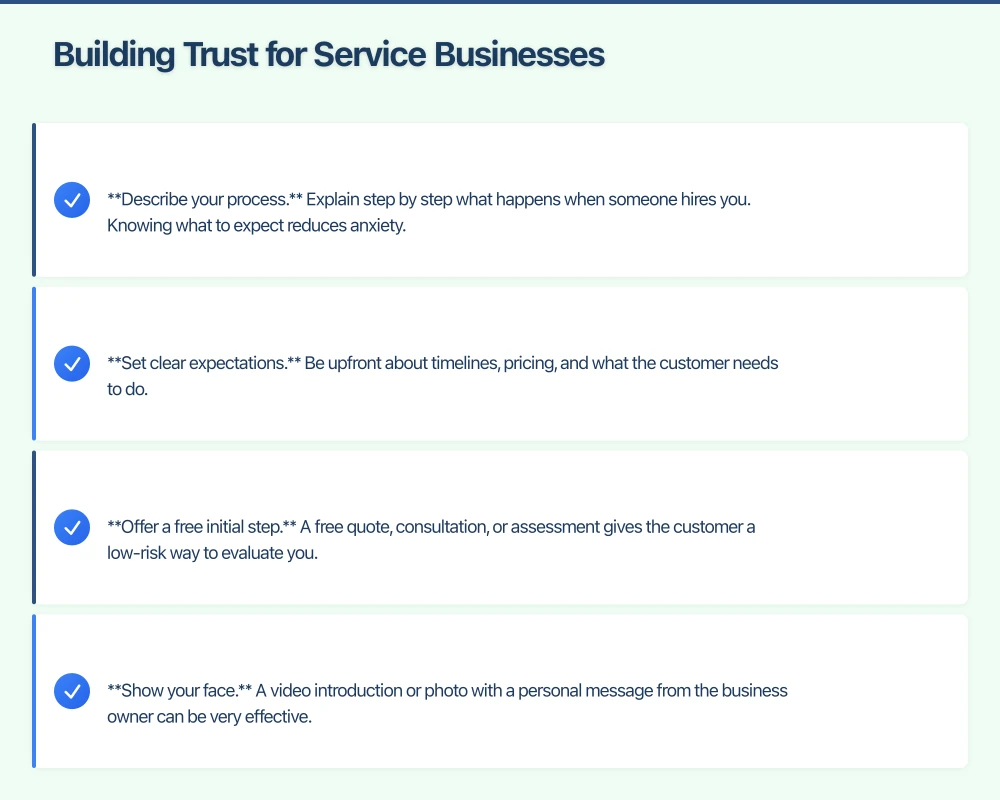
Service businesses face an extra trust challenge because customers are buying something intangible. You cannot show them the finished product before they commit. To overcome this:
- Describe your process. Explain step by step what happens when someone hires you. Knowing what to expect reduces anxiety.
- Set clear expectations. Be upfront about timelines, pricing, and what the customer needs to do.
- Offer a free initial step. A free quote, consultation, or assessment gives the customer a low-risk way to evaluate you.
- Show your face. A video introduction or photo with a personal message from the business owner can be very effective.
Building Trust for E-Commerce
Online shoppers need reassurance that their purchase is safe and that they will receive what they paid for:
- Display security badges from your payment processor
- Show clear return and refund policies
- Include detailed product descriptions and multiple photos
- Display customer reviews on product pages
- Offer Australian-based customer support
- Show estimated delivery times
Measuring Trust
How do you know if your website is building trust effectively? Look at:
- Bounce rate: A high bounce rate may indicate visitors are not finding what they expect or do not trust what they see
- Time on site: Longer visits suggest visitors are engaging with your content
- Conversion rate: The percentage of visitors who take a desired action (call, enquire, purchase)
- Contact form submissions: More submissions suggest more trust
- Customer feedback: Ask new customers how they found you and what made them choose you
Start Building Trust Today
Review your website with fresh eyes. Better yet, ask someone who has never seen your site to browse it and tell you what impression they get. Their honest feedback will reveal trust gaps you might not notice yourself.
If your website needs trust-building improvements, Cosmo Web Tech designs websites for Western Sydney businesses that look professional, build trust, and convert visitors into customers. Contact us to discuss how we can improve your website’s effectiveness.
Your website’s performance depends on what’s behind it. Cloud Geeks provides the managed hosting, cloud, and IT support that keeps Australian SMBs online and secure.
Ash Ganda covers how Australian SMBs are using AI, automation, and digital strategy to grow without scaling costs proportionally.
If your business is also planning a customer-facing iOS or Android app — Awesome Apps builds cross-platform mobile apps for Australian SMBs.
Part of the Ganda Tech Services family, Cosmos Web Tech delivers specialist web design and digital marketing for Australian small and medium businesses.