
If you’re running a business in the Hills District and wondering whether blogging is worth the effort, here’s the truth: your potential customers are searching for solutions right now. The question is whether they’ll find you or your competitors.
Content marketing isn’t about fancy writing or complex strategies. It’s about helping your local customers find answers to their questions and positioning your business as the go-to expert in Western Sydney. When done right, blog posts bring in qualified leads who are already interested in what you offer.
Why Content Marketing Works for Local Businesses
Here’s what most Hills District businesses don’t realize: every question a customer asks is an opportunity to create content that brings in more customers like them.
When someone searches “best plumber Castle Hill” or “accountant near Baulkham Hills,” Google looks for helpful, relevant content. If your business has a blog post answering common questions in your industry, you’re much more likely to show up in those searches.
Real local example: A Bella Vista electrician we work with started publishing simple blog posts answering common questions like “Why does my circuit breaker keep tripping?” and “How much does it cost to install ceiling fans?” Within six months, these posts were bringing in 15-20 qualified leads per month, people who had already read their advice and trusted their expertise.
The numbers back this up. Businesses that blog regularly get 67% more leads than those that don’t, according to HubSpot’s 2024 research. For local service businesses in Western Sydney, that gap is even bigger because you’re competing in a smaller geographic area where trust and local expertise matter more.
Choosing Blog Topics That Attract Customers
The biggest mistake we see local businesses make is writing about what they think is interesting rather than what their customers are actually searching for.
Start by listening to your customers. What questions do they ask when they call or visit your business? What problems are they trying to solve? Those questions are your best blog topics.
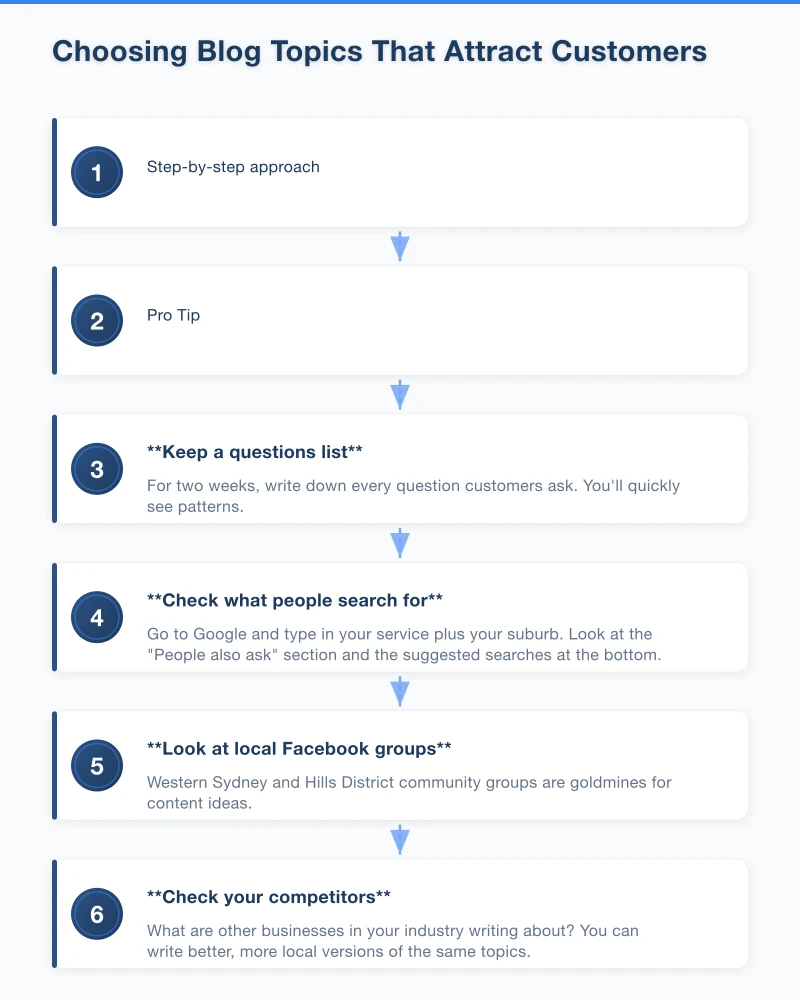
Step-by-step approach:
- Keep a questions list: For two weeks, write down every question customers ask. You’ll quickly see patterns.
-
Check what people search for: Go to Google and type in your service plus your suburb. Look at the “People also ask” section and the suggested searches at the bottom. These are real questions from real people in your area.
-
Look at local Facebook groups: Western Sydney and Hills District community groups are goldmines for content ideas. What are people asking about in groups like “Castle Hill Community” or “Western Sydney Families”?
-
Check your competitors: What are other businesses in your industry writing about? You can write better, more local versions of the same topics.
Pro Tip: The best blog topics are specific and practical. Instead of “Plumbing Tips,” write “5 Things Every Hills District Homeowner Should Know About Preventing Blocked Drains in Winter.” The more specific, the more likely you’ll rank in Google and attract exactly the right customers.
For Hills District businesses, adding local context makes a huge difference. A post about “Landscaping Ideas” gets lost in millions of results. But “Best Native Plants for Hills District Gardens” speaks directly to your local customers and has much less competition.
Writing Blog Posts That Google (and Customers) Love
You don’t need to be a professional writer to create effective blog posts. You just need to be helpful and clear.
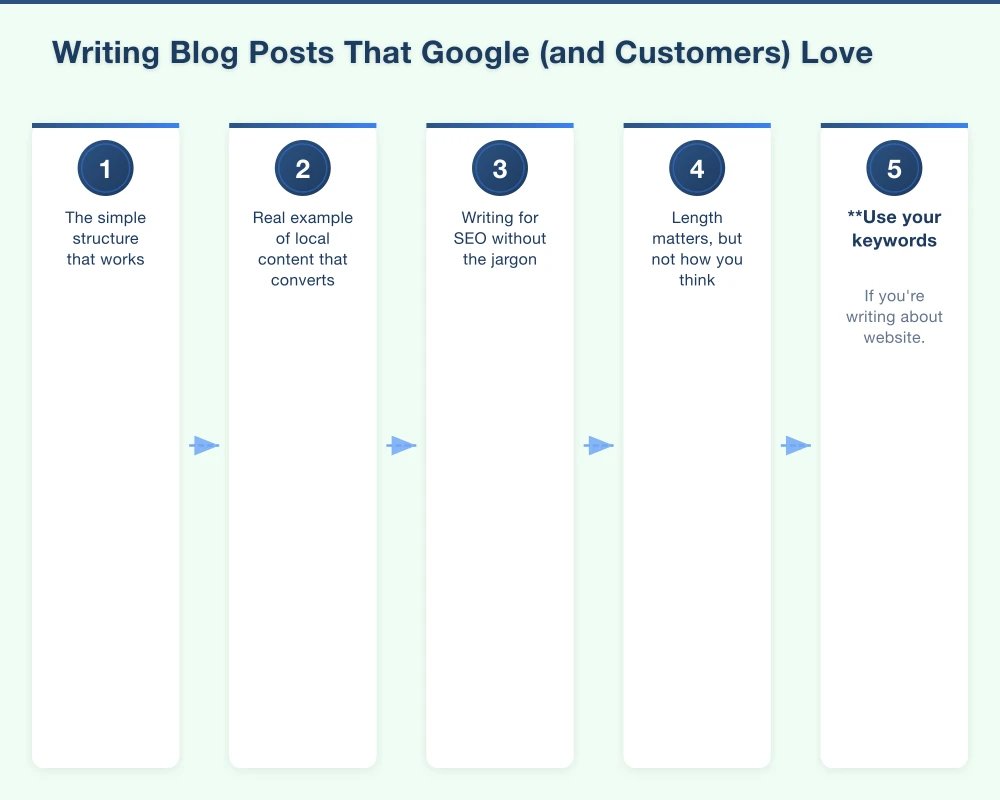
The simple structure that works:
-
Start with the problem (75-100 words): Tell readers you understand their challenge. “Is your Google Business Profile not getting any clicks? You’re not alone. Most Hills District businesses struggle to show up in local searches.”
-
Explain why it matters (100-150 words): Help them understand the impact. “When potential customers search for your services, they click on the first few results. If you’re not showing up, they’re calling your competitors instead.”
-
Give them the solution (500-800 words): Provide clear, actionable steps. Number them. Be specific. Include time estimates. Don’t assume they know technical terms.
-
End with next steps (50-100 words): Tell them exactly what to do next, whether it’s implementing your advice or contacting you for help.
Real example of local content that converts:
A Rouse Hill dental practice wrote a blog post titled “What to Do If You Crack a Tooth After Hours in Hills District.” The post explained immediate steps to take, which local emergency services to call, and when to wait until morning. It included their after-hours contact number and what emergency dental services they provide.
That single post brings them 8-12 emergency patients every month, people who found them at their moment of greatest need and already trusted their advice.
Writing for SEO without the jargon:
-
Use your keywords naturally: If you’re writing about website design for local businesses, use phrases like “website design Western Sydney” and “Hills District web designer” naturally in your writing. Don’t force it, just use the words your customers actually use.
-
Write helpful headings: Use headings (the ## symbols) to break up your content. Include keywords in headings where it makes sense: “How Much Does Website Design Cost in Castle Hill?”
-
Make it readable: Short paragraphs (2-3 sentences). Bullet points. Bold important phrases. White space. Most people skim before they read, so make your content easy to scan.
-
Answer the question completely: Google rewards content that thoroughly answers the searcher’s question. Don’t leave them needing to search elsewhere.
Length matters, but not how you think: You don’t need to write long posts to rank well. You need to write complete posts. If you can fully answer the question in 800 words, that’s perfect. If it takes 1,500 words, that’s fine too. What doesn’t work is padding short content with fluff.
Pro Tip: Read your post out loud before publishing. If it sounds natural and helpful, you’re on the right track. If it sounds like you’re trying too hard to please Google, simplify it.
Local Content Strategy for Western Sydney Success
Creating great content is only half the battle. You need a strategy that positions your business throughout the customer journey.
The local content mix that works:
Educational content (60%): Answer common questions in your industry. These posts bring in people at the research stage. Example: “What Should I Look for When Choosing a Parramatta Accountant?”
Local area guides (20%): Demonstrate your local expertise and rank for location-specific searches. Example: “Business Services Directory: Castle Hill and Surrounding Suburbs”
Case studies and results (20%): Show how you’ve helped local customers. Example: “How We Helped a Bella Vista Cafe Increase Foot Traffic by 40%”
Publishing schedule for small businesses:
You don’t need to post daily. Consistency matters more than frequency. For most Hills District small businesses, one quality blog post every two weeks is enough to see real results.
Make it manageable:
- Week 1: Choose topic and outline (30 minutes)
- Week 2: Write first draft (1-2 hours)
- Week 3: Edit, add images, publish (30 minutes)
- Week 4: Promote on social media (15 minutes)
That’s about 2.5 hours per post, spread across a month. Most business owners can manage that.
Repurpose your content: Turn one blog post into multiple pieces of content:
- Pull out key tips for social media posts
- Create an email to past customers
- Answer questions in local Facebook groups with a link to your full post
- Update and republish successful posts every 6-12 months
Local link building: Once you have good content, reach out to other Western Sydney businesses, local directories, and community websites. A link from the Castle Hill Chamber of Commerce or a local news site carries significant weight for local SEO.
Turning Readers Into Customers
Great content brings visitors to your website. But if you don’t give them a clear next step, they’ll leave without contacting you.
Essential conversion elements:
1. Clear calls to action: At the end of every blog post, tell readers exactly what to do next. Make it specific to the post topic.
If the post is about emergency plumbing issues: “Need a plumber now? Call us on [number] for same-day service in Hills District.”
If it’s an educational post: “Want help implementing this strategy? Book a free 20-minute consultation.”
2. Easy contact options: Make it simple for them to reach you. Include:
- Click-to-call phone number (especially important for mobile users)
- Contact form right on the blog post
- Your Google Business Profile link
- Operating hours
3. Trust signals: Help readers feel confident about contacting you:
- “Serving Castle Hill and Western Sydney for 15 years”
- “Read our 127 five-star Google reviews”
- “Family-owned Hills District business”
4. Free resources: Offer something valuable in exchange for their email address:
- Downloadable checklists
- Free guides
- Quote calculators
- Assessment tools
A Baulkham Hills real estate agent offers a free “Property Selling Checklist” at the end of relevant blog posts. This brings in 40-50 email addresses per month from motivated sellers who often list with them when ready.
Tracking what works: You don’t need fancy analytics to track content marketing success. Start with these simple metrics:
- How many people visit each blog post (Google Analytics is free)
- Which posts generate contact form submissions
- Which posts people mention when they call you
Ask every new customer: “How did you find us?” When they say “I read your article about…”, you know content marketing is working.
Local measurement tip: Set up a Google Business Profile post linking to your newest blog article. You’ll see exactly how many people click through from your profile to your website.
Getting Started This Week
You don’t need a perfect content strategy to start. You just need to help one potential customer with one question.
Your action plan:
This week, write down five questions customers have asked you recently. Pick the one that comes up most often. Write a simple blog post answering that question completely. Aim for 800-1,000 words. Include a clear call to action at the end.
Next week, publish it on your website. Share it on your Facebook page and in relevant Western Sydney community groups (following group rules about business posts).
The following week, monitor how many people view it and whether it generates any inquiries.
Then repeat with the next question.
Common concerns:
“I’m not a good writer”: You don’t need to be. You just need to be helpful. Write like you’re explaining the answer to a customer face-to-face.
“I don’t have time”: Start with one post per month. Even that will put you ahead of 80% of your local competitors.
“What if no one reads it?”: Your first posts might not get much traffic. That’s normal. Google rewards consistency. By post six or seven, you’ll start seeing traction.
Content marketing for Hills District businesses isn’t about viral posts or massive traffic. It’s about being there when your ideal customer searches for answers. It’s about building trust before they ever walk through your door or pick up the phone.
Every blog post you publish is a 24/7 salesperson, answering questions and bringing in leads while you focus on running your business. The businesses that start now will have a significant advantage over competitors who wait.
The question isn’t whether content marketing works for local businesses. The question is whether you’ll start creating content before your competitors do.
Ready to improve your online presence? Get in touch for a free website review and content marketing consultation.
Your website’s performance depends on what’s behind it. Cloud Geeks provides the managed hosting, cloud, and IT support that keeps Australian SMBs online and secure.
Ash Ganda covers how Australian SMBs are using AI, automation, and digital strategy to grow without scaling costs proportionally.
If your business is also planning a customer-facing iOS or Android app — Awesome Apps builds cross-platform mobile apps for Australian SMBs.
Part of the Ganda Tech Services family, Cosmos Web Tech delivers specialist web design and digital marketing for Australian small and medium businesses.