
You’ve probably heard that your business needs a blog. But if you’re a Western Sydney small business owner juggling customers, staff, suppliers, and everything else that comes with running a business, the thought of regularly writing blog posts feels overwhelming. Where do you even find the time?
Here’s the truth: a well-planned blog strategy doesn’t require posting daily or becoming a professional writer. What it requires is understanding what your local customers want to know, answering their questions, and doing it consistently–even if that’s just twice a month.
This guide shows you how to create a realistic content marketing strategy for your local business. One that attracts customers from Western Sydney and beyond, without consuming all your time or requiring you to write like a journalist.
Why Blogging Works for Local Businesses
Before we get into strategy, let’s understand why blogging remains one of the most effective marketing tactics for local businesses in 2025.
It Builds Trust Before the First Contact
When someone searches for a solution to their problem and finds a helpful article on your website, you’ve positioned yourself as the expert before they’ve even called you. A Blacktown accountant who blogs about tax tips demonstrates expertise. A Castle Hill physiotherapist who writes about injury prevention shows they know their field.
This trust-building happens 24/7, while you’re serving other customers. Your blog articles work as silent salespeople, answering questions and building credibility around the clock.
It Improves Your Search Rankings
Google rewards websites that regularly publish helpful, relevant content. Each blog post is another opportunity to rank for keywords your customers are searching. A single well-written article about “preparing your Hills District home for summer” could attract visitors for years.
For local businesses, blog content helps you rank for longer, more specific searches. You might struggle to rank for “plumber Parramatta” (very competitive), but you could rank well for “how to fix a dripping tap Parramatta” (less competitive, still valuable).
It Gives You Content for Other Channels
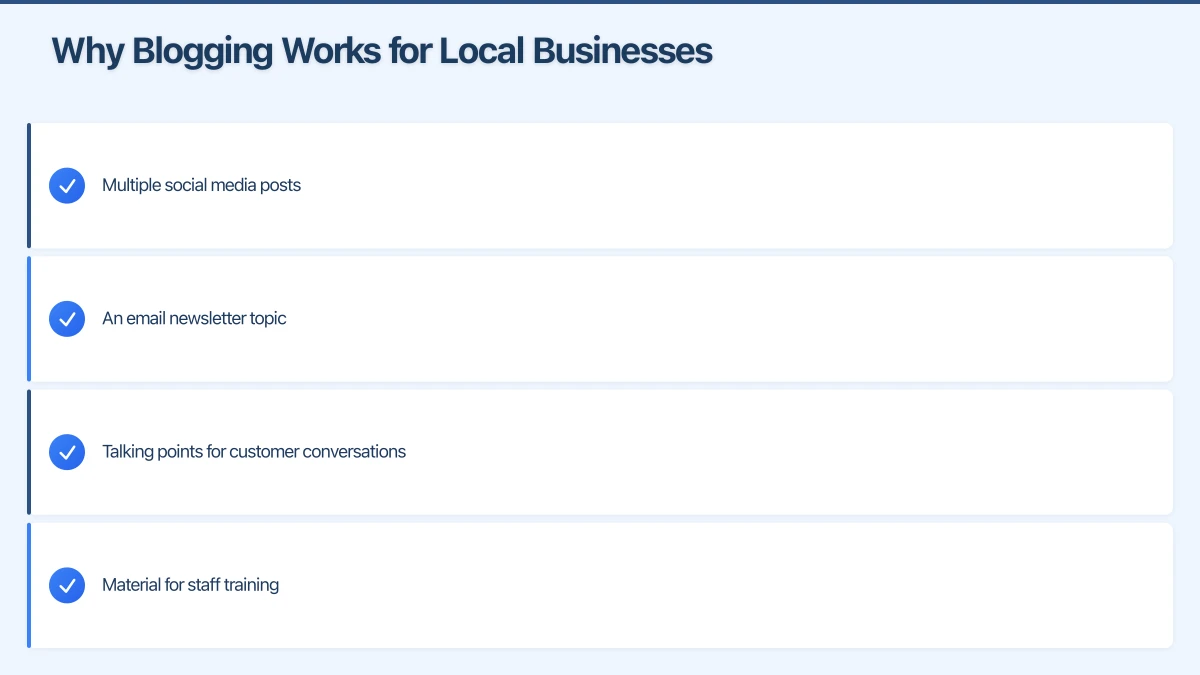
Struggling to post on social media? Your blog provides ready-made content. A blog article becomes:
- Multiple social media posts
- An email newsletter topic
- Talking points for customer conversations
- Material for staff training
One piece of content, repurposed across multiple channels, multiplies your marketing impact without multiplying your effort.
Understanding Your Local Audience
The first step in any content strategy is understanding who you’re writing for. For Western Sydney businesses, your audience has specific characteristics and needs.
What Local Customers Search For
Local searchers typically fall into three categories:
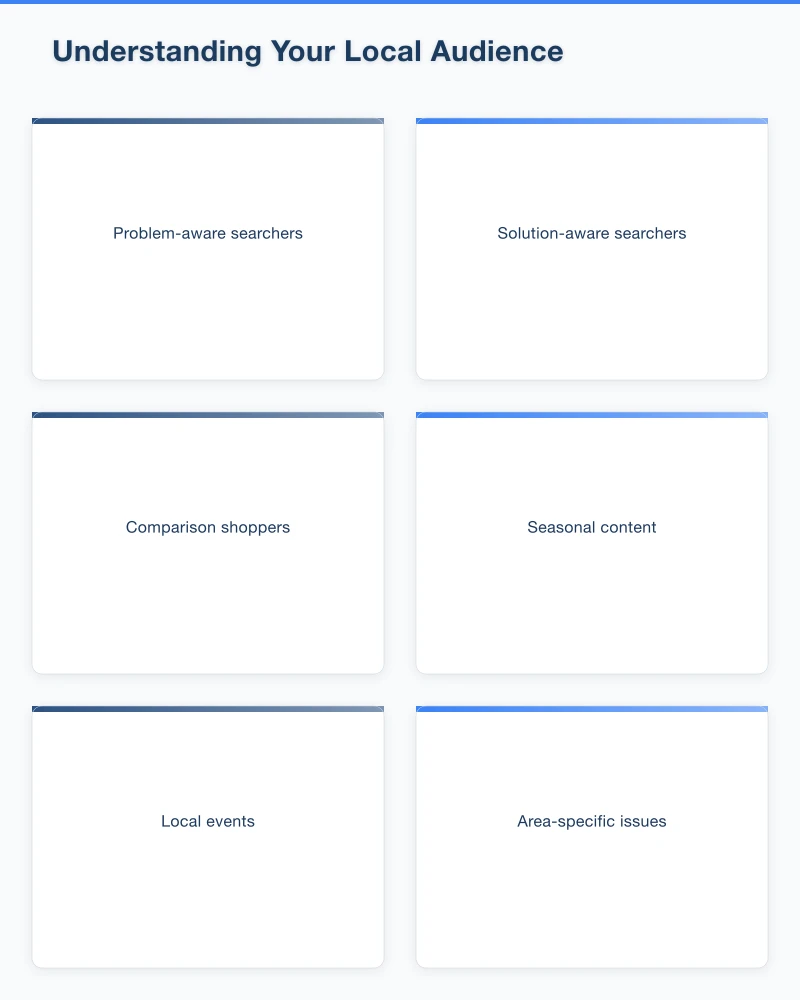
Problem-aware searchers: They know they have a problem but not the solution. “Why is my air conditioner leaking?” or “back pain after sitting all day”
Solution-aware searchers: They know what they need but are choosing a provider. “best electrician Hills District” or “dentist near Bella Vista reviews”
Comparison shoppers: They’re evaluating options. “solar panels cost Western Sydney” or “private school fees Hills District”
Your blog should address all three types. Helpful articles for problem-aware searchers build trust. Location-focused content attracts solution-aware searchers. Comparison guides and case studies help comparison shoppers choose you.
Local Topics That Resonate
Western Sydney has unique characteristics that create content opportunities:
Seasonal content: Summer heat and air conditioning, winter energy costs, spring gardens, holiday trading hours
Local events: Western Sydney Wanderers seasons, Westfield developments, new business precincts, community events
Area-specific issues: Water quality, traffic and commuting, local school considerations, property market trends
Community focus: Shop local movements, Hills District business networks, Blacktown business chambers
Weaving local context into your content helps you connect with readers and signals to Google that your business serves this area.
Creating Your Content Strategy
Now let’s build a practical content plan that works for a busy small business owner.
Step 1: Define Your Content Pillars
Content pillars are the main topics your blog will cover. Choose 3-5 pillars based on:
- Services you offer
- Questions customers frequently ask
- Topics you’re knowledgeable about
- Keywords you want to rank for
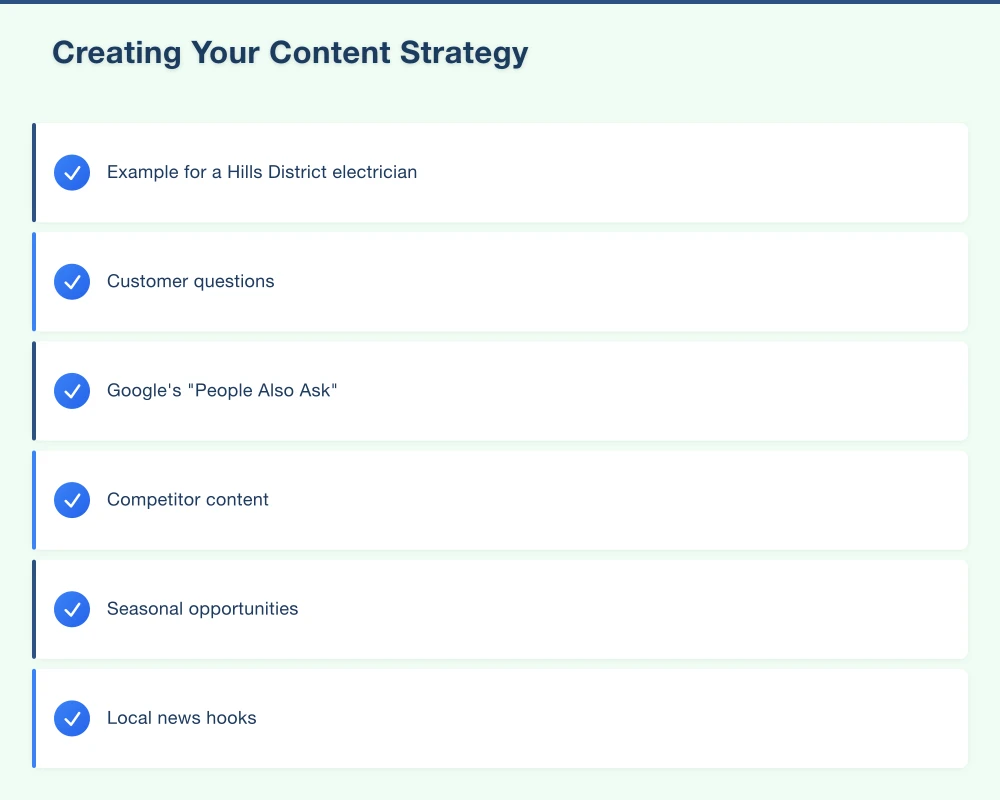
Example for a Hills District electrician:
- Home electrical safety
- Energy efficiency and solar
- Electrical upgrades and renovations
- Emergency electrical issues
- Business electrical services
Every blog post should fit within one of these pillars. This keeps your content focused and helps you build authority in specific areas.
Step 2: Build Your Topic List
For each pillar, brainstorm specific topics. The best sources for ideas:
Customer questions: What do customers ask before, during, and after hiring you? Each question is a potential blog post.
Google’s “People Also Ask”: Search for your main services and note the questions Google suggests. These are exactly what people want to know.
Competitor content: What are other local businesses blogging about? You can cover similar topics with your own unique perspective.
Seasonal opportunities: What services or products are more relevant at certain times of year?
Local news hooks: Are there local developments, regulations, or events relevant to your industry?
Aim to generate at least 20-30 topic ideas. This gives you months of content without having to brainstorm each time.
Step 3: Set a Realistic Publishing Schedule
Here’s where many local businesses fail–they start with ambitious plans, publish frequently for a few weeks, then stop entirely. Consistency matters more than frequency.
Realistic schedules for busy business owners:
- Minimum viable: 1 post per month (12 posts/year)
- Good momentum: 2 posts per month (24 posts/year)
- Strong presence: 1 post per week (52 posts/year)
Start with what you can genuinely maintain. It’s better to publish one quality post monthly for three years than to publish weekly for two months and then stop.
Pro Tip: Batch your content creation. Set aside one morning monthly to write 2-3 posts, then schedule them to publish automatically. This is far more efficient than trying to write on the fly.
Step 4: Plan Your Content Calendar
Map out your topics across the coming months, considering:
Seasonal relevance: Tax tips before EOFY, summer preparation before December, back-to-school content in January
Business priorities: Promoting a new service? Write supporting content. Slow period coming? Prepare promotional posts.
Local timing: Align with Western Sydney events, school holidays, local shopping seasons
A simple spreadsheet works fine:
- Column 1: Publish date
- Column 2: Topic/title
- Column 3: Content pillar
- Column 4: Target keywords
- Column 5: Status (draft, written, published)
Writing Blog Posts That Attract Customers
You don’t need to be a professional writer. You need to be helpful and clear. Here’s how to create content that works.
Structure Your Posts for Readability
Online readers scan before they read. Make scanning easy:
Use headings: Break content into sections with clear headings (like this article does)
Short paragraphs: 2-3 sentences maximum. Long blocks of text lose readers.
Bullet points and lists: Perfect for steps, tips, or features
Bold key points: Helps scanners catch important information
Write How You Talk
Forget formal business writing. Your blog should sound like you explaining something to a customer. Read your draft out loud–if it sounds stiff or unnatural, rewrite it.
Avoid: “Our establishment provides comprehensive solutions for all your residential electrical requirements.”
Write: “We handle all types of home electrical work, from fixing dodgy power points to complete rewires.”
Include Local References
Mention Western Sydney suburbs, landmarks, and context naturally throughout your posts. This helps with local SEO and makes content feel relevant to your readers.
“Many Castle Hill homes built in the 1990s have…” “If you’re dealing with Parramatta’s summer humidity…” “Hills District families often ask us about…”
Add Practical Value
Every post should leave the reader with something useful–knowledge they didn’t have before, steps they can take, or clarity on a confusing topic. Ask yourself: “If someone reads this, what can they now do that they couldn’t before?”
Optimising Your Posts for Search
A few simple practices help your blog posts rank well in search results.
Target Specific Keywords
Each post should focus on one main keyword phrase. Include it in:
- Your title
- The first paragraph
- At least one heading
- Naturally throughout the content
- Your meta description
Example: For a post about “home solar battery installation,” include variations like “solar batteries for homes,” “home battery installation,” and “residential solar storage.”
Write Compelling Titles
Your title appears in search results and determines whether people click. Good titles:
- Include your main keyword
- Promise a clear benefit
- Create curiosity or urgency
- Stay under 60 characters
Weak: “Solar Batteries” (too vague) Better: “Solar Battery Installation: Hills District Homeowner Guide” (specific, local, promises guidance)
Use Internal Links
Link to other relevant pages on your website within your blog posts. This helps:
- Visitors discover more of your content
- Search engines understand your site structure
- Pages share ranking authority
If you mention a service you offer, link to that service page. If a previous blog post is relevant, link to it.
Measuring Your Blog’s Success
Track these metrics to understand what’s working:
Traffic: How many visitors do your blog posts attract? Google Analytics shows this clearly.
Engagement: Are people reading or bouncing immediately? Check time on page and bounce rate.
Search rankings: Are your posts appearing in search results for target keywords? Use Google Search Console.
Conversions: Are blog visitors becoming customers? Track contact form submissions and phone calls from blog pages.
Review these metrics monthly. Double down on topics and formats that perform well. Learn from posts that underperform.
Getting Started This Week
Here’s your action plan to launch your content marketing:
Day 1: Define your 3-5 content pillars
Day 2-3: Brainstorm 20+ topic ideas across your pillars
Day 4: Create your content calendar for the next 3 months
Week 2: Write your first blog post
Week 3: Publish and share on social media
Week 4: Write your second post
Monthly: Maintain your publishing schedule, review metrics, adjust based on results
The Compound Effect of Content Marketing
Content marketing is a long-term strategy. Your first few posts won’t transform your business. But consistent publishing over months and years creates compounding returns.
A Hills District business that publishes two quality posts monthly will have 120 articles after five years. That’s 120 opportunities to rank in search results, 120 pieces of content building trust, 120 answers to customer questions working for them around the clock.
Start now, stay consistent, and let your content work for your business while you focus on serving customers.
Need help developing your content strategy? Cosmos Web Technologies offers content planning and blog setup services for Western Sydney businesses.
Your website’s performance depends on what’s behind it. Cloud Geeks provides the managed hosting, cloud, and IT support that keeps Australian SMBs online and secure.
Ash Ganda covers how Australian SMBs are using AI, automation, and digital strategy to grow without scaling costs proportionally.
If your business is also planning a customer-facing iOS or Android app — Awesome Apps builds cross-platform mobile apps for Australian SMBs.
Part of the Ganda Tech Services family, Cosmos Web Tech delivers specialist web design and digital marketing for Australian small and medium businesses.