Customer Review Management Strategy for Local Businesses
Online reviews are one of the most influential factors in a customer’s decision to choose your business. Studies consistently show that the vast majority of consumers read online reviews before making a purchase or hiring a service provider. For local businesses in Western Sydney, reviews on Google, Facebook, and industry-specific platforms can make or break your ability to attract new customers.
But reviews do not manage themselves. You need a strategy for generating reviews, responding to them, and using them to grow your business.
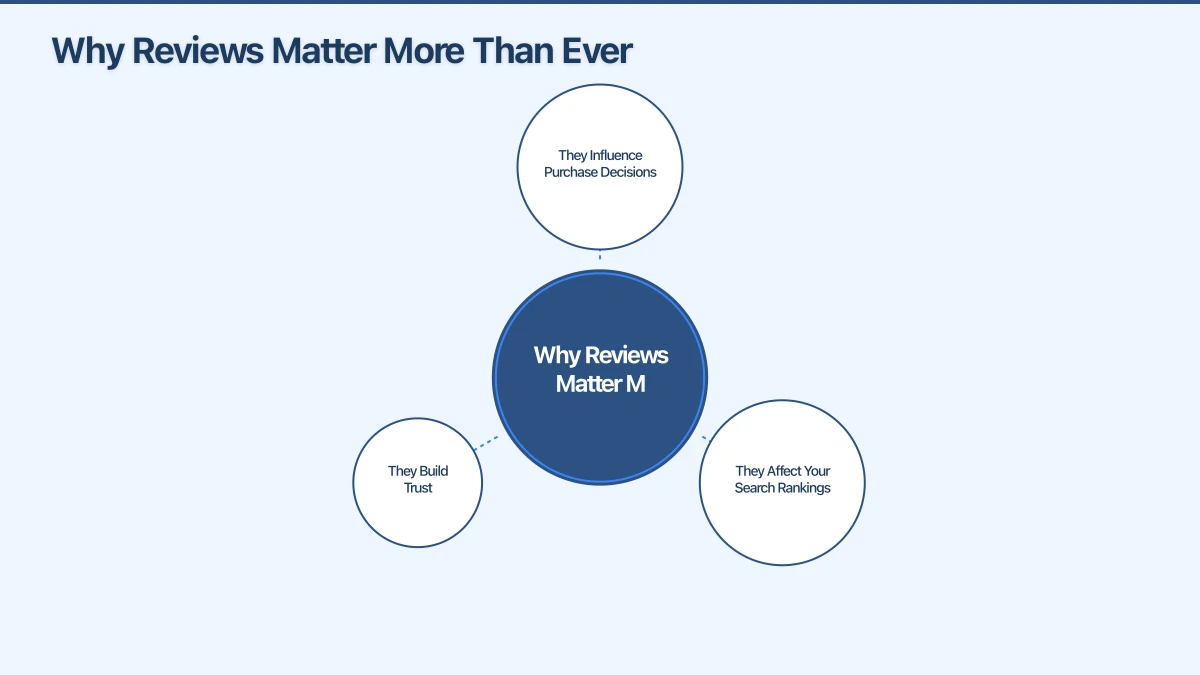
Why Reviews Matter More Than Ever
They Influence Purchase Decisions
Most customers trust online reviews as much as personal recommendations. Before calling a plumber, choosing a restaurant, or booking a hairdresser, people check the reviews. A business with 50 positive reviews is far more likely to get the call than a competitor with three reviews or none at all.
They Affect Your Search Rankings
Google uses reviews as a ranking factor for local search results. Businesses with more reviews and higher ratings tend to appear higher in the local pack (the map results at the top of local searches). The quantity, quality, and recency of your reviews all play a role.
They Build Trust
Reviews provide social proof. When potential customers see that others have had positive experiences with your business, they feel more confident about choosing you. This is especially important for service businesses where the customer cannot evaluate the product before purchasing.
Where to Focus Your Review Efforts
Google Reviews
For most local businesses, Google reviews should be your primary focus. They appear prominently when someone searches for your business or your service category. They also directly influence your Google Business Profile ranking.
Facebook Reviews (Recommendations)
Facebook uses a “Recommend” system rather than star ratings, but these recommendations still influence potential customers who discover your business on Facebook.
Industry-Specific Platforms
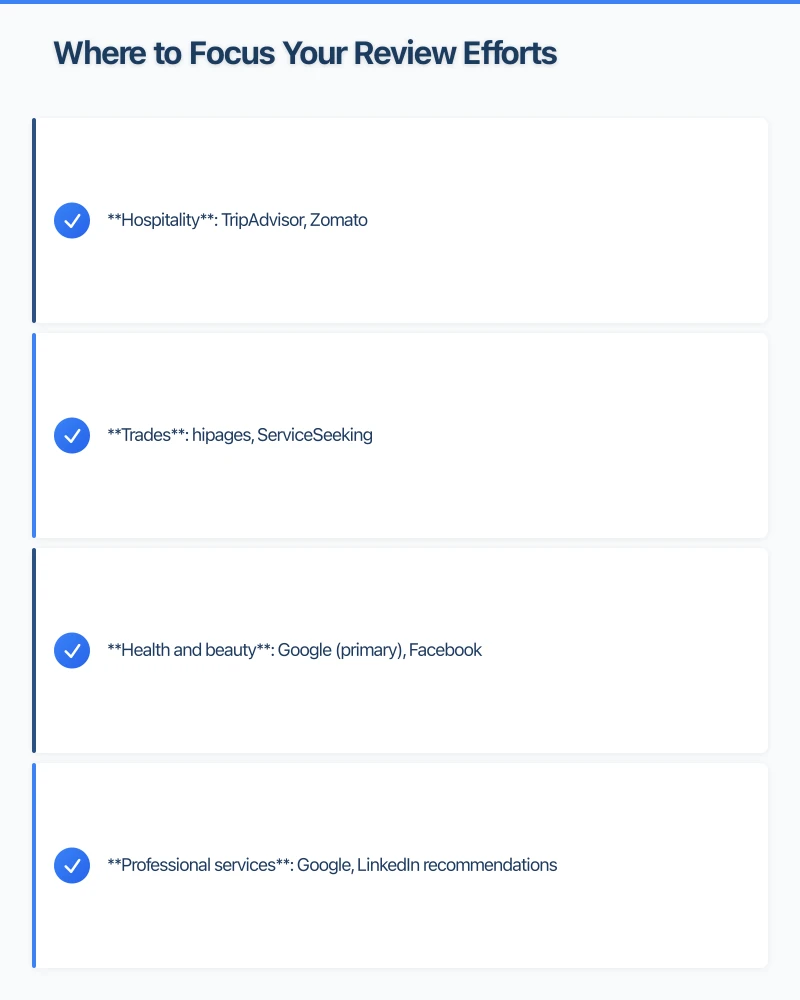
Depending on your industry, reviews on specific platforms may also matter:
- Hospitality: TripAdvisor, Zomato
- Trades: hipages, ServiceSeeking
- Health and beauty: Google (primary), Facebook
- Professional services: Google, LinkedIn recommendations
Focus on Google first, then add one or two additional platforms relevant to your industry.
How to Get More Reviews
Ask at the Right Moment
The best time to ask for a review is right after a positive customer experience. This could be:
- After completing a job and the customer expresses satisfaction
- After a positive interaction in your shop or cafe
- After a customer receives a product and sends positive feedback
- During a follow-up call or email after service delivery
Timing matters. Ask while the positive experience is fresh.
Make It Easy
The biggest barrier to getting reviews is friction. Make the process as easy as possible:
- Create a direct link to your Google review page. In your Google Business Profile, there is a “share review form” option that gives you a short link. Share this link in emails, text messages, and on your website.
- Send a follow-up email. After completing a job or sale, send a thank-you email that includes a direct link to leave a review.
- Display a QR code. Print a QR code that links to your review page and display it at your counter, on invoices, or on business cards.
Ask Personally
A personal request is far more effective than a generic one. “We would really appreciate it if you could leave us a Google review. It helps other people find us” is simple, honest, and effective.
Train your team to ask for reviews naturally as part of the customer interaction. It does not need to be pushy. A genuine, friendly request is usually well received.
Do Not Incentivise Reviews
Google’s guidelines prohibit offering incentives for reviews (discounts, gifts, etc.). Do not offer anything in exchange for a review. You can encourage reviews through good service and polite requests, but never pay for them.
How to Respond to Reviews
Respond to Every Review
Yes, every single one. Positive and negative. Responding shows that you value customer feedback and are actively engaged with your customers. It also signals to potential customers that you care about their experience.
Responding to Positive Reviews
Keep it genuine and personal. Thank the customer by name, reference something specific about their experience if possible, and express your appreciation.
Example: “Thanks so much for the kind words, Sarah. We are glad the new kitchen turned out exactly how you envisioned it. It was a great project to work on. We appreciate you taking the time to share your experience.”
Avoid generic copy-paste responses. Customers can tell when a response is templated, and it feels impersonal.
Responding to Negative Reviews
Negative reviews are inevitable, even for excellent businesses. How you respond matters more than the review itself. Here is a framework:
- Stay calm. Do not respond in anger. If you are upset, wait a few hours before writing your response.
- Thank them for the feedback. Even if you disagree, acknowledge that they took the time to share their experience.
- Apologise for the experience. You can apologise for how they felt without admitting fault.
- Offer to resolve the issue. Provide a way for them to contact you directly (phone number or email) to discuss the matter.
- Keep it brief. Long, defensive responses look worse than a short, professional one.
Example: “Thanks for sharing your feedback, John. We are sorry to hear that your experience did not meet your expectations. We take all feedback seriously and would like to understand more about what happened. Please call us on [phone number] so we can discuss this directly and find a resolution.”
What Not to Do
- Do not argue or get defensive
- Do not share personal details about the customer or their transaction
- Do not accuse the reviewer of lying
- Do not use generic copy-paste responses for every review
- Do not ignore negative reviews
Dealing with Fake or Unfair Reviews
Occasionally, you may receive a review that is fake, from someone who was never a customer, or violates Google’s review policies. If this happens:
- Flag the review through Google Business Profile by clicking the three dots next to the review and selecting “Flag as inappropriate”
- Respond professionally to the review in case Google does not remove it
- Document why you believe the review is fake or violates policy
- If Google does not remove it, respond with a brief, professional note explaining that you have no record of the reviewer as a customer
Google does not always remove flagged reviews, so a professional response is important regardless.
Using Reviews in Your Marketing
Positive reviews are powerful marketing material. Use them across your business:
On Your Website
Feature customer reviews on your homepage, service pages, and a dedicated testimonials page. Real reviews with the customer’s name (and photo, with permission) are more credible than anonymous quotes.
On Social Media
Share positive reviews as social media posts. A simple graphic with a customer quote makes compelling content. Thank the customer in your caption and invite others to share their experiences.
In Sales Materials
Include reviews in proposals, presentations, and printed materials. When a potential customer is comparing options, seeing positive feedback from other customers can tip the balance in your favour.
In Email Marketing
Include a customer review in your email newsletters or in follow-up emails to leads. Social proof at the consideration stage can be very effective.
Building a Review Culture
The most successful businesses do not treat reviews as an occasional activity. They build a review culture where gathering and managing feedback is part of everyday operations.
- Train all customer-facing staff on how to ask for reviews
- Include a review request in your standard follow-up process
- Set a monthly goal for new reviews
- Review and respond to all reviews weekly
- Celebrate positive reviews with your team
- Use negative reviews as learning opportunities
Tracking Your Progress
Monitor your review metrics monthly:
- Total number of reviews on Google and other platforms
- Average star rating
- Number of new reviews received this month
- Response rate (aim for 100 percent)
- Common themes in positive and negative feedback
Over time, you should see your review count and average rating steadily improve.
Start Today
If you have not been actively managing your reviews, today is a great day to start. Check your Google Business Profile, read any unresponded reviews, and craft thoughtful responses. Then begin asking satisfied customers for reviews.
If you need help with your online reputation management, Cosmo Web Tech helps Western Sydney businesses build and maintain strong online reputations. Get in touch to learn more about our review management services.
Your website’s performance depends on what’s behind it. Cloud Geeks provides the managed hosting, cloud, and IT support that keeps Australian SMBs online and secure.
Ash Ganda covers how Australian SMBs are using AI, automation, and digital strategy to grow without scaling costs proportionally.
If your business is also planning a customer-facing iOS or Android app — Awesome Apps builds cross-platform mobile apps for Australian SMBs.
Part of the Ganda Tech Services family, Cosmos Web Tech delivers specialist web design and digital marketing for Australian small and medium businesses.