You’ve got a marketing budget. Not a massive one, but enough to try some paid advertising. The question keeping you up at night: should you spend it on Facebook Ads or Google Ads?
If you’re a local business owner in Western Sydney or the Hills District, you’re not alone in this dilemma. Every week, I talk to business owners who’ve tried one platform, got mediocre results, and wonder if the grass is greener on the other side.
Here’s the honest truth: both platforms can work brilliantly for local businesses. But they work in completely different ways, and choosing the wrong one for your business type can waste thousands of dollars.
Let me break down exactly how each platform works, what they cost, and most importantly, which one is right for your business.
Understanding the Fundamental Difference
Before we dive into costs and features, you need to understand the basic difference between these platforms. It’s the key to everything else.
Google Ads captures demand that already exists. When someone searches “emergency plumber Castle Hill” at 10pm with water flooding their kitchen, they’re ready to buy right now. Google Ads puts your business in front of people actively looking for what you sell.
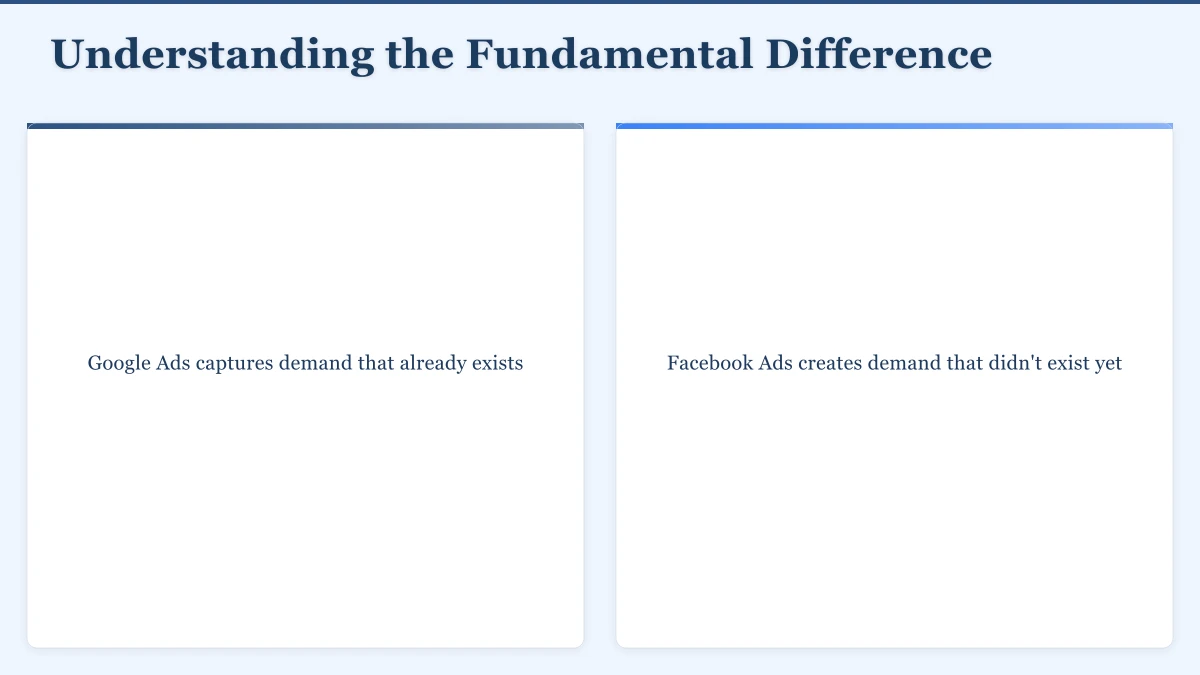
Facebook Ads creates demand that didn’t exist yet. Someone scrolling Facebook on their lunch break isn’t thinking about buying anything. But when they see your ad for a new cafe in Bella Vista with 20% off this week, they might decide to check it out on the weekend.
Think of it this way: Google Ads is like having a shopfront on the busiest street in town. Facebook Ads is like handing out flyers at Westfield. Both can work, but they suit different types of businesses.
How Much They Actually Cost
Let’s talk real numbers because this matters when you’re working with a limited budget.
Google Ads costs in Western Sydney (based on what I’m seeing with local clients in mid-2024):
- Service businesses (plumbers, electricians, lawyers): $8-25 per click
- Retail and e-commerce: $1-5 per click
- Professional services (accountants, dentists): $5-15 per click
- Restaurants and cafes: $0.50-3 per click
Facebook Ads costs for local businesses:
- Cost per click: $0.50-2.50 (much cheaper)
- Cost per thousand impressions: $5-15
- Cost per lead: $10-50 depending on your industry
On the surface, Facebook looks way cheaper. And it is. But here’s the catch: Facebook clicks are much less valuable because people aren’t actively looking for your service. You might need 10 Facebook clicks to get one enquiry, while 3 Google clicks might get you one.
For most Hills District businesses I work with, a realistic monthly budget is:
- Minimum for Google Ads: $800-1,200 to get meaningful results
- Minimum for Facebook Ads: $500-800 to build momentum
Anything less than these amounts, and you’re probably better off focusing on free methods like improving your Google Business Profile and posting on local Facebook groups.
Targeting: Finding Your Customers
This is where things get interesting, because each platform has completely different strengths.
Google Ads targeting is all about intent. You’re targeting:
- Specific search terms (“web designer Parramatta”)
- Location (within 10km of your business)
- Device type and time of day
- Demographics (age, household income)
The beauty of Google Ads is that you don’t need to guess who your customer is. If they’re searching for what you offer, they’re your customer.
Facebook Ads targeting is incredibly detailed. You can target:
- People who live in specific suburbs (Castle Hill, Baulkham Hills, etc.)
- Age, gender, interests, behaviours
- People who like your competitors’ pages
- People who’ve visited your website before
- Custom audiences based on your customer email list
For local businesses, Facebook’s location targeting is fantastic. You can show ads only to people within 5km of your Bella Vista cafe, excluding people who are just passing through.
Pro Tip: If you run both platforms, you can use Facebook’s retargeting to show ads to people who clicked your Google Ads but didn’t convert. This one-two punch works brilliantly for professional services.
Which Platform Converts Better?
Conversion rates vary wildly by industry, but here’s what I’m seeing with Western Sydney businesses in 2024:
Google Ads typically converts better for:
- Emergency services (plumbers, locksmiths, towing)
- Professional services people actively search for (lawyers, accountants)
- Specific products (“buy XYZ online”)
- Local services with high intent (“dentist near me”)
Average conversion rates: 3-8% from click to enquiry or sale.
Facebook Ads typically converts better for:
- Restaurants and cafes (especially with offers)
- Retail stores and boutiques
- Health and beauty services
- Real estate agents
- Events and courses
Average conversion rates: 1-4% from click to enquiry or sale.
But here’s where Facebook shines: brand awareness. Even if someone doesn’t click your ad, they see your business name and remember you. When they need your service in three months, you’re top of mind.
The Best Platform for Your Business Type
Let me give you specific recommendations based on what I’ve seen work for different types of Hills District and Western Sydney businesses:
Choose Google Ads if you’re:
- A tradie (electrician, plumber, builder, pest control)
- An emergency service provider
- A professional service (lawyer, accountant, financial planner)
- Selling products people search for by name
- In a competitive local market where you need to capture existing demand
Example: A Castle Hill plumbing business running Google Ads for “blocked drain Castle Hill” and “emergency plumber Hills District” gets 15-20 calls per month from a $1,200 budget. Each job is worth $300-800, so the ROI is clear.
Choose Facebook Ads if you’re:
- A cafe, restaurant, or food business
- A retail store or boutique
- A health/beauty/wellness service
- Running special promotions or events
- Trying to build brand awareness in your local area
Example: A new boutique in Bella Vista runs Facebook Ads to women 25-45 within 10km, showcasing new arrivals and a “20% off for first-time customers” offer. For $600/month, they’re getting 30-40 new customers through the door.
Do both if you’re:
- A dentist or medical practice
- A real estate agent
- A gym or fitness studio
- A home services business with both emergency and planned work
The strategy: Use Google Ads to capture high-intent searches, and Facebook Ads to stay visible in your local area and retarget people who visited your website.
Setting Up for Success: Quick Start Guide
If you’re going with Google Ads, here’s your first campaign:
- Start with Google Search Ads (not Display)
- Target only your local area (5-15km radius)
- Use 5-10 specific search terms your customers actually use
- Set up conversion tracking so you know what’s working
- Start with a $30-40 daily budget
- Run it for at least 30 days before judging results
If you’re going with Facebook Ads, here’s your approach:
- Create a Business Page if you don’t have one
- Install Facebook Pixel on your website
- Target people within 10km of your business
- Use eye-catching images (photos of your actual business work best)
- Include a clear offer or call-to-action
- Start with a $20-25 daily budget
- Test 2-3 different ad images and see what performs best
Pro Tip: Whichever platform you choose, make sure your website loads fast on mobile and has your phone number clearly visible. I see so many local businesses waste ad spend by sending people to slow, confusing websites.
Common Mistakes Western Sydney Businesses Make
Over the years, I’ve seen local business owners make the same mistakes with paid advertising. Here’s what to avoid:
With Google Ads:
- Targeting too broad an area (all of Sydney instead of just Western Sydney)
- Not using negative keywords (wasting money on irrelevant searches)
- Sending people to your homepage instead of a specific service page
- Giving up after two weeks (Google Ads needs time to optimise)
- Not tracking phone calls from ads
With Facebook Ads:
- Using stock photos instead of real images of your business
- Writing too much text (keep it short and punchy)
- Not testing different audiences
- Boosting posts instead of creating proper ads
- Not retargeting website visitors
The biggest mistake of all? Trying to run ads without fixing your basics first. If your Google Business Profile isn’t fully optimised, if your website doesn’t work on mobile, if you don’t have a clear offer, paid ads will just amplify those problems.
Measuring What Actually Matters
Both platforms give you hundreds of metrics, but here’s what actually matters for local businesses:
For Google Ads, track:
- Cost per conversion (enquiry, call, or sale)
- Conversion rate from your best-performing keywords
- Quality Score (indicates if your ads are relevant)
- Impression share (are you showing up for your target searches?)
For Facebook Ads, track:
- Cost per result (link click, lead, purchase)
- Reach and frequency in your local area
- Click-through rate (should be at least 1-2%)
- Return on ad spend for e-commerce
The golden metric for any local business: customer acquisition cost. If you spend $1,200 on Google Ads and get 10 new customers worth $500 each, you’ve spent $120 to make $500. That’s a 316% return. That’s the math that matters.
The Hybrid Approach for Maximum Results
Here’s what I recommend to most Western Sydney businesses with a decent marketing budget ($1,500+ per month):
Month 1-2: Start with Google Ads
- Capture people actively searching for your service
- Generate immediate enquiries and revenue
- Figure out which keywords convert best
- Build up customer reviews and testimonials
Month 3: Add Facebook Ads
- Use Facebook to retarget people who visited from Google but didn’t convert
- Run brand awareness campaigns in your local suburbs
- Promote special offers to stay top of mind
- Build your remarketing audience
Month 4+: Optimise both
- Increase spend on what’s working, pause what’s not
- Use insights from both platforms to improve targeting
- Test seasonal promotions and offers
- Refine your local area targeting based on where customers come from
This approach works because you’re covering both bases: capturing existing demand (Google) while creating future demand (Facebook).
What You’ll Achieve with the Right Platform
When you choose the right advertising platform for your business type and set it up properly, here’s what you can realistically expect:
In the first month:
- Start getting enquiries from people who’ve never heard of you
- Get data on which messages and offers resonate
- Begin building momentum with the platform’s algorithm
- See which areas and demographics respond best
After 3 months:
- Consistent flow of new enquiries or customers
- Clear picture of your customer acquisition cost
- Optimised campaigns spending money only on what works
- Growing remarketing audience for future campaigns
After 6 months:
- Predictable return on ad spend
- Established presence in local search or feeds
- Detailed understanding of your most valuable customer segments
- Ability to scale up or down based on business capacity
For most Hills District and Western Sydney businesses, the goal isn’t to get famous. It’s to have a reliable stream of new customers coming through the door or calling your phone. Both Google Ads and Facebook Ads can deliver that, when used correctly.
Getting Started This Week
You don’t need to spend thousands to test these platforms. Here’s how to start small:
Option 1: Test Google Ads for 2 weeks
- Budget: $400 ($30/day for 14 days)
- Target: 3-5 high-intent keywords for your local area
- Goal: Get at least 5 enquiries to prove the concept
- Time investment: 2-3 hours to set up, 30 minutes daily to monitor
Option 2: Test Facebook Ads for 2 weeks
- Budget: $280 ($20/day for 14 days)
- Target: 10km radius, age/gender of your typical customer
- Goal: Get at least 100 clicks to your website or 20 enquiries
- Time investment: 2 hours to set up, 15 minutes daily to monitor
Both platforms offer plenty of free learning resources, but honestly, if you’re time-poor (and what business owner isn’t?), consider getting help from someone who knows the local market. The money you save on wasted ad spend will more than cover the cost.
The best time to start advertising was six months ago. The second-best time is today. Pick the platform that matches your business type, set a budget you can afford to test with, and give it a proper go.
Your Hills District competitors are already advertising. The question is whether you’ll be there when your next customer searches or scrolls.
Need help deciding which platform is right for your Western Sydney business, or want someone to set it up properly? Get in touch and let’s work out the best strategy for your budget and goals.
Your website’s performance depends on what’s behind it. Cloud Geeks provides the managed hosting, cloud, and IT support that keeps Australian SMBs online and secure.
Ash Ganda covers how Australian SMBs are using AI, automation, and digital strategy to grow without scaling costs proportionally.
If your business is also planning a customer-facing iOS or Android app — Awesome Apps builds cross-platform mobile apps for Australian SMBs.
Part of the Ganda Tech Services family, Cosmos Web Tech delivers specialist web design and digital marketing for Australian small and medium businesses.