Google Ads Quality Score: How to Improve Your Ad Performance
If you are running Google Ads for your business, Quality Score is one of the most important metrics to understand. It directly affects how much you pay per click and where your ads appear in search results. A higher Quality Score means lower costs and better ad positions. A lower one means you pay more for less visibility.
Let us break down what Quality Score is, why it matters, and how you can improve it.
What Is Quality Score?
Quality Score is Google’s rating of the quality and relevance of your keywords, ads, and landing pages. It is measured on a scale of 1 to 10, with 10 being the best. You can see the Quality Score for each keyword in your Google Ads account.
Google uses Quality Score as part of the ad auction process. When someone searches for a keyword you are bidding on, Google considers both your bid amount and your Quality Score to determine your ad’s position and what you actually pay per click.
The formula works roughly like this:
Ad Rank = Bid Amount x Quality Score
This means a business with a lower bid but higher Quality Score can outrank a competitor with a higher bid but lower Quality Score. For small businesses working with limited budgets, this is great news. Quality can beat a bigger budget.
The Three Components of Quality Score
Quality Score is made up of three components, each rated as “Below average,” “Average,” or “Above average”:
1. Expected Click-Through Rate (CTR)
This is Google’s estimate of how likely someone is to click your ad when it appears for a particular keyword. It is based on historical performance of your ads and the keyword.
A high expected CTR tells Google that your ad is relevant and appealing to searchers. A low one suggests your ad does not resonate with what people are looking for.
2. Ad Relevance
This measures how closely your ad matches the intent behind a search query. If someone searches for “emergency plumber Parramatta” and your ad talks about general home maintenance, the ad relevance will be low.
Your ad copy should directly relate to the keywords in each ad group. This is why organising your keywords into tightly themed ad groups is so important.
3. Landing Page Experience
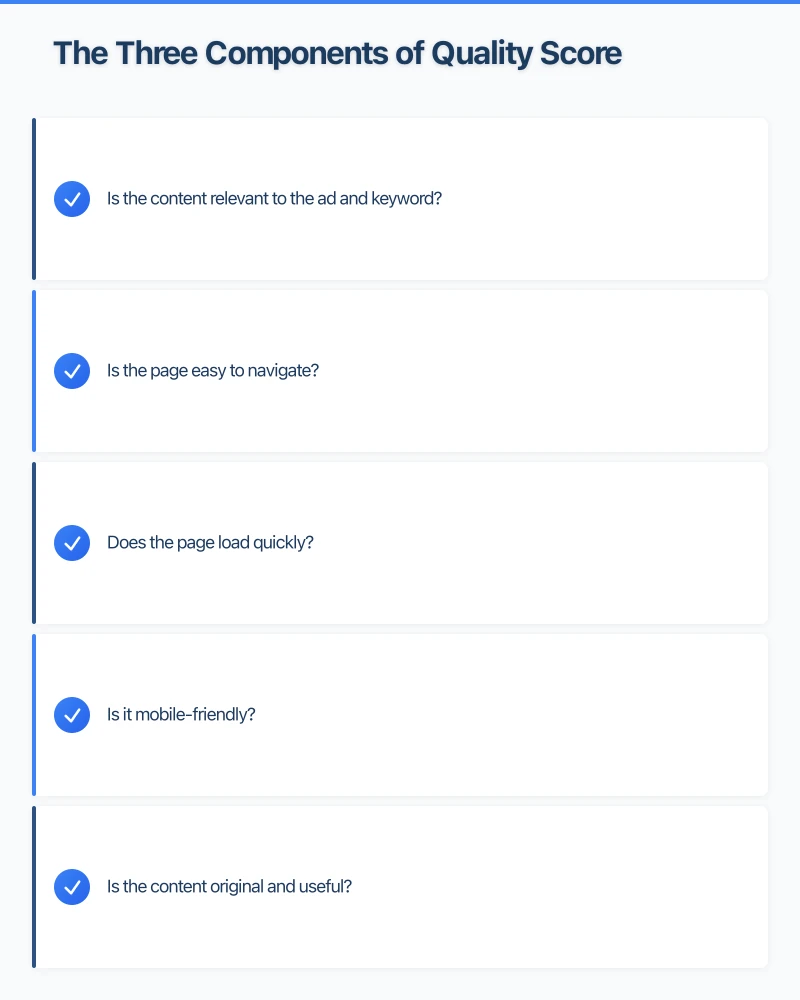
This evaluates the quality of the page someone lands on after clicking your ad. Google considers factors like:
- Is the content relevant to the ad and keyword?
- Is the page easy to navigate?
- Does the page load quickly?
- Is it mobile-friendly?
- Is the content original and useful?
A poor landing page experience drags down your Quality Score regardless of how good your ads are.
Why Quality Score Matters for Your Business
Lower Cost Per Click
A higher Quality Score directly reduces your cost per click. Google rewards relevant, high-quality ads with lower prices. Businesses with Quality Scores of 7 or above can pay significantly less per click than those with scores of 3 or 4.
For a local business in Western Sydney with a limited advertising budget, this difference adds up quickly. If you are paying $5 per click instead of $8, that same budget gets you 60 percent more clicks.
Better Ad Positions
Higher Quality Scores also help your ads appear in higher positions on the search results page. Being in the top positions means more visibility and more clicks.
More Efficient Budget
When you pay less per click and get better positions, your overall return on investment improves. You get more value from every dollar you spend on Google Ads.
How to Improve Your Quality Score
Improve Your Expected Click-Through Rate
Write compelling ad copy. Your headlines should be specific and relevant. Include your keyword, highlight unique benefits, and use strong calls to action.
Use ad extensions. Sitelink extensions, callout extensions, and call extensions make your ad larger and more informative, which tends to improve click-through rates.
Test multiple ad variations. Create several responsive search ads with different headlines and descriptions. Google will test them and show the best performers more often.
Include numbers and specifics. “20 Years Experience” or “Free Same-Day Quotes” are more clickable than vague statements.
Improve Your Ad Relevance
Organise keywords into tight ad groups. Group closely related keywords together and write ads that specifically address those keywords. An ad group for “blocked drains” should have different ads than one for “hot water systems.”
Include your keyword in your ad headlines. When your ad headline matches the search query, it signals strong relevance. If your ad group targets “web design Parramatta,” include “Web Design in Parramatta” as one of your headlines.
Use keyword insertion carefully. Google Ads allows dynamic keyword insertion, which automatically places the triggering keyword into your ad. This can improve relevance, but use it thoughtfully to ensure your ads still read naturally.
Match intent. If someone searches for a specific service, your ad should talk about that service, not your business in general.
Improve Your Landing Page Experience
Use dedicated landing pages. Do not send all ad clicks to your homepage. Create specific landing pages for each ad group or service. If someone clicks an ad about “bathroom renovations,” they should land on a page about bathroom renovations.
Ensure relevance. The content on your landing page should match what the ad promised. If your ad mentions a free quote, the landing page should make it easy to request a free quote.
Improve page speed. Slow pages hurt your Quality Score and lose visitors. Use Google’s PageSpeed Insights to check your page speed and fix issues like large images, slow hosting, or excessive scripts.
Make it mobile-friendly. More than half of Google searches happen on mobile devices. Your landing page must work well on phones with easy-to-read text, tappable buttons, and fast loading.
Include clear calls to action. Make it obvious what you want the visitor to do: call, fill in a form, or make a purchase. Place your call to action prominently on the page.
Add trust signals. Include customer reviews, industry certifications, business credentials, and your ABN. These elements build trust and improve the overall page experience.
Provide original, useful content. Your landing page should offer genuine value to visitors. Answer their questions, explain your process, and show them why they should choose your business.
Common Quality Score Problems and Fixes
Problem: Quality Score is 1 to 3
This usually indicates a fundamental mismatch between your keywords, ads, and landing pages. Review whether your keywords are relevant to your business, your ads address those keywords, and your landing pages match the ad content.
Problem: “Below Average” Ad Relevance
Your ad copy does not match your keywords well enough. Reorganise your keywords into smaller, more specific ad groups, and rewrite your ads to directly address each group’s theme.
Problem: “Below Average” Landing Page Experience
Your landing page needs work. Check page speed, mobile-friendliness, content relevance, and usability. Consider creating dedicated landing pages for your key ad groups.
Problem: “Below Average” Expected CTR
Your ads are not compelling enough. Test new headlines that include keywords, specific benefits, and stronger calls to action. Make sure your ads stand out from competitors.
Monitoring and Maintaining Quality Score
Quality Score is not a set-and-forget metric. Check it regularly and look for trends:
- Review Quality Score at least monthly
- Note which keywords have low scores and prioritise improvements
- Track how changes to ads and landing pages affect your scores over time
- Keep testing new ad variations to maintain strong click-through rates
A Practical Approach
You do not need a perfect 10 on every keyword. Aim for Quality Scores of 7 or above on your most important keywords. Focus your improvement efforts on:
- Your highest-spending keywords (where improvements save the most money)
- Keywords with the lowest Quality Scores (where there is the most room for improvement)
- Keywords that drive the most conversions (your most valuable terms)
Improving Quality Score is a gradual process. Make changes, give them a week or two to take effect, measure the impact, and iterate.
Quality Score and conversion tracking both depend on clean, consented visitor data. If you run analytics or ad pixels, make sure you have a compliant consent system in place — see our guide on cookie consent banners for Australian small business websites.
If you need help improving your Google Ads performance, Cosmo Web Tech manages Google Ads campaigns for businesses across Western Sydney. We focus on maximising your return on investment through better Quality Scores, smarter targeting, and effective ad copy.
Your website’s performance depends on what’s behind it. Cloud Geeks provides the managed hosting, cloud, and IT support that keeps Australian SMBs online and secure.
Ash Ganda covers how Australian SMBs are using AI, automation, and digital strategy to grow without scaling costs proportionally.
If your business is also planning a customer-facing iOS or Android app — Awesome Apps builds cross-platform mobile apps for Australian SMBs.
Part of the Ganda Tech Services family, Cosmos Web Tech delivers specialist web design and digital marketing for Australian small and medium businesses.