Google Ads vs Facebook Ads: Which Works for Local Business
If you are a local business owner thinking about investing in online advertising, you have probably come across two major options: Google Ads and Facebook Ads. Both are powerful platforms, but they work in fundamentally different ways and serve different purposes.
The question is not really which one is “better” – it is which one is right for your specific business, goals, and budget. In this guide, we will break down both platforms so you can make an informed decision.
The Fundamental Difference
The core difference between Google Ads and Facebook Ads comes down to intent versus interest.
Google Ads targets people who are actively searching for something. When someone types “emergency plumber Western Sydney” into Google, they have a problem they need solved right now. Google Ads lets you appear at the top of those search results.
Facebook Ads targets people based on their demographics, interests, and behaviours. You are showing your ad to people while they scroll through their feed, even if they are not actively looking for your product or service at that moment.
Think of it this way: Google Ads catches people with a fishing rod (they are already biting). Facebook Ads casts a net (you are reaching a broader audience who might be interested).
Google Ads: The Details
How It Works
Google Ads (formerly Google AdWords) lets you bid on keywords so your ad appears at the top of Google search results. You pay each time someone clicks your ad (pay-per-click or PPC).
For local businesses, you can also run Local Services Ads (available for certain industries) and Display Ads that appear on websites across the Google Display Network.
Strengths for Local Business
- High purchase intent: People searching on Google often want to buy or hire now
- Location targeting: You can target specific suburbs, postcodes, or a radius around your business
- Measurable results: You can track exactly how many calls, form submissions, and website visits your ads generate
- Immediate visibility: Your ad can appear at the top of Google within hours of setting up a campaign
- Works for urgent services: Trades, emergency services, and time-sensitive needs perform exceptionally well
Typical Costs
Google Ads costs vary significantly by industry and competition. For local businesses in Western Sydney, you might pay anywhere from $1 to $10 or more per click depending on your industry. Highly competitive keywords like “lawyer Sydney” or “plumber emergency” tend to cost more.
A reasonable starting budget for a local business is $500 to $1,500 per month, though you can start with less while you test.
Best For
- Service businesses where customers search when they have a need (tradespeople, professionals, emergency services)
- Businesses where the customer already knows what they want
- Competitive local markets where organic rankings are difficult
- Businesses wanting immediate leads
Challenges
- Can be expensive in competitive industries
- Requires ongoing management and optimisation
- Complex interface with a learning curve
- Click fraud can be an issue (though Google has safeguards)
- Results stop the moment you stop paying
Facebook Ads: The Details
How It Works
Facebook Ads lets you create ads that appear in people’s Facebook and Instagram feeds (Facebook owns Instagram, and you manage both from the same ad platform). You can target people based on their location, age, gender, interests, behaviours, and much more.
You can pay per click, per impression (views), or per action (like a form submission).
Strengths for Local Business
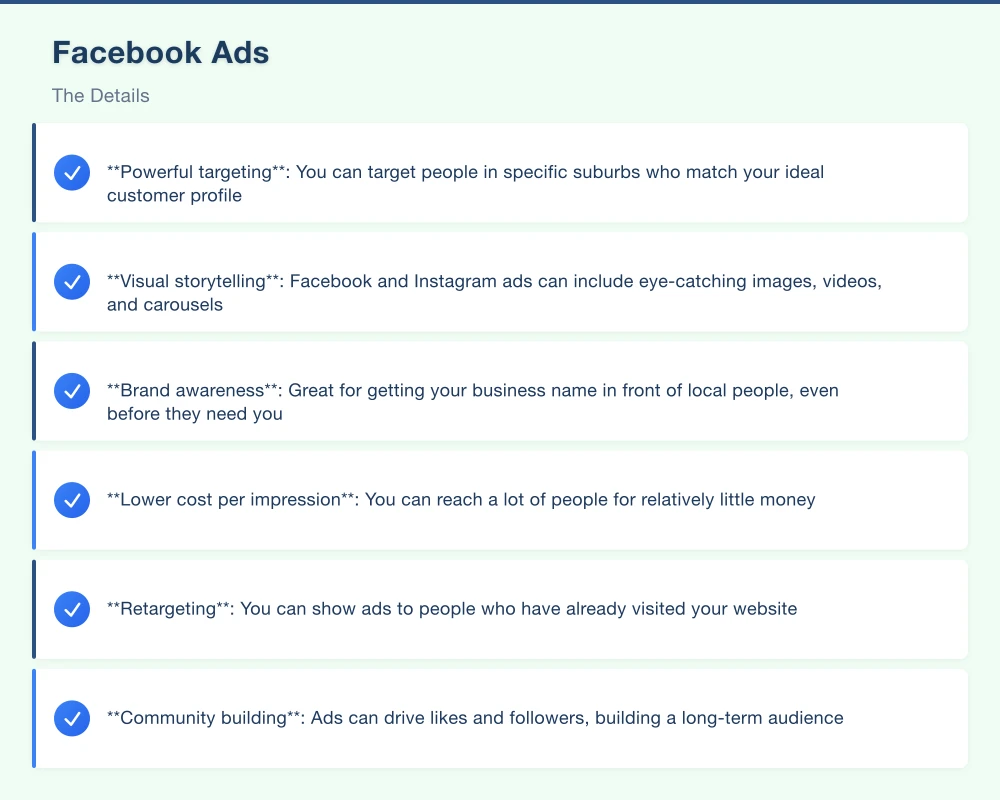
- Powerful targeting: You can target people in specific suburbs who match your ideal customer profile
- Visual storytelling: Facebook and Instagram ads can include eye-catching images, videos, and carousels
- Brand awareness: Great for getting your business name in front of local people, even before they need you
- Lower cost per impression: You can reach a lot of people for relatively little money
- Retargeting: You can show ads to people who have already visited your website
- Community building: Ads can drive likes and followers, building a long-term audience
Typical Costs
Facebook Ads are generally more affordable per click than Google Ads for local businesses. You might pay $0.50 to $3 per click, depending on your targeting and industry.
You can start with as little as $5 to $10 per day, making it accessible even for very small budgets.
Best For
- Businesses selling products people buy on impulse or aspiration (fashion, food, beauty, fitness)
- Businesses wanting to build brand awareness in their local area
- Visually appealing products or services
- Businesses targeting specific demographics (age, interests, life events)
- Event promotion
- Businesses with longer sales cycles where awareness matters
Challenges
- People are not actively looking for your product (lower intent)
- Ad fatigue – people can get tired of seeing the same ads
- Requires compelling creative (images and copy)
- iOS privacy changes are starting to affect tracking and targeting
- Algorithm changes can impact performance
Side-by-Side Comparison
Here is a practical comparison to help you decide:
When someone needs you right now: Google Ads wins. If your business serves people with immediate needs (a broken pipe, a toothache, a locked car), Google Ads captures that intent.
When you need to build awareness: Facebook Ads wins. If people in your area do not know your business exists yet, Facebook Ads can put you in front of thousands of local people affordably.
When you have a visual product or service: Facebook Ads wins. Beautiful food, stunning renovations, stylish clothing – these perform brilliantly on visual platforms.
When you have a small budget: Facebook Ads is generally more affordable to get started with, though Google Ads can deliver faster returns for service businesses.
When you want measurable leads: Both platforms offer strong tracking, but Google Ads often delivers more directly measurable leads for service businesses because of the higher intent.
When you want long-term brand building: Facebook Ads wins. Building a community of followers and keeping your brand top of mind is where Facebook excels.
What About Using Both?
For many local businesses, the best approach is actually using both platforms together. Here is a common strategy:
- Use Google Ads to capture people actively searching for your services. These are your highest-intent leads.
- Use Facebook Ads to build awareness and stay top of mind with your local community. When they eventually need your services, they will think of you first.
- Use Facebook retargeting to show ads to people who visited your website (whether they came from Google Ads, organic search, or anywhere else) but did not convert.
This creates a powerful combination where Google catches people ready to buy and Facebook builds your brand with everyone else.
Getting Started: Practical Tips
If You Choose Google Ads
- Start with a small number of highly relevant keywords
- Use location targeting to focus on Western Sydney or your specific service area
- Write ad copy that includes your location and a clear call to action
- Set up conversion tracking so you know which clicks turn into leads
- Start with a modest budget and increase as you see results
If You Choose Facebook Ads
- Start with a “reach” or “traffic” campaign targeting your local area
- Use high-quality images or short videos
- Write conversational, benefit-focused ad copy
- Target by location first, then layer on relevant interests
- Test different ads to see what resonates with your audience
If You Choose Both
- Allocate your budget based on your goals (more to Google for immediate leads, more to Facebook for awareness)
- Track results from both platforms separately
- Adjust spending based on which platform delivers better returns
Common Mistakes to Avoid
- Not setting clear goals: Know what you want before you spend money. Leads? Brand awareness? Website traffic?
- Targeting too broadly: For a local business, tight geographic targeting is essential. Do not waste money showing ads to people outside your service area.
- Setting and forgetting: Both platforms require regular monitoring and optimisation. Check your campaigns at least weekly.
- No landing page: Sending ad traffic to your homepage instead of a relevant, focused landing page wastes money. Create dedicated pages for your ads.
- Giving up too soon: Advertising takes testing and optimisation. Give campaigns at least two to four weeks before drawing conclusions.
The Bottom Line
There is no universal answer to the Google Ads vs Facebook Ads question. It depends on your business type, your customers, your goals, and your budget.
For most local businesses in Western Sydney, Google Ads delivers faster, more direct results, while Facebook Ads builds longer-term brand awareness. If your budget allows, using both strategically gives you the best of both worlds.
The most important thing is to start somewhere, track your results, and adjust based on what the data tells you. Online advertising is one of the most trackable and adjustable marketing investments you can make.
If you need help setting up or managing your online advertising campaigns, our team works with local businesses across Western Sydney. We can help you figure out the right approach for your specific situation.
Your website’s performance depends on what’s behind it. Cloud Geeks provides the managed hosting, cloud, and IT support that keeps Australian SMBs online and secure.
Ash Ganda covers how Australian SMBs are using AI, automation, and digital strategy to grow without scaling costs proportionally.
If your business is also planning a customer-facing iOS or Android app — Awesome Apps builds cross-platform mobile apps for Australian SMBs.
Part of the Ganda Tech Services family, Cosmos Web Tech delivers specialist web design and digital marketing for Australian small and medium businesses.