LinkedIn Marketing for Australian B2B Small Businesses
If your business sells to other businesses, LinkedIn should be a central part of your marketing strategy. With over 12 million Australian members, LinkedIn is where business decision-makers spend their time online. It is the only major social platform built specifically for professional networking and business relationships.
Yet many small B2B businesses treat LinkedIn as an afterthought – a place to post the occasional company update and forget about. That is a missed opportunity. LinkedIn, when used strategically, can generate leads, build your reputation, and open doors that cold calling never could.
This guide covers how to use LinkedIn effectively as a B2B small business in Australia.
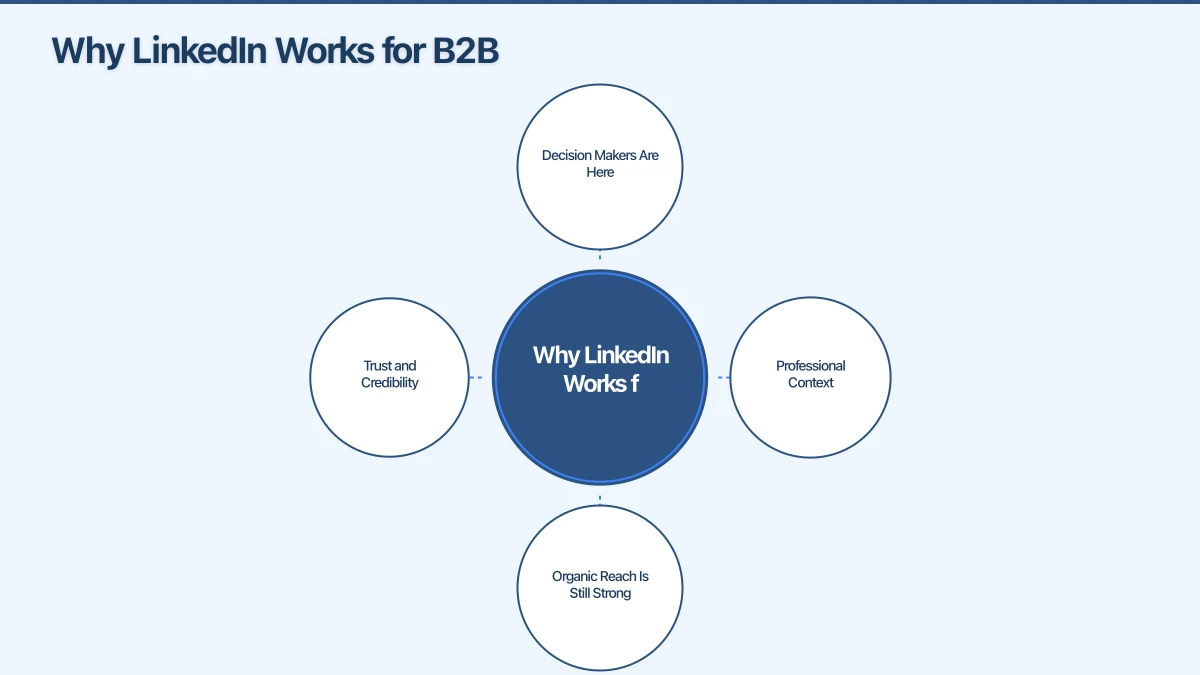
Why LinkedIn Works for B2B
Decision Makers Are Here
LinkedIn’s user base includes business owners, managers, directors, and executives. These are the people who make purchasing decisions. They are not usually scrolling Instagram during business hours, but they are on LinkedIn.
Professional Context
Unlike other social platforms, people are on LinkedIn in a business mindset. They are open to learning about products, services, and solutions that can help their business. Your marketing message is received in the right context.
Organic Reach Is Still Strong
While organic reach on Facebook has declined significantly, LinkedIn still offers strong organic reach. A good post can reach thousands of people without paid promotion.
Trust and Credibility
LinkedIn profiles and company pages provide transparency about who you are, your experience, and your professional background. This builds credibility before a sales conversation even begins.
Optimising Your Company Page
Your LinkedIn Company Page is your business’s profile on the platform. Start by making sure it is complete and professional.
Company Logo and Banner
- Use your logo as the company profile image
- Create a professional banner image that communicates what you do
- Ensure both images are high quality and correctly sized
About Section
Write a clear description of your business that includes:
- What you do and who you help
- Your location and service areas
- Key differentiators
- A call to action
Include relevant keywords naturally. People search for businesses on LinkedIn, and your description affects whether you appear.
Company Details
Fill in all available fields:
- Industry
- Company size
- Headquarters location
- Website URL
- Phone number
- Specialities (up to 20)
Custom Button
LinkedIn lets you add a CTA button to your page. Choose the most relevant option: Visit Website, Contact Us, Learn More, or Sign Up.
Optimising Your Personal Profile
For B2B businesses, your personal profile is often more important than your company page. People connect with people, not logos. If you are the business owner or a key team member, your personal profile is a powerful marketing asset.
Professional Headshot
Use a clear, professional photo. It does not need to be a studio shot, but it should be well-lit, recent, and appropriate. Profiles with photos get significantly more engagement.
Headline
Your headline is the text that appears below your name everywhere on LinkedIn. Do not just use your job title. Use it to communicate what you do and who you help.
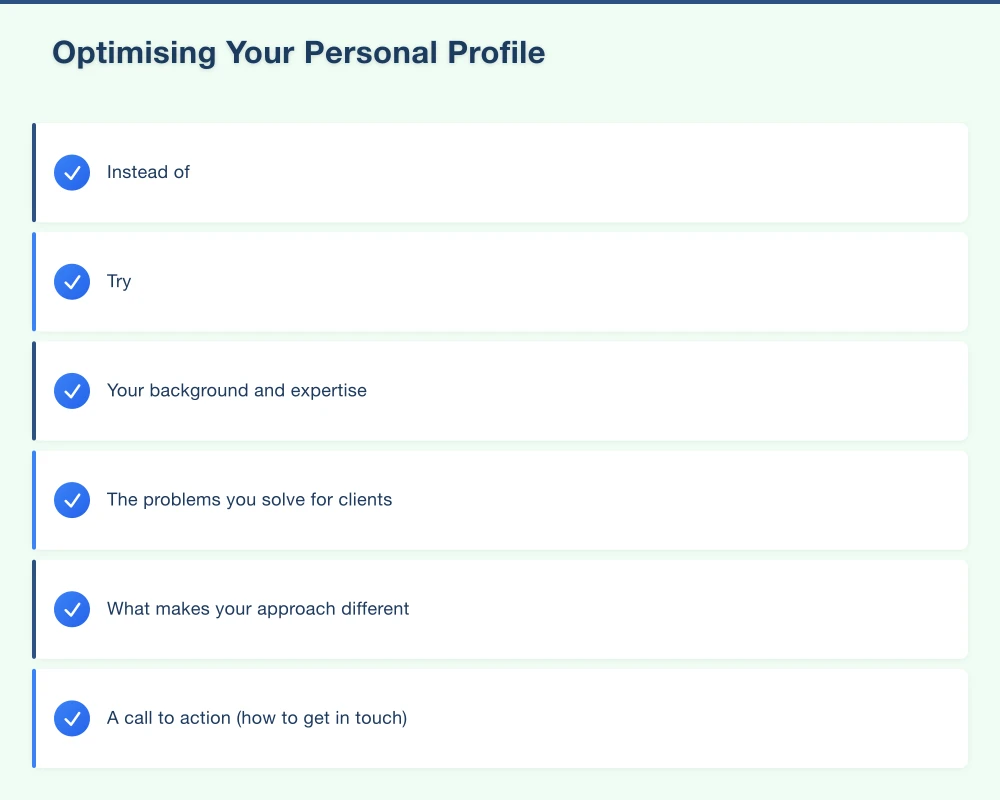
Instead of: “Director at Smith Consulting” Try: “Helping Western Sydney Businesses Grow Through Strategic Marketing | Director at Smith Consulting”
About Section
Write your about section in first person. Tell your story, explain what you do, who you help, and what drives you. Include:
- Your background and expertise
- The problems you solve for clients
- What makes your approach different
- A call to action (how to get in touch)
Experience
Detail your current role and relevant past experience. Include achievements and results where possible.
Skills, Endorsements, and Recommendations
- Add relevant skills to your profile
- Ask clients and colleagues for recommendations
- Endorse others’ skills (they often reciprocate)
Content Strategy for LinkedIn
Content is how you build visibility and authority on LinkedIn. Here is what works for B2B businesses.
Types of Content
Industry insights: Share your perspective on industry trends, news, and developments. What does a recent change mean for your clients?
Tips and how-to content: Practical advice your target audience can use. An IT support company might share cybersecurity tips. A bookkeeper might share end-of-year financial preparation advice.
Case studies and results: Share stories of how you helped a client (with their permission). Focus on the problem, your approach, and the results.
Lessons learned: Share experiences from your business journey. What have you learned? What mistakes taught you the most? Authenticity resonates on LinkedIn.
Behind the scenes: Show your team, your process, your workspace. People want to see the humans behind the business.
Questions and conversations: Ask your network questions. “What is the biggest challenge facing your business heading into 2022?” Posts that invite comments get more engagement.
Company updates: New hires, awards, partnerships, and milestones. Keep these occasional – people follow you for value, not announcements.
Content Format Tips
Text posts: Plain text posts (no link, no image) often get the best organic reach on LinkedIn. Keep them to 1,300 characters or fewer for optimal engagement.
Image posts: Posts with a relevant image or graphic stand out in the feed. Use clear, professional images.
Document posts: LinkedIn lets you upload PDFs that people can swipe through like a carousel. These perform very well for educational content, checklists, and step-by-step guides.
Video: Native video (uploaded directly to LinkedIn, not as a YouTube link) gets good engagement. Keep videos under two minutes.
Articles: LinkedIn’s built-in article feature lets you publish longer-form content directly on the platform. Good for thought leadership pieces.
Posting Frequency
Aim for three to five posts per week. If that is too much, start with two to three and build from there. Consistency matters more than volume.
Best Times to Post
Generally, weekday mornings (7 to 9 AM) and lunch hours (12 to 1 PM) Australian time work well. Tuesday through Thursday tend to get the most engagement. Test different times and see what works for your audience.
Building Your Network
Who to Connect With
- Current and past clients
- Prospects and potential clients
- Industry peers
- Complementary businesses (not direct competitors)
- Local business owners
- People you meet at events and networking functions
How to Connect
Always personalise your connection request. A brief message explaining why you want to connect dramatically increases acceptance rates.
Example: “Hi Sarah, I enjoyed your presentation at the Hills District Business Chamber event last week. Would love to stay connected.”
Engaging With Others
Do not just post your own content. Engage with other people’s posts:
- Like and comment on posts from your connections
- Share valuable content from others with your own commentary
- Join LinkedIn Groups relevant to your industry
- Participate in conversations genuinely
This builds relationships and increases your visibility on the platform.
Lead Generation on LinkedIn
Warm Outreach
LinkedIn is excellent for warm outreach. Instead of cold calling, you can:
- Connect with potential clients
- Engage with their content over time
- Build familiarity and trust
- Reach out when the time is right with a personalised message
This approach is slower but dramatically more effective than cold outreach.
LinkedIn Search
Use LinkedIn’s search to find potential clients. Filter by:
- Location (Sydney, Western Sydney, specific suburbs)
- Industry
- Job title (find decision makers)
- Company size
Content as Lead Generation
Valuable content attracts ideal clients to you. When you consistently share insights relevant to your target audience, they come to you rather than you chasing them.
End posts with a soft call to action: “If you are facing this challenge, happy to chat – send me a message.”
LinkedIn Advertising
LinkedIn offers paid advertising with powerful B2B targeting. You can target by:
- Job title and seniority
- Industry and company size
- Location
- Skills and interests
LinkedIn ads are more expensive per click than Facebook ads, but for B2B businesses, the quality of leads is often much higher. Start with a small budget to test before scaling.
Measuring Your LinkedIn Results
Key Metrics
- Profile views: Are people looking at your profile? This indicates interest.
- Connection growth: Is your network growing with relevant people?
- Post engagement: Likes, comments, shares on your content.
- Website clicks: How much traffic LinkedIn drives to your website.
- Inbound messages: Are people reaching out to you about your services?
- Leads generated: Track how many business conversations start from LinkedIn.
LinkedIn Analytics
Both personal profiles and company pages offer analytics. Review them monthly to understand what content resonates and how your audience is growing.
Common LinkedIn Mistakes for B2B Businesses
- Treating it like Facebook: LinkedIn has a different tone and audience. Keep it professional and valuable.
- Only posting company updates: Self-promotional content gets low engagement. Focus on value.
- Not using personal profiles: For small B2B businesses, the owner’s personal profile is usually more effective than the company page.
- Spamming sales messages: Nothing burns bridges faster than sending a sales pitch as your first message to a new connection.
- Inconsistent activity: Posting once a month and going silent does not build presence. Be consistent.
- Ignoring comments: When someone comments on your post, reply. This boosts engagement and builds relationships.
Your LinkedIn Action Plan
This week:
- Optimise your personal profile (photo, headline, about section)
- Complete or update your company page
- Connect with 20 relevant people
This month: 4. Post three times per week (mix of tips, insights, and stories) 5. Engage with five other people’s posts each day 6. Join two relevant LinkedIn Groups
Ongoing: 7. Maintain your posting schedule 8. Grow your network by 10 to 20 relevant connections per week 9. Track your results monthly and adjust
LinkedIn is a long game, but for B2B businesses, it is one of the most effective marketing channels available. Start building your presence now, and by mid-2022 you will have a network and reputation that generates real business opportunities.
If you need help with your LinkedIn strategy or creating content for your business, our team works with B2B businesses across Western Sydney. Get in touch and let us help you make LinkedIn work for your business.
Your website’s performance depends on what’s behind it. Cloud Geeks provides the managed hosting, cloud, and IT support that keeps Australian SMBs online and secure.
Ash Ganda covers how Australian SMBs are using AI, automation, and digital strategy to grow without scaling costs proportionally.
If your business is also planning a customer-facing iOS or Android app — Awesome Apps builds cross-platform mobile apps for Australian SMBs.
Part of the Ganda Tech Services family, Cosmos Web Tech delivers specialist web design and digital marketing for Australian small and medium businesses.