Introduction
When someone in Parramatta searches for a plumber, restaurant, or dentist, they check the reviews first. Online reviews have become the modern word-of-mouth, and for Western Sydney businesses, they can make or break your local reputation.
This guide covers practical strategies for getting more reviews, responding effectively, and building a review profile that attracts customers.
Why Reviews Matter for Local Business
The Decision Factor
Studies consistently show that online reviews influence purchasing decisions:
- Most consumers read reviews before visiting a local business
- Star ratings are often the first thing people notice
- Businesses with more reviews appear more trustworthy
- Recent reviews matter more than old ones
For a Western Sydney tradie, cafe, or professional service, reviews directly impact whether the phone rings.
Google’s Local Pack
When someone searches “electrician Blacktown” or “best coffee Parramatta,” Google shows a map with three local businesses. Getting into this “local pack” depends significantly on:
- Number of Google reviews
- Average star rating
- Recency of reviews
- Keywords in reviews
More quality reviews means better visibility to local searchers.
Getting More Reviews
Make It Easy
The biggest barrier to reviews is friction. Remove as many obstacles as possible.
Direct Links
Create a direct link to your Google review page:
- Search for your business on Google
- Click “Write a review”
- Copy the URL
- Shorten it (using bit.ly or similar)
Share this link everywhere.
QR Codes
Create a QR code linking to your review page:
- On receipts and invoices
- On business cards
- On table tents (for hospitality)
- On job completion forms
- In email signatures
Follow-Up Messages
After a service or purchase:
- Send a thank you email with review link
- Include SMS follow-up with link
- Time it appropriately (not too soon, not too late)
Ask at the Right Moment
The Happy Customer Window
Ask for reviews when customers are most satisfied:
- Immediately after complimenting your service
- After successfully resolving a problem
- When they’re expressing gratitude
- At project completion
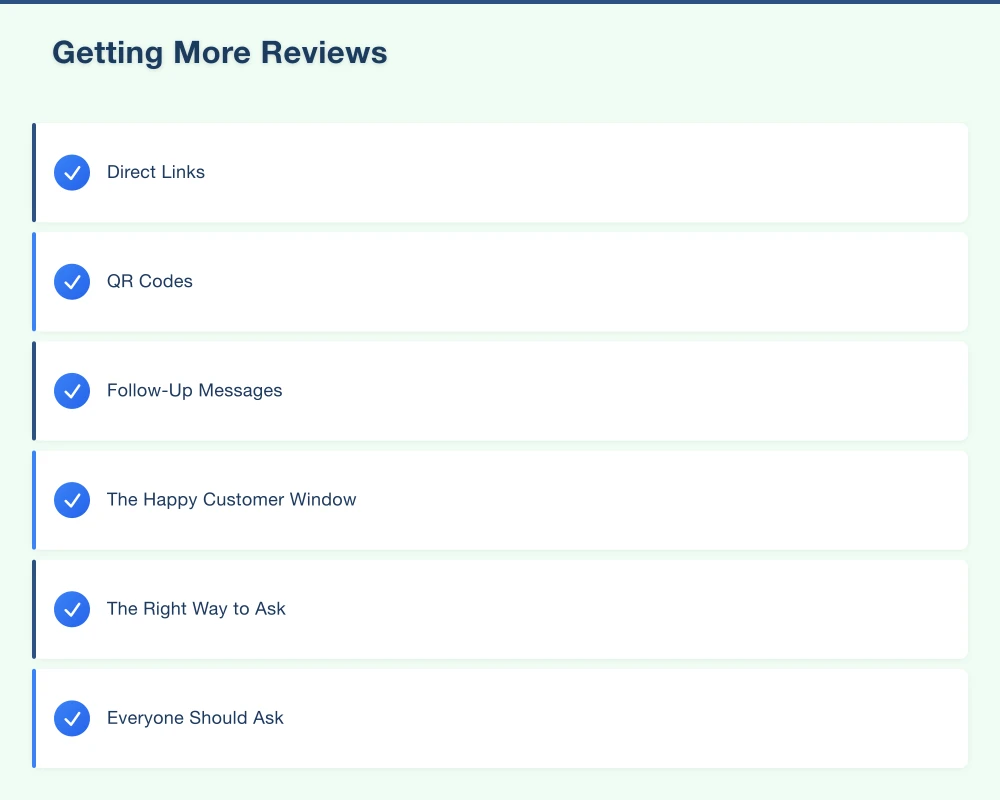
The Right Way to Ask
Keep it natural and personal:
“We’re really glad you’re happy with the work. Would you mind sharing that experience on Google? It really helps other people find us.”
Train Your Team
Everyone Should Ask
Every customer-facing team member should know:
- How to recognise happy customers
- How to ask comfortably
- What link or QR code to share
- When to escalate unhappy situations instead
Make It Part of Process
Build review requests into your workflows:
- Part of job completion checklist
- Included in payment confirmation
- Added to automated follow-up sequences
Which Platforms Matter
Google Business Profile
Most important for local businesses. This is where most local searches happen.
Still relevant, especially for:
- Hospitality businesses
- Event-based businesses
- Businesses with strong social presence
Industry-Specific
Consider platforms relevant to your industry:
- TripAdvisor for hospitality and tourism
- Hipages for tradies
- Productreview.com.au for products
- HealthEngine for medical practices
Don’t Spread Too Thin
Focus on one or two platforms rather than trying to build presence everywhere. Google should be your priority.
Responding to Reviews
Why Responses Matter
Responding to reviews shows:
- You care about customer feedback
- You’re actively engaged with your business
- You value customer relationships
Google also considers owner responses as a ranking signal.
Responding to Positive Reviews
Always Respond
Even a simple thank you matters. Make it personal:
Generic (avoid): “Thanks for the review!”
Better: “Thanks so much for the kind words, Sarah! We’re glad the new fence turned out exactly how you wanted. Enjoy your backyard!”
Include Keywords Naturally
Reviews and responses can help with search rankings:
“Thank you for trusting us with your bathroom renovation in Penrith! We loved working on this project.”
Responding to Negative Reviews
Stay Professional
Negative reviews test your professionalism. Never:
- Get defensive or aggressive
- Argue publicly
- Reveal private customer information
- Ignore legitimate complaints
The Response Formula
- Acknowledge - Thank them for the feedback
- Apologise - Even if you disagree, apologise for their experience
- Take it offline - Offer to resolve privately
- Follow up - Actually reach out to resolve
Example Response
“Hi Michael, thank you for taking the time to share your experience. We’re sorry the delivery didn’t meet your expectations–that’s not the standard we aim for. We’d like to make this right. Please contact us at [email] or call [number] so we can discuss how to resolve this for you.”
When Reviews Are Unfair
Fake or Mistaken Reviews
Sometimes you receive reviews that are:
- For the wrong business
- From people who never used your service
- Obviously fake
What to Do
- Respond professionally explaining the situation
- Flag the review through Google’s reporting tool
- Gather evidence if needed
- Follow up with Google support
Getting reviews removed is difficult. Focus on building enough positive reviews that occasional unfair ones don’t significantly impact your rating.
Handling Common Situations
The Angry Customer
Before They Review
Catch problems before they become public:
- Clear communication throughout service
- Check in during projects
- Ask if everything’s okay at completion
- Have a complaint process
If They’ve Already Reviewed
- Respond promptly and professionally
- Take the conversation offline
- Try to resolve the underlying issue
- Ask (don’t demand) if they’d update the review
Review Requests That Feel Awkward
Normalise the Ask
Make it routine, not special:
“We send this to everyone–if you have a minute, we’d really appreciate a quick review.”
Offer Alternatives
If someone seems hesitant:
“No pressure at all. If you’d rather just tell us directly how we can improve, we’d value that too.”
When Business Is Slow
Leverage Existing Customers
Reach out to past satisfied customers:
“Hi [Name], hope you’re well! We’re focusing on growing our online presence. If you were happy with our service, we’d really appreciate a Google review. Here’s the link: [URL]”
Don’t Buy Reviews
Never pay for fake reviews. Google can detect patterns and penalties are severe–including removal from search results entirely.
Building a Review Strategy
Regular Monitoring
Check Weekly
Set a weekly reminder to:
- Review new feedback across platforms
- Respond to any reviews
- Note any trends or recurring issues
- Update your team
Use Tools
Google Business Profile has built-in notifications. Third-party tools can aggregate reviews across platforms if you’re active on multiple sites.
Tracking Progress
Metrics to Watch
- Total review count
- Average star rating
- Review frequency (how often new reviews appear)
- Response rate
- Sentiment trends
Set Goals
Realistic targets for a local business:
- One new review per week
- Respond to all reviews within 48 hours
- Maintain 4.5+ star average
- Address all negative reviews promptly
Using Reviews for Improvement
Pattern Recognition
Reviews reveal what matters to customers:
- Frequently praised aspects (keep doing these)
- Repeated complaints (fix these)
- Service gaps (opportunity areas)
- Staff mentions (recognise or coach)
Close the Loop
When you make changes based on feedback:
- Thank customers who suggested improvements
- Announce improvements (shows you listen)
- Monitor if issues persist
Legal and Ethical Considerations
What’s Not Okay
- Incentivising reviews with discounts (violates platform terms)
- Fake reviews from staff or friends
- Review exchanges with other businesses
- Deleting or hiding negative feedback
- Pressuring customers
What’s Fine
- Asking customers for honest reviews
- Making the review process easy
- Responding to all reviews
- Sharing positive reviews on your website
- Using reviews for internal improvement
Conclusion
Online reviews are ongoing reputation management, not a set-and-forget task. For Western Sydney businesses competing locally, a strong review profile provides a genuine competitive advantage.
Start by making reviews easy to leave, ask at the right moments, and respond to every piece of feedback. Over time, you’ll build a review profile that attracts new customers and builds trust before they ever contact you.
The businesses that take reviews seriously are the ones that appear at the top of local searches. Don’t leave your reputation to chance.
Your website’s performance depends on what’s behind it. Cloud Geeks provides the managed hosting, cloud, and IT support that keeps Australian SMBs online and secure.
Ash Ganda covers how Australian SMBs are using AI, automation, and digital strategy to grow without scaling costs proportionally.
If your business is also planning a customer-facing iOS or Android app — Awesome Apps builds cross-platform mobile apps for Australian SMBs.
Part of the Ganda Tech Services family, Cosmos Web Tech delivers specialist web design and digital marketing for Australian small and medium businesses.