Planning Your 2022 Digital Marketing Budget
As the year winds down, smart business owners are already planning their marketing strategy and budget for 2022. If you are a small business owner who has been approaching marketing on an ad-hoc basis – spending money here and there without a clear plan – the new year is the perfect time to get strategic.
A well-planned marketing budget does not have to be large. It has to be intentional. Even modest budgets deliver strong results when they are directed at the right activities.
Here is how to plan a practical digital marketing budget for your Australian small business in 2022.
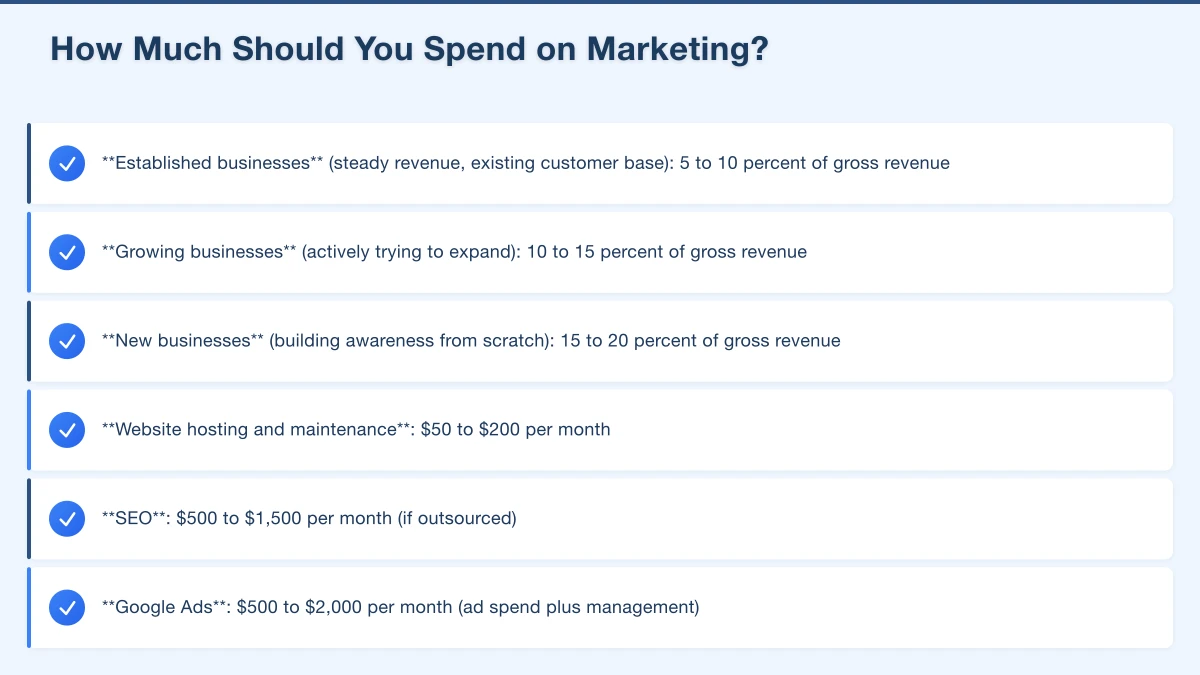
How Much Should You Spend on Marketing?
This is the first question most business owners ask, and the honest answer is: it depends. But here are some widely-used benchmarks.
General Guidelines
- Established businesses (steady revenue, existing customer base): 5 to 10 percent of gross revenue
- Growing businesses (actively trying to expand): 10 to 15 percent of gross revenue
- New businesses (building awareness from scratch): 15 to 20 percent of gross revenue
These are guidelines, not rules. A business with $500,000 in annual revenue spending 10 percent would have a $50,000 annual marketing budget, or roughly $4,000 per month. That is a reasonable budget for a comprehensive digital marketing strategy.
Minimum Effective Spend
If percentages feel abstract, here are minimum monthly amounts needed to make meaningful progress with different marketing activities:
- Website hosting and maintenance: $50 to $200 per month
- SEO: $500 to $1,500 per month (if outsourced)
- Google Ads: $500 to $2,000 per month (ad spend plus management)
- Social media management: $500 to $1,500 per month (if outsourced)
- Content creation: $300 to $1,000 per month
- Email marketing: $20 to $100 per month (platform costs)
You do not need to do all of these at once. Prioritise based on your goals and budget.
Step 1: Review Your 2021 Results
Before planning 2022, understand what worked this year.
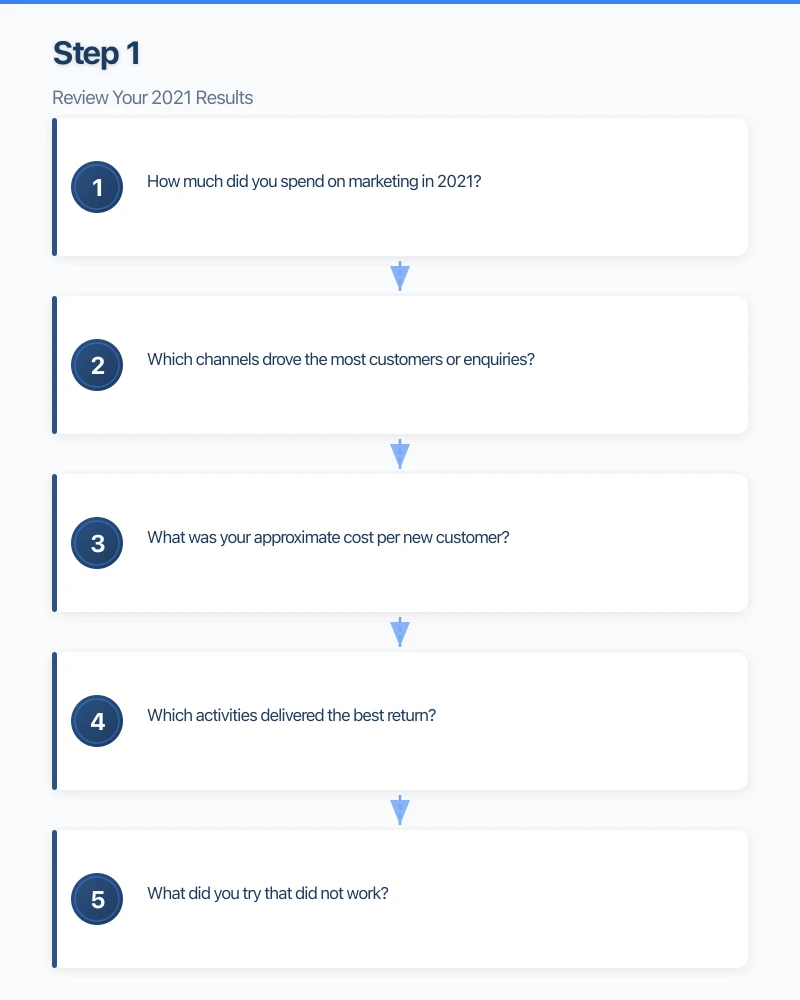
Questions to Answer
- How much did you spend on marketing in 2021?
- Which channels drove the most customers or enquiries?
- What was your approximate cost per new customer?
- Which activities delivered the best return?
- What did you try that did not work?
Use your Google Analytics, ad platform data, and sales records to answer these questions. If you do not have this data, that is a sign that tracking should be a priority in 2022.
Keep What Works
If Google Ads consistently delivers profitable leads, keep investing there. If your blog generates steady organic traffic, maintain your content schedule. Do not fix what is not broken.
Cut or Adjust What Does Not
If you spent money on a platform or strategy that delivered poor results, either improve the approach or redirect that budget elsewhere.
Step 2: Set Clear Marketing Goals
Your budget should be driven by your goals, not the other way around.
Common Goals for Small Businesses
- Generate leads: A specific number of enquiries or quotes per month
- Increase website traffic: A target percentage increase in monthly visitors
- Build brand awareness: Reach a certain number of people in your local area
- Grow your email list: A target number of new subscribers
- Increase revenue: A specific revenue target from online channels
- Improve conversion rate: Turn more website visitors into customers
Make your goals specific and measurable. “Get more customers” is not a goal. “Generate 20 qualified leads per month through our website” is a goal you can plan for and measure.
Step 3: Choose Your Marketing Channels
Based on your goals and budget, choose the channels that will be most effective for your business.
Website (Foundation)
Your website is the hub of all your digital marketing. Budget for:
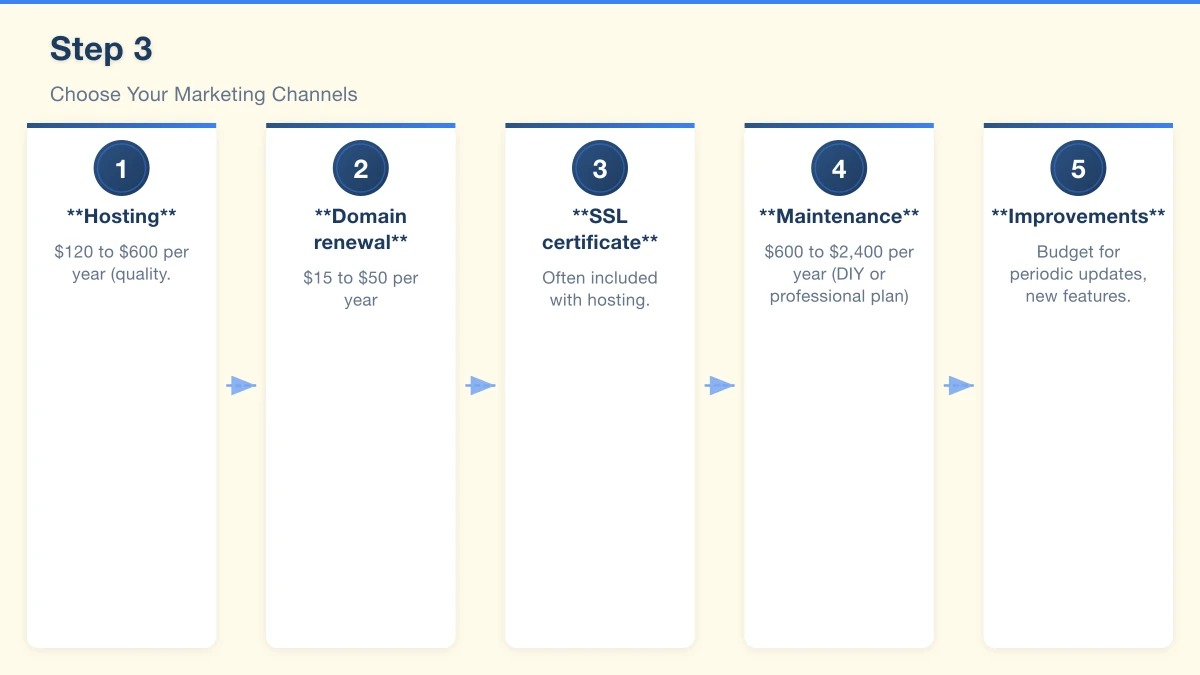
- Hosting: $120 to $600 per year (quality Australian hosting)
- Domain renewal: $15 to $50 per year
- SSL certificate: Often included with hosting, otherwise $50 to $200 per year
- Maintenance: $600 to $2,400 per year (DIY or professional plan)
- Improvements: Budget for periodic updates, new features, or design refreshes
If your website is outdated, a redesign might be the best investment you make in 2022. A new website typically costs $3,000 to $15,000 depending on complexity.
SEO (Long-Term Growth)
SEO builds sustainable traffic over time. Budget for:
- Professional SEO services: $500 to $2,000 per month
- DIY approach: Your time plus tools ($50 to $100 per month for premium tools like Ahrefs or SEMrush, though free tools like Google Search Console cover the basics)
SEO is a long-term investment. Expect to see meaningful results within three to six months of consistent effort.
Content Marketing (Authority and SEO)
Content marketing supports your SEO and positions you as an expert. Budget for:
- Blog writing: $150 to $500 per post (if outsourced) or your time (if written in-house)
- Aim for two to four posts per month
- Content planning and strategy: Factor in time for keyword research and topic planning
Google Ads (Immediate Leads)
Google Ads delivers immediate visibility and leads. Budget for:
- Ad spend: $500 to $3,000 per month depending on your industry and competition
- Management: $300 to $800 per month if using an agency, or your time if self-managed
- Landing page creation: $500 to $2,000 per page (one-time cost)
Google Ads works best with dedicated landing pages, not just your homepage.
Social Media (Brand Awareness and Engagement)
Social media marketing builds awareness and relationships. Budget for:
- Content creation: $300 to $1,000 per month (design, photography, copywriting)
- Social media management: $500 to $1,500 per month if outsourced
- Paid social advertising: $300 to $1,500 per month in ad spend
- Tools: $0 to $50 per month for scheduling tools
Email Marketing (Customer Retention)
Email marketing nurtures leads and retains customers. Budget for:
- Email platform: $0 to $100 per month (depending on list size and features)
- Content creation: Time for writing regular newsletters
- Design: Templates can be created once and reused
Google My Business (Local Visibility)
GMB is free to use but requires time to maintain. Budget for:
- Photography: $200 to $500 for professional photos (one-time)
- Time: Regular updates, review responses, and posts
Step 4: Allocate Your Budget
Here are three sample budget allocations for different business sizes and goals.
Small Budget ($500 to $1,000 per month)
Focus on the highest-impact free and low-cost activities:
- Website maintenance: $50 to $100
- Google My Business optimisation: Your time
- Content creation (blog): $150 to $300 (two posts per month, or DIY)
- Social media: Your time plus $50 for occasional boosted posts
- Email marketing: $20 to $50 (platform cost)
- Google Ads: $200 to $500 in ad spend
Medium Budget ($1,500 to $3,000 per month)
Invest in professional help for key activities:
- Website maintenance: $100 to $200
- SEO services: $500 to $1,000
- Content creation: $300 to $500 (two to four posts per month)
- Google Ads: $500 to $1,000 in ad spend plus management
- Social media management and ads: $300 to $500
- Email marketing: $50 to $100
Larger Budget ($3,000 to $5,000 per month)
Comprehensive marketing across multiple channels:
- Website maintenance and improvements: $200 to $400
- SEO services: $1,000 to $1,500
- Content creation: $500 to $800
- Google Ads: $1,000 to $1,500 in ad spend plus management
- Social media management and ads: $500 to $1,000
- Email marketing: $50 to $100
- Video content creation: $200 to $500
Step 5: Plan Your Calendar
Map your budget to a monthly calendar. Some activities are consistent (SEO, content), while others might be seasonal (holiday promotions, event marketing).
Monthly Fixed Costs
- Hosting, tools, and platform subscriptions
- SEO retainer (if using an agency)
- Social media management (if outsourced)
Variable and Seasonal Costs
- Increased ad spend during peak seasons
- Special promotions (Black Friday, Christmas, Easter)
- One-off projects (website redesign, new landing pages, photography)
Quarterly Review Points
Schedule quarterly reviews to assess performance and adjust your budget allocation. If Google Ads is delivering strong results but social media is not, shift budget accordingly.
Step 6: Track Your Return on Investment
The most important part of any marketing budget is knowing whether it is working.
Set Up Tracking
- Google Analytics goals for website conversions
- Call tracking for phone enquiries (if feasible)
- UTM parameters for campaign tracking
- CRM or spreadsheet to track leads and their sources
Calculate Your Cost Per Lead
Divide your marketing spend by the number of leads generated. This tells you how much you are paying for each new enquiry. Compare across channels to see which are most cost-effective.
Calculate Your Customer Acquisition Cost
Divide your marketing spend by the number of new customers acquired. This tells you the true cost of winning a new customer.
Review Monthly
Check your metrics monthly and adjust. Marketing is not a set-and-forget activity. The businesses that review, learn, and adjust consistently outperform those that set a plan and never revisit it.
Common Budgeting Mistakes
- No budget at all: Ad-hoc spending without a plan wastes money. Even a simple budget brings discipline.
- All eggs in one basket: Relying entirely on one channel is risky. Diversify.
- Expecting instant results: Some channels (especially SEO and content marketing) take months to deliver. Be patient.
- Not tracking results: If you cannot measure it, you cannot improve it.
- Cutting marketing first: When times are tough, marketing is often the first budget to be cut. But reducing your visibility when you need customers most is counterproductive.
- Ignoring your website: Spending thousands on ads that send people to a poor website wastes your ad budget.
Take Action This Month
- Review your 2021 marketing spending and results
- Set two to three clear marketing goals for 2022
- Choose your priority channels based on goals and budget
- Create your 2022 marketing budget spreadsheet
- Plan your January and February activities in detail
A thoughtful marketing budget transforms your marketing from random activity into strategic investment. You do not need a large budget to make a significant impact – you need a focused one.
If you want help planning your 2022 digital marketing strategy and budget, our Western Sydney team works with small businesses to create practical, results-driven marketing plans. Get in touch and let us help you make the most of your marketing investment next year.
Your website’s performance depends on what’s behind it. Cloud Geeks provides the managed hosting, cloud, and IT support that keeps Australian SMBs online and secure.
Ash Ganda covers how Australian SMBs are using AI, automation, and digital strategy to grow without scaling costs proportionally.
Part of the Ganda Tech Services family, Cosmos Web Tech delivers specialist web design and digital marketing for Australian small and medium businesses.