Setting Marketing Goals for Your Business in 2023
The end of the year is the perfect time to step back, review what worked in 2022, and set clear marketing goals for the year ahead. Without defined goals, marketing becomes reactive. You end up chasing whatever trend appears, spending money without a clear purpose, and struggling to measure whether your efforts are working.
Let us walk through a practical process for setting marketing goals that will actually drive your business forward in 2023.
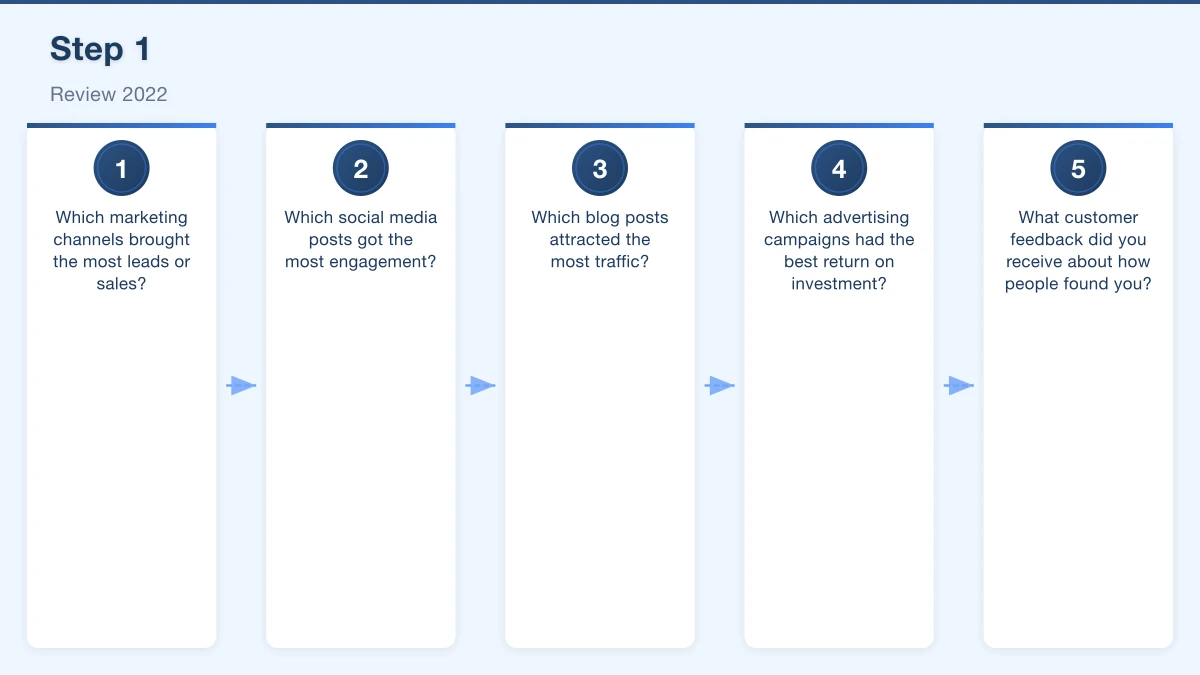
Step 1: Review 2022
Before you plan ahead, look back. An honest review of this year helps you make smarter decisions for the next one.
What Worked?
Look at the data:
- Which marketing channels brought the most leads or sales?
- Which social media posts got the most engagement?
- Which blog posts attracted the most traffic?
- Which advertising campaigns had the best return on investment?
- What customer feedback did you receive about how people found you?
Double down on what is working. If Google Ads brought in your most profitable leads, consider increasing your ad spend. If your blog attracted consistent search traffic, commit to more regular publishing.
What Did Not Work?
Be honest about what underperformed:
- Were there campaigns or channels that consumed time and money without results?
- Did you start initiatives that fizzled out?
- Were there areas you neglected that could have performed better?
Let go of what is not working. Not every channel or tactic is right for every business.
What Changed?
Consider external changes that affected your marketing:
- Did your industry or competitive landscape shift?
- Did your customer base change?
- Were there algorithm changes or platform updates that impacted your results?
- Did your business add new services or enter new markets?
Step 2: Define Your Business Goals
Marketing goals should support your broader business objectives. Before setting marketing goals, get clear on what your business needs to achieve in 2023:
- Increase revenue by a specific percentage?
- Enter a new market or suburb?
- Launch a new product or service?
- Build brand awareness in your local area?
- Reduce your dependence on a single channel (like referrals)?
Your marketing goals should directly connect to these business objectives. If your business goal is to increase revenue by 20 percent, your marketing goals should outline how marketing will contribute to that growth.
Step 3: Set SMART Marketing Goals
Good marketing goals are SMART: Specific, Measurable, Achievable, Relevant, and Time-bound.
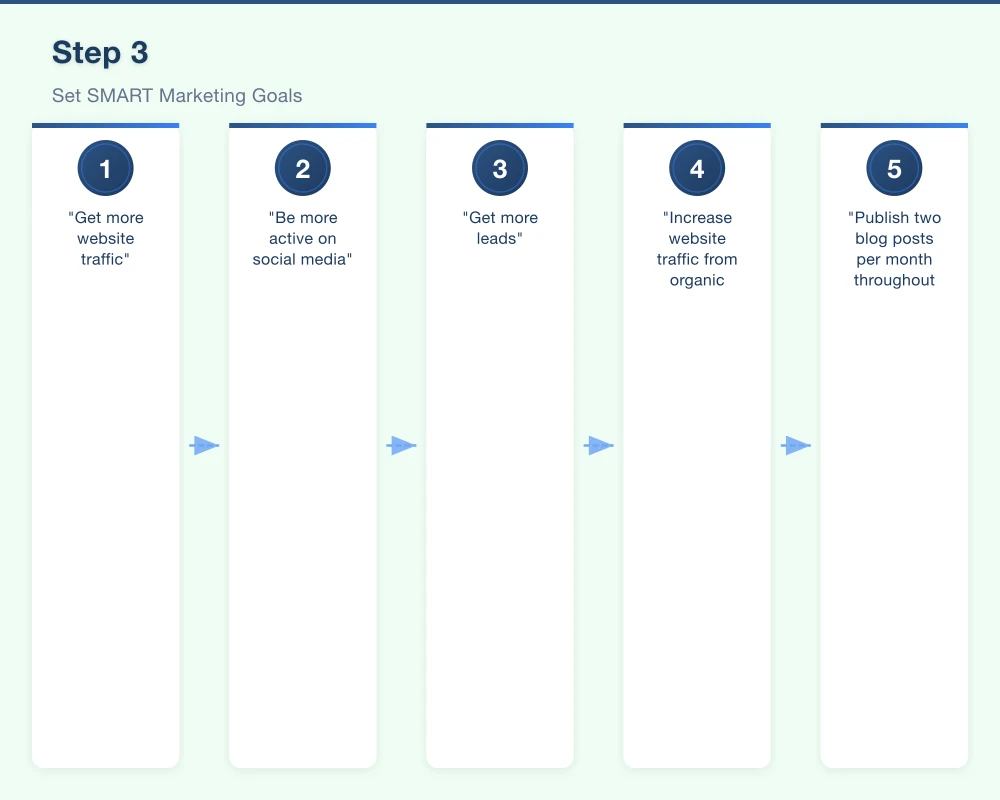
Examples of Poor Goals
- “Get more website traffic”
- “Be more active on social media”
- “Get more leads”
These are too vague to act on or measure.
Examples of SMART Goals
- “Increase website traffic from organic search by 30 percent by June 2023, measured through Google Analytics”
- “Publish two blog posts per month throughout 2023”
- “Generate 15 leads per month from Google Ads by March 2023, with a cost per lead under $50”
- “Grow our email list from 200 to 500 subscribers by December 2023”
- “Achieve a 4.5-star average Google review rating with at least 50 total reviews by June 2023”
- “Post four times per week on Instagram, including two Reels, throughout 2023”
Each of these goals is specific (you know exactly what to do), measurable (you can track progress), achievable (realistic for a small business), relevant (connected to business growth), and time-bound (has a deadline).
Step 4: Choose Your Key Channels
You cannot do everything well. Choose the marketing channels that are most likely to deliver results for your business and focus your effort there.
For most local businesses in Western Sydney, the highest-impact channels are:
Must-Haves
- Google Business Profile: Essential for local visibility. Maintain it actively with updates, photos, and review responses.
- Website with SEO: Your website is your digital shopfront. Invest in content and on-page SEO.
- Google reviews: A strong review profile influences local rankings and customer decisions.
High-Impact Options (Choose Two or Three)
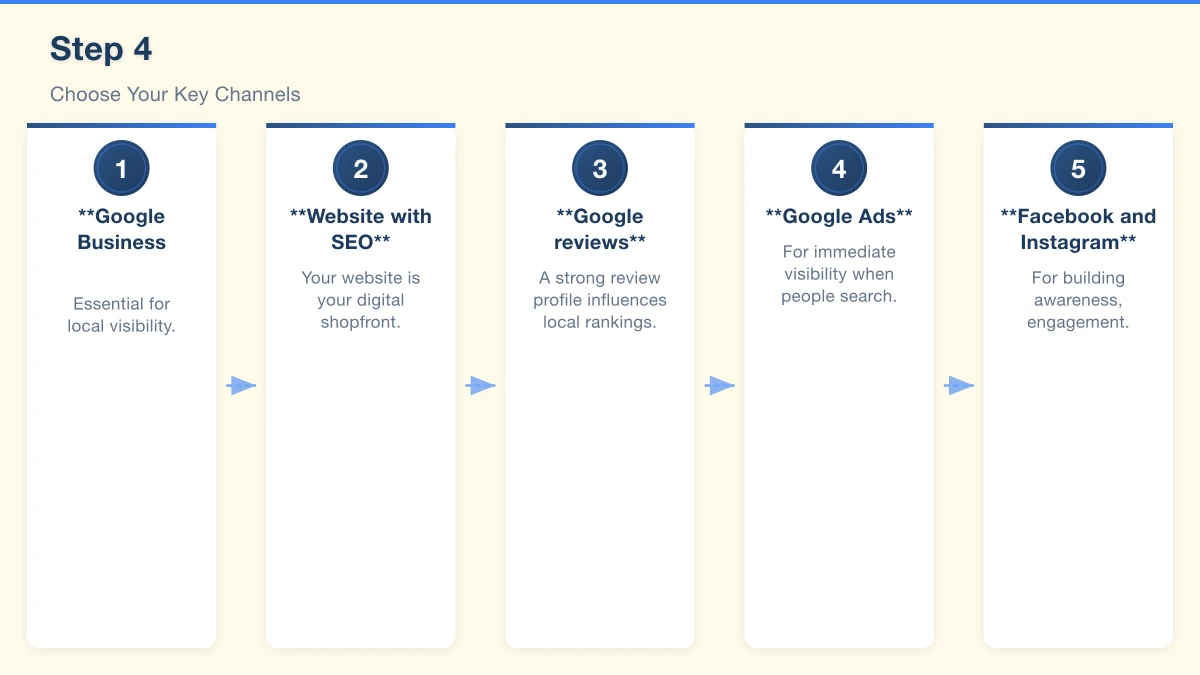
- Google Ads: For immediate visibility when people search for your services
- Facebook and Instagram: For building awareness, engagement, and running targeted local ads
- Email marketing: For nurturing relationships with existing leads and customers
- Content marketing (blogging): For attracting search traffic and demonstrating expertise
Consider Adding
- Instagram Reels or TikTok: For reaching new local audiences through short-form video
- LinkedIn: For B2B businesses or professional services
- Pinterest: For product-based businesses with visual appeal
Choose based on where your customers are, what you can realistically maintain, and what has worked in the past.
Step 5: Set a Marketing Budget
Your marketing budget should reflect your goals. A common guideline for small businesses is to allocate 5 to 10 percent of revenue to marketing. If your business generates $500,000 per year, that is $25,000 to $50,000 for marketing.
Break your budget down by channel:
- Website maintenance and improvement: Ongoing costs for hosting, updates, and enhancements
- Advertising: Google Ads, Facebook Ads budget
- Content creation: Blog writing, photography, video production
- Tools and software: Email marketing platform, social media scheduling tools, analytics tools
- Professional services: Web design, SEO, marketing consulting
If your budget is limited, focus spending on the channels with the highest return. For most local businesses, Google Ads and website SEO tend to deliver the best direct return on investment.
Step 6: Create an Action Plan
Turn your goals into monthly actions. For example:
January
- Set up Google Analytics 4 if not done already
- Review and update Google Business Profile
- Plan blog content calendar for Q1
- Set up email marketing platform and create first sign-up form
February
- Launch or optimise Google Ads campaign
- Publish first two blog posts
- Begin regular social media posting schedule
- Send first email newsletter
March
- Review Q1 results and adjust
- Start Instagram Reels content
- Implement review generation process
- Optimise Google Ads based on first month of data
Continue planning quarterly, with monthly check-ins to review progress and make adjustments.
Step 7: Track and Measure
You cannot improve what you do not measure. Set up tracking for each of your goals:
- Website traffic: Google Analytics (set up GA4 now)
- Search rankings: Google Search Console
- Google Ads performance: Google Ads dashboard
- Social media metrics: Platform analytics (Facebook Insights, Instagram Insights)
- Email marketing: Open rates, click rates, subscriber growth
- Reviews: Monthly count and average rating
- Leads and sales: Your CRM or a simple spreadsheet
Review your metrics at least monthly. A quick 30-minute review each month keeps you on track and helps you spot issues early.
Step 8: Stay Flexible
Your plan should be a guide, not a prison. Things will change throughout 2023. New opportunities will arise, some tactics will not work as expected, and external factors will shift.
Review your goals quarterly and adjust as needed. The businesses that succeed with marketing are not the ones with perfect plans. They are the ones that plan, execute, measure, and adapt.
Common Goal-Setting Mistakes
Setting too many goals. Focus on three to five key marketing goals. Too many goals spread your attention too thin.
Not connecting marketing goals to business outcomes. “Get 1,000 Instagram followers” is not useful unless it connects to business results like leads or sales.
Being unrealistic. If you have never blogged, committing to four posts per week is unrealistic. Start with what you can actually maintain.
Not reviewing progress. Setting goals and forgetting about them is the same as not setting them at all. Schedule regular reviews.
Ignoring what the data says. If something is not working after a reasonable trial period, change your approach. Do not keep doing something just because it is in the plan.
Start Planning Now
Take an hour this week to review your 2022 marketing results and draft your goals for 2023. Write them down, share them with your team, and break them into monthly actions. A clear plan gives you direction and purpose in your marketing efforts.
If you would like help developing your 2023 marketing strategy, Cosmo Web Tech partners with Western Sydney businesses to create practical, results-focused marketing plans. Contact us to start planning for a successful year ahead.
Your website’s performance depends on what’s behind it. Cloud Geeks provides the managed hosting, cloud, and IT support that keeps Australian SMBs online and secure.
Ash Ganda covers how Australian SMBs are using AI, automation, and digital strategy to grow without scaling costs proportionally.
If your business is also planning a customer-facing iOS or Android app — Awesome Apps builds cross-platform mobile apps for Australian SMBs.
Part of the Ganda Tech Services family, Cosmos Web Tech delivers specialist web design and digital marketing for Australian small and medium businesses.