Introduction
When a potential customer lands on your website, they’re asking themselves a simple question: “Can I trust this business?” Social proof–evidence that others have trusted you and been satisfied–is your most powerful tool for answering that question.
For local businesses across Western Sydney, social proof can be the difference between a website visitor becoming a customer or clicking away to a competitor. Yet many small business websites barely use it, or use it poorly.
What Is Social Proof?
The Psychology Behind It
Social proof is a psychological phenomenon where people look to others’ actions to determine their own. We assume that if many people do something, it must be the right thing to do.
In business terms: if other customers have used your services and been happy, new customers feel safer choosing you.
This isn’t manipulation–it’s how humans naturally make decisions, especially when they lack complete information (which is almost always).
Types of Social Proof
Customer Testimonials: Direct quotes from satisfied customers.
Reviews: Third-party reviews on Google, Facebook, and industry platforms.
Case Studies: Detailed stories of customer success.
Numbers: Statistics showing volume (customers served, years in business, projects completed).
Credentials: Industry certifications, awards, memberships.
Media Mentions: Press coverage, features, interviews.
Social Following: Size and engagement of social media audience.
Client Logos: Recognisable brands you’ve worked with.
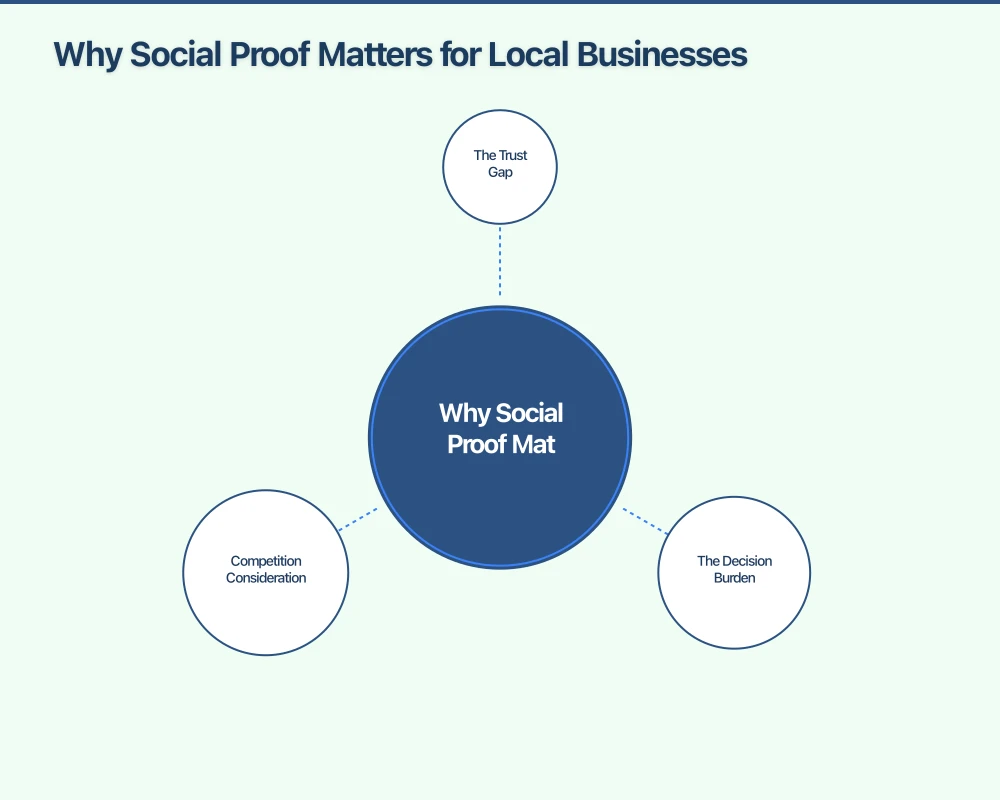
Why Social Proof Matters for Local Businesses
The Trust Gap
Local businesses face a fundamental challenge: potential customers often haven’t heard of them. Unlike national brands with marketing budgets and brand recognition, a Parramatta plumber or Hills District accountant needs to build trust from scratch with each website visitor.
Social proof bridges this gap efficiently.
The Decision Burden
Choosing a local service provider involves risk. Will they do good work? Are they reliable? Will they rip me off? These concerns are real, and every piece of social proof helps reduce them.
Competition Consideration
If a customer is comparing two similar businesses and one has strong social proof while the other has none, the choice becomes easy.
Implementing Testimonials Effectively
Getting Good Testimonials
The biggest challenge is collecting testimonials. Here’s what works:
Ask at the Right Time Request testimonials when customers are happiest–right after successful project completion or when they express satisfaction.
Make It Easy Provide specific questions to answer:
- What problem were you trying to solve?
- Why did you choose us?
- What was the result?
- Would you recommend us?
Offer to Write a Draft Many happy customers don’t write testimonials because they don’t know what to say. Offer to draft something based on their feedback for them to approve.
Follow Up People are busy. A polite follow-up reminder often gets results when the initial request didn’t.
Displaying Testimonials
Location Matters Place testimonials where decisions happen:
- Homepage (general trust building)
- Service pages (relevant to that service)
- Contact/quote pages (overcome final hesitation)
- About page (credibility support)
Include Key Details A testimonial with a name, suburb, and photo is far more credible than an anonymous quote. If appropriate, include:
- Full name
- Suburb or area
- Photo
- Service used
- Date (recent testimonials are more valuable)
Video Testimonials Video testimonials are particularly powerful. A 30-second clip of a real customer speaking about their experience beats a page of written quotes. Most smartphones can capture adequate quality.
What Makes a Good Testimonial
Specific Results “Great service” is weak. “Fixed our blocked drain within two hours on a Sunday, and charged exactly what they quoted” is strong.
Addresses Concerns The best testimonials address the worries potential customers have. A testimonial mentioning fair pricing addresses price concerns. One mentioning punctuality addresses reliability concerns.
Relatable Customers A testimonial from a customer similar to your target audience is most effective. A Hills District mum praising a local kids’ activity business speaks to other Hills District mums.
Leveraging Reviews
Google Reviews
For local businesses, Google reviews are the most important. They appear in search results and Maps, often before someone even visits your website.
Building Reviews
- Ask happy customers directly
- Send follow-up emails with review links
- Include review requests on invoices/receipts
- Make the review link easily accessible
Responding to Reviews Always respond to reviews–positive and negative. This shows you’re engaged and care about customer experience.
Negative reviews, handled well, can actually build trust. A professional, helpful response to criticism shows character.
Displaying Reviews on Your Site Embed Google reviews on your website using plugins or widgets. Real-time feeds from Google add authenticity that self-posted testimonials lack.
Facebook Reviews/Recommendations
If your audience uses Facebook, these matter too. Many local customers check Facebook pages before engaging a business.
Industry-Specific Platforms
Depending on your industry:
- Trades: HiPages, Service Seeking
- Hospitality: TripAdvisor, Zomato
- Healthcare: HealthEngine, HotDoc
- Professional services: Industry directories
Using Numbers as Social Proof
Statistics That Impress
Numbers create instant credibility:
- “Serving Western Sydney for 15 years”
- “Over 2,000 happy customers”
- “500+ five-star reviews”
- “98% customer satisfaction rate”
Making Numbers Believable
Round numbers can seem invented. “Over 2,100 happy customers” feels more real than “Over 2,000 happy customers.”
Be honest–inflated numbers can backfire if customers sense exaggeration.
Where to Display Numbers
- Homepage hero area
- About page
- Service pages
- Trust badges in header or footer
Trust Badges and Credentials
Industry Certifications
Display relevant certifications prominently:
- Trades: Licensed, insured, certified
- Professional services: Industry memberships, qualifications
- Retail: Authorised dealer, official partner
Security and Payment Badges
For e-commerce or businesses taking online payments:
- SSL security badges
- Payment provider logos (Visa, Mastercard, PayPal)
- Money-back guarantees
Local and Industry Memberships
- Local business chamber membership
- Industry association logos
- Award badges
Association Logos
Being part of recognised groups builds trust:
- Better Business Bureau
- Professional associations
- Local business groups
A Castle Hill business displaying Hills District Chamber of Commerce membership signals local commitment.
Case Studies
When to Use Case Studies
Case studies are detailed success stories. They’re most effective for:
- Higher-value services
- Complex problems
- B2B services
- Differentiating from competitors
Case Study Structure
The Challenge: What problem did the customer face?
The Solution: How did you solve it?
The Results: What specific outcomes were achieved?
Include numbers where possible. “Increased website traffic by 150% in 3 months” is compelling.
Presenting Case Studies
Keep them scannable–busy readers won’t wade through dense paragraphs. Use:
- Clear headings
- Bullet points
- Pull quotes
- Before/after comparisons
- Visual elements
Social Media as Social Proof
Follower Counts
Displaying follower counts can work both ways. 10,000 followers impresses; 47 followers undermines. Only display if the numbers support your credibility.
User-Generated Content
Photos customers share of your products, premises, or work are powerful social proof. Encourage and reshare this content.
Engagement
Active social media with genuine engagement signals a legitimate, engaged business. Stagnant profiles with no recent activity do the opposite.
Common Social Proof Mistakes
Fake Testimonials
Never invent testimonials. Fake reviews are unethical, often illegal, and customers can usually tell. The trust damage when exposed far outweighs any benefit.
Outdated Proof
Testimonials from 2015 suggest you haven’t done good work recently. Keep social proof current.
Missing Attribution
Anonymous testimonials feel untrustworthy. At minimum, include a name and suburb.
Wrong Placement
Social proof buried on a testimonials page no one visits is wasted. Integrate it throughout your site where it supports decision-making.
Ignoring Negative Reviews
Hiding from negative feedback looks worse than addressing it professionally. A few negative reviews among many positive ones is actually more believable than perfect scores.
Building Your Social Proof Strategy
Start with What You Have
Audit your existing assets:
- Any written testimonials?
- Google reviews?
- Social media comments?
- Email thanks from customers?
Establish a Collection System
Make review collection part of your process:
- Post-project follow-up emails
- Thank you cards with review links
- Direct requests from satisfied customers
- Staff incentives for collecting feedback
Display Strategically
Place social proof where it has maximum impact:
- Homepage: General trust building
- Service pages: Service-specific testimonials
- Contact page: Final conversion support
- About page: Credibility enhancement
Maintain and Update
Regularly refresh your social proof:
- Add new testimonials quarterly
- Update statistics annually
- Respond to new reviews promptly
- Remove outdated elements
Measuring Impact
Track Conversion Changes
Before implementing social proof improvements, note your current conversion rates. After implementation, measure the change.
A/B Testing
If you have enough traffic, test different approaches:
- Testimonials vs. no testimonials
- Photos vs. no photos
- Different testimonial placements
Survey Customers
Ask new customers what influenced their decision. “How did you hear about us?” and “What made you choose us?” reveal social proof’s impact.
Conclusion
Social proof isn’t about manipulation–it’s about helping potential customers make confident decisions. When someone searches for a local service in Western Sydney, they face dozens of options and limited information to choose between them.
Your testimonials, reviews, credentials, and case studies provide the evidence they need to choose you with confidence.
Start collecting and displaying social proof systematically, and you’ll see the difference in your website’s conversion rate.
Looking to improve your website’s conversion rate with better social proof integration? Our team can help you design and implement effective trust signals that turn visitors into customers. Get in touch for a free website review.
Your website’s performance depends on what’s behind it. Cloud Geeks provides the managed hosting, cloud, and IT support that keeps Australian SMBs online and secure.
Ash Ganda covers how Australian SMBs are using AI, automation, and digital strategy to grow without scaling costs proportionally.
Part of the Ganda Tech Services family, Cosmos Web Tech delivers specialist web design and digital marketing for Australian small and medium businesses.