WordPress vs Custom Website: What Australian SMBs Should Choose
One of the first decisions you face when building a business website is choosing the platform. For Australian small and medium businesses, the choice usually comes down to two main options: WordPress or a custom-built website.
Both have genuine strengths and real limitations. The right choice depends on your business needs, budget, technical comfort, and growth plans. In this guide, we will give you an honest comparison so you can make an informed decision.
Understanding the Options
WordPress
WordPress is a content management system (CMS) that powers roughly 40 percent of all websites on the internet. It is open-source software that you install on your own hosting, and it can be extended with thousands of themes and plugins.
Important note: We are talking about WordPress.org (the self-hosted version), not WordPress.com (which is a hosted blogging platform with more limitations).
Custom Website
A custom-built website is coded from scratch by a developer, tailored specifically to your business requirements. This could use various technologies – HTML, CSS, JavaScript, PHP, Python, or modern frameworks – depending on what your project needs.
WordPress: Pros and Cons
Advantages
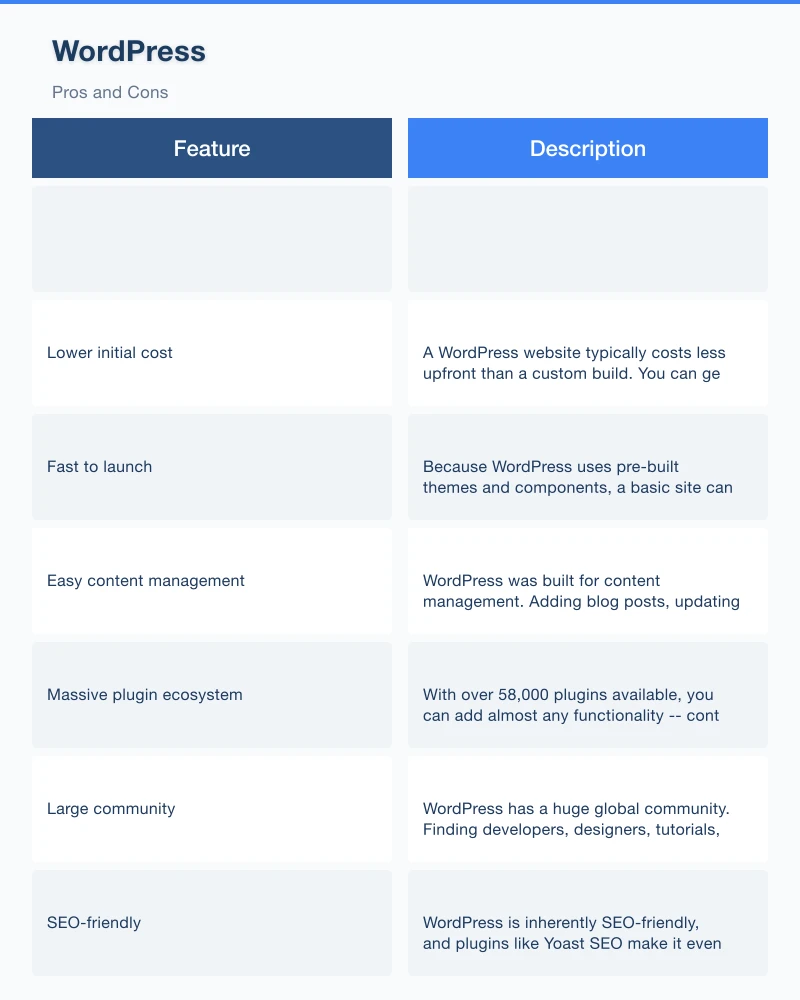
Lower initial cost: A WordPress website typically costs less upfront than a custom build. You can get a professional WordPress site built for anywhere from $2,000 to $10,000, depending on complexity. Templates and themes further reduce costs.
Fast to launch: Because WordPress uses pre-built themes and components, a basic site can be up and running in weeks rather than months.
Easy content management: WordPress was built for content management. Adding blog posts, updating pages, and managing media is straightforward, even for people without technical skills.
Massive plugin ecosystem: With over 58,000 plugins available, you can add almost any functionality – contact forms, SEO tools, e-commerce, booking systems, galleries, and more – without custom coding.
Large community: WordPress has a huge global community. Finding developers, designers, tutorials, and support is easy. In Australia, there is no shortage of WordPress professionals.
SEO-friendly: WordPress is inherently SEO-friendly, and plugins like Yoast SEO make it even easier to optimise your content.
Disadvantages
Plugin dependency: Heavy reliance on plugins can cause performance issues, security vulnerabilities, and compatibility problems when plugins conflict with each other or are not kept up to date.
Security concerns: Because WordPress is so popular, it is a frequent target for hackers. Keeping WordPress core, themes, and plugins updated is essential for security.
Performance limitations: Out of the box, WordPress can be slow, especially with multiple plugins and unoptimised themes. Speed optimisation requires ongoing attention.
Customisation limits: While WordPress is flexible, there are limits. Achieving highly custom functionality sometimes requires awkward workarounds or custom plugin development, which can negate the cost advantage.
Ongoing maintenance: WordPress requires regular updates to its core software, themes, and plugins. Neglecting updates can lead to security issues and broken functionality.
Theme restrictions: Pre-built themes can limit your design options. Customising a theme beyond its intended design can be frustrating and sometimes requires significant development work.
Custom Website: Pros and Cons
Advantages
Complete flexibility: A custom website can be built to do exactly what you need, with no compromises. The design and functionality are limited only by your budget and your developer’s skills.
Better performance: Custom websites can be optimised from the ground up, resulting in faster load times and smoother performance.
Stronger security: Without the overhead of a widely-known CMS, custom websites can be more secure. There is no publicly known code for hackers to exploit.
Scalability: Custom builds can be architected to scale with your business. As your needs grow, the site can grow with you without the limitations of a template.
Unique design: Your website will be genuinely unique. No other business will have a site that looks or functions like yours.
No plugin dependency: Functionality is built into the site itself, reducing the risk of plugin conflicts, updates breaking features, or third-party code introducing vulnerabilities.
Disadvantages
Higher initial cost: Custom websites typically cost more upfront – anywhere from $5,000 to $50,000 or more, depending on complexity. For very complex projects, costs can be even higher.
Longer development time: Building from scratch takes more time. A custom site might take two to six months to develop, compared to weeks for a WordPress site.
Content management can be harder: Unless the developer builds a custom CMS or integrates a headless CMS, updating content may require technical knowledge.
Developer dependency: You need your developer (or someone familiar with the codebase) for changes and updates. If your developer becomes unavailable, finding someone else to work on a custom codebase can be challenging.
Smaller talent pool: While WordPress developers are abundant, finding developers skilled in your specific custom technology stack can be more difficult and expensive.
Which Is Right for Your Business?
Choose WordPress If:
- Your budget is limited: You need a professional website without spending tens of thousands of dollars.
- You want to manage content yourself: You plan to regularly update your site, publish blog posts, or manage products without relying on a developer.
- Your needs are standard: You need a brochure site, blog, basic e-commerce, or portfolio. WordPress handles these use cases well.
- You need to launch quickly: Time is a factor, and you want to be online soon.
- You value community and support: You want access to a large community, extensive documentation, and readily available help.
Choose Custom If:
- You have unique requirements: Your business needs functionality that WordPress cannot deliver well (complex web applications, custom integrations, unique user experiences).
- Performance is critical: You need the fastest possible site and cannot afford the overhead that comes with WordPress and its plugins.
- Security is paramount: You handle sensitive data or operate in an industry with strict security requirements.
- You are building a web application: If your website is really an application (with user accounts, complex workflows, or interactive features), a custom build is usually the better choice.
- You have the budget: You can invest in a higher-quality build and understand the long-term value.
The Middle Ground
There are also middle-ground options worth considering:
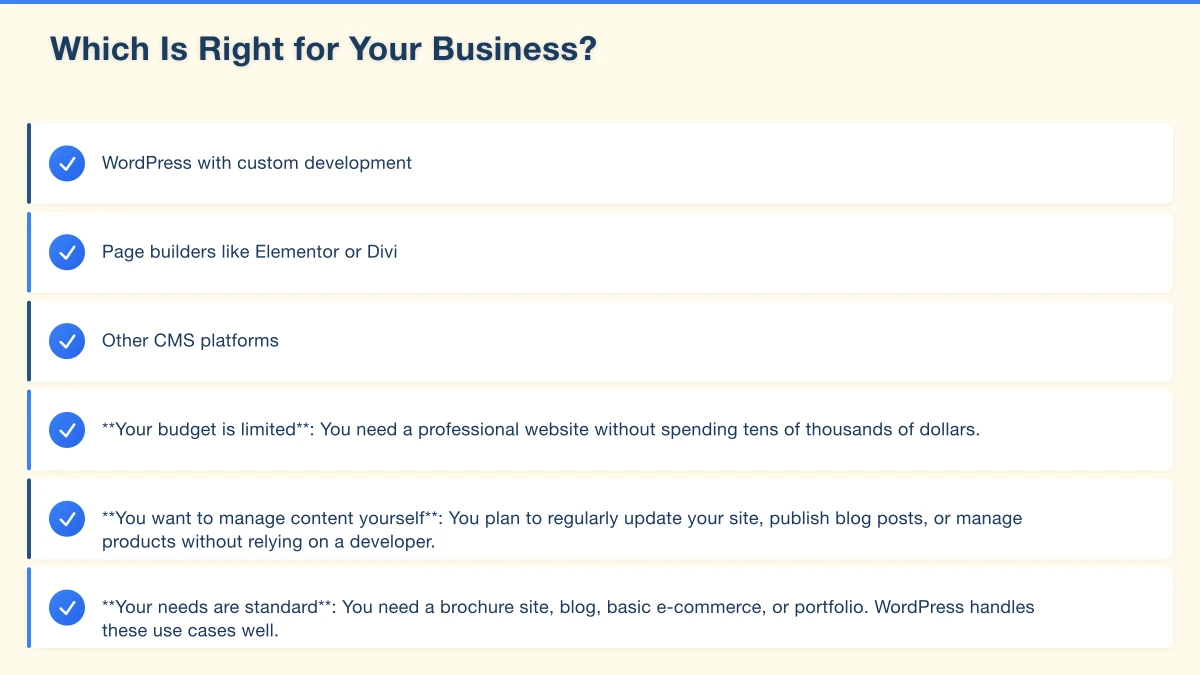
WordPress with custom development: Start with WordPress but have a developer build a custom theme and custom plugins for your specific needs. This gives you the content management benefits of WordPress with more tailored design and functionality.
Page builders like Elementor or Divi: These WordPress plugins offer drag-and-drop design capabilities that bridge the gap between template-based and custom design. They add some overhead but increase flexibility.
Other CMS platforms: Shopify (for e-commerce), Squarespace (for simple sites), or Webflow (for designer-friendly builds) might suit specific needs better than either WordPress or a fully custom approach.
Cost Comparison for Australian Businesses
Here is a rough guide to what you can expect to invest:
Basic WordPress site: $2,000 to $5,000
- Professional theme, basic customisation, essential pages, contact form, blog setup
Advanced WordPress site: $5,000 to $15,000
- Custom theme, advanced functionality, e-commerce, custom integrations
Basic custom website: $5,000 to $15,000
- Clean design, essential pages, basic interactivity, content management
Advanced custom website: $15,000 to $50,000 and above
- Complex functionality, custom applications, integrations, advanced design
These are approximate ranges. Actual costs depend on your specific requirements, the agency or developer you work with, and the complexity of your project.
Ongoing Costs to Consider
Both options have ongoing costs:
WordPress: Hosting ($10 to $50 per month), premium plugin licences ($100 to $500 per year), maintenance and updates ($50 to $200 per month if outsourced), security monitoring.
Custom: Hosting ($10 to $100 per month), developer retainer for updates and changes (varies widely), security monitoring.
Making Your Decision
Ask yourself these questions:
- What is my budget for the initial build?
- How much can I invest in ongoing maintenance?
- Do I need to update content frequently myself?
- How unique are my requirements?
- How important is site performance and speed?
- What is my timeline for launching?
- Am I planning to scale significantly in the next few years?
For most small businesses in Western Sydney and across Australia, WordPress is the practical choice. It offers a strong balance of affordability, flexibility, and ease of use that suits the needs of most local businesses.
However, if you have specific requirements that push beyond what WordPress handles well, investing in a custom build can pay dividends in performance, security, and user experience.
Whatever you choose, the most important thing is that your website serves your business goals and provides a great experience for your customers. We help businesses across Western Sydney make this decision every day, and we are happy to help you figure out the right path forward.
Your website’s performance depends on what’s behind it. Cloud Geeks provides the managed hosting, cloud, and IT support that keeps Australian SMBs online and secure.
Ash Ganda covers how Australian SMBs are using AI, automation, and digital strategy to grow without scaling costs proportionally.
If your business is also planning a customer-facing iOS or Android app — Awesome Apps builds cross-platform mobile apps for Australian SMBs.
Part of the Ganda Tech Services family, Cosmos Web Tech delivers specialist web design and digital marketing for Australian small and medium businesses.