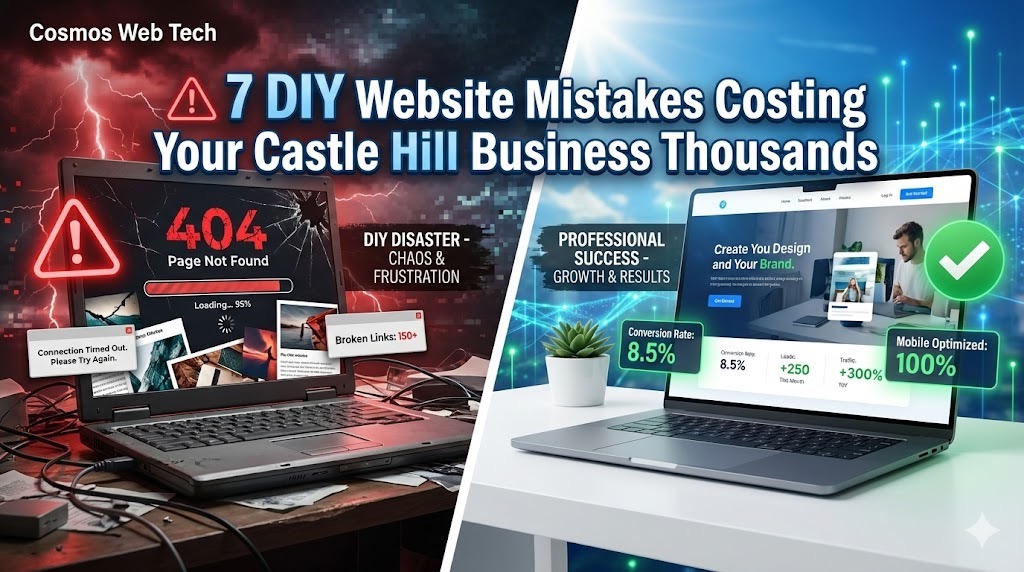
7 DIY Website Mistakes That Are Costing Your Castle Hill Business Thousands in 2024
As a Castle Hill business owner, you’ve probably considered building your own website. After all, with so many DIY website builders available, it seems like an easy way to save money and get online quickly. However, what many local business owners don’t realise is that common DIY website mistakes can end up costing thousands in lost revenue, missed opportunities, and expensive fixes down the road.
At Cosmos Web Tech, we’ve worked with countless Castle Hill businesses who initially tried the DIY route, only to discover that their well-intentioned efforts were actually hurting their bottom line. Our professional web design services have helped businesses recover from these costly mistakes. In this comprehensive guide, we’ll reveal the most expensive DIY website mistakes we see regularly and show you how to avoid them.
The Hidden Cost of Poor First Impressions
Your website is often the first interaction potential customers have with your Castle Hill business. Research shows that users form an opinion about your website in just 0.05 seconds – faster than the blink of an eye. When DIY websites fail to make a professional first impression, the financial impact is immediate and significant.
Common Design Mistakes That Drive Customers Away
Template Overload: Many DIY builders offer limited customisation options, resulting in websites that look identical to competitors. When your Castle Hill plumbing business uses the same template as hundreds of others, you fail to differentiate yourself in a competitive market. Mobile Responsiveness Issues: Over 60% of web traffic in Australia comes from mobile devices, yet many DIY websites aren’t properly optimised for mobile viewing. Poor mobile experience directly translates to lost customers – studies show that 57% of users won’t recommend a business with a poorly designed mobile site. Learn more about our mobile-first design approach that prioritizes mobile users. Inconsistent Branding: DIY websites often suffer from mismatched fonts, clashing colours, and inconsistent messaging. This lack of cohesive branding undermines trust and professionalism, causing potential customers to question your business’s credibility. Real-World Impact: A Castle Hill restaurant owner we worked with lost an estimated $15,000 in bookings over six months due to a DIY website that looked unprofessional and was difficult to navigate on mobile devices. After redesigning their site, they saw a 40% increase in online reservations within three months. 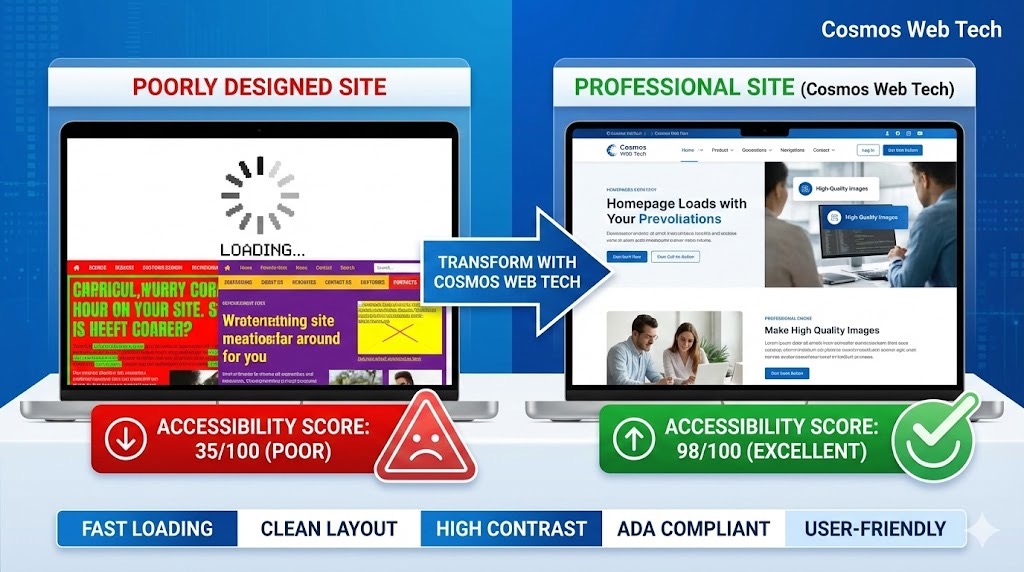
SEO Disasters That Make Your Business Invisible
Search Engine Optimisation (SEO) is crucial for Castle Hill businesses wanting to be found by local customers. Unfortunately, DIY websites often contain SEO mistakes that can take months or years to recover from, costing businesses thousands in lost organic traffic.
The SEO Mistakes Killing Your Online Visibility
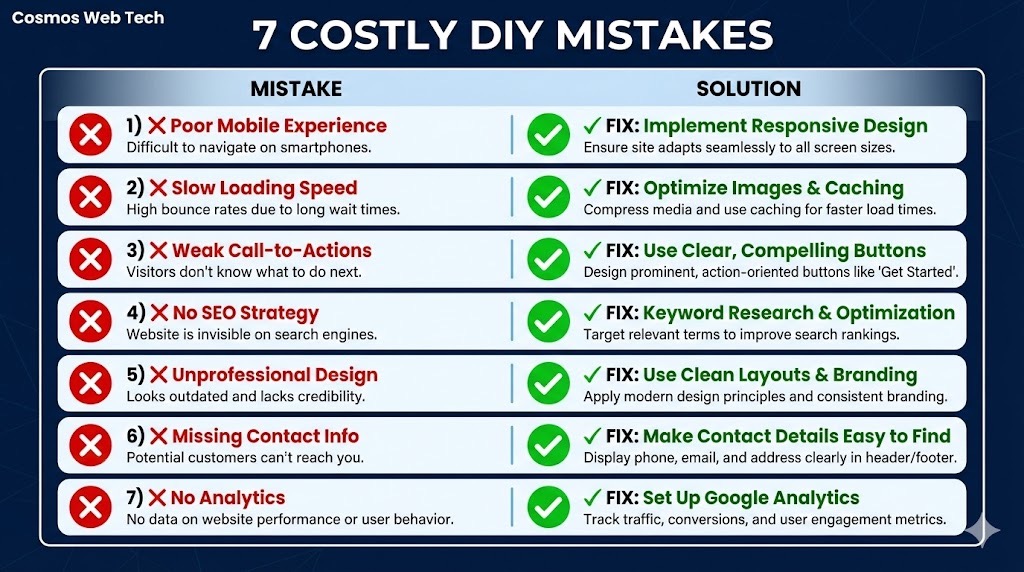
Missing Local SEO Elements: Many DIY websites fail to include essential local SEO components like proper schema markup, Google My Business integration, and location-specific keywords. For a Castle Hill business, not appearing in “near me” searches means missing out on high-intent local customers. Poor Site Structure: DIY builders often create websites with confusing navigation and poor internal linking structure. Search engines struggle to understand and index these sites properly, resulting in lower rankings and reduced visibility. Slow Loading Speeds: DIY websites frequently suffer from bloated code, oversized images, and poor hosting choices. Google considers page speed a ranking factor, and slow sites not only rank lower but also have higher bounce rates. Duplicate Content Issues: Many DIY users copy content from competitors or use generic template text, creating duplicate content issues that can result in search engine penalties. Case Study: A Castle Hill accounting firm’s DIY website wasn’t ranking for any relevant local terms. After conducting an SEO audit, we discovered their site had no meta descriptions, broken internal links, and was loading in over 8 seconds. Our redesign and optimisation resulted in first-page rankings for 15 relevant keywords within four months, generating an additional $30,000 in new client revenue.
Security Vulnerabilities Putting Your Business at Risk
Website security isn’t just about protecting data – it’s about protecting your business’s reputation and avoiding costly downtime. DIY websites often lack proper security measures, leaving Castle Hill businesses vulnerable to attacks that can cost thousands to resolve.
Security Risks You Can’t Afford to Ignore
Outdated Software and Plugins: DIY website owners often forget to update their platforms, themes, and plugins regularly. Outdated software contains known vulnerabilities that hackers actively exploit. Weak Backup Systems: Many DIY platforms offer basic backup solutions, but these aren’t always reliable or comprehensive. When websites crash or get hacked, inadequate backups can mean losing years of content and customer data. SSL Certificate Issues: While most platforms now include basic SSL certificates, improper implementation or expired certificates can trigger browser warnings that immediately drive customers away. Inadequate User Permission Controls: DIY websites often lack sophisticated user management systems, making it difficult to control who has access to what information. Financial Impact: A Castle Hill retail business we worked with had their DIY e-commerce site hacked, resulting in customer credit card information being compromised. The incident cost them $25,000 in legal fees, compliance costs, and lost sales during the three-week recovery period. Additionally, the reputation damage led to a 30% decrease in online sales for six months.
Conversion Problems That Waste Your Marketing Investment
Even if your DIY website attracts visitors, poorly designed conversion paths can prevent those visitors from becoming paying customers. This is particularly costly when you’re investing in paid advertising or other marketing efforts to drive traffic to your site.
Conversion Killers Hiding in Plain Sight
Confusing Navigation: Complex or unclear navigation structures frustrate users and prevent them from finding what they need. If visitors can’t easily find your contact information, services, or products, they’ll leave and find a competitor. Weak Calls-to-Action (CTAs): DIY websites often have generic, poorly positioned CTAs that don’t encourage user action. Buttons saying “Click Here” or “Submit” don’t create urgency or clearly communicate value. Lack of Trust Signals: Professional websites include testimonials, certifications, awards, and other trust indicators. DIY sites often overlook these crucial elements that help convince visitors to choose your Castle Hill business over competitors. Poor Contact Forms: Overly complicated contact forms, forms that don’t work properly, or forms that don’t follow up appropriately can result in lost leads and frustrated potential customers. No Analytics or Tracking: Many DIY website owners don’t properly set up Google Analytics, conversion tracking, or other measurement tools. Without data, you can’t identify problems or optimise for better performance. Real Example: A Castle Hill fitness studio’s DIY website was getting 500 monthly visitors but only generating 2-3 inquiries per month. After redesigning with clear CTAs, simplified navigation, and proper lead capture forms, they increased their inquiry rate to 25-30 per month – a more than 1000% improvement that translated to $20,000 in additional monthly revenue.
The Long-Term Costs of DIY Limitations
While DIY website builders might seem cost-effective initially, their limitations can become expensive obstacles as your Castle Hill business grows. Understanding these long-term costs helps you make informed decisions about your digital presence.
Growth Limitations That Cost Money
Platform Lock-In: Most DIY builders use proprietary systems that make it difficult or impossible to migrate your site elsewhere. As your needs evolve, you might need to rebuild from scratch rather than simply upgrading. Limited Functionality: DIY platforms restrict the features and integrations available to your website. As your business grows, you might need specific functionality that your DIY platform can’t provide, forcing expensive workarounds or complete rebuilds. Scalability Issues: DIY websites often can’t handle increased traffic, complex product catalogues, or advanced business requirements. During peak seasons or growth periods, these limitations can result in lost sales and frustrated customers. Integration Challenges: As your business adopts new tools for CRM, inventory management, or marketing automation, DIY websites often can’t integrate properly, creating inefficiencies and data silos. Opportunity Cost: Time spent learning DIY platforms, troubleshooting issues, and making updates could be better invested in running your business. The opportunity cost of DIY website management often exceeds the cost of professional services.
Making the Smart Investment: When to Choose Professional Web Design
Recognising when DIY isn’t the right choice for your Castle Hill business can save thousands in the long run. Professional web design isn’t just an expense – it’s an investment that pays dividends through increased conversions, better search rankings, and improved customer trust.
Signs It’s Time to Go Professional
- Your website needs to generate leads or sales (not just provide information)
- You’re investing in marketing or advertising to drive traffic
- Your business serves customers beyond family and friends
- You need specific functionality or integrations
- Your industry is competitive in the Castle Hill area
- You value your time and prefer focusing on your core business
The ROI of Professional Web Design
While professional web design requires upfront investment, the return typically far exceeds the cost. Our Castle Hill clients regularly see:
- 200-400% increases in website conversions
- 50-100% improvements in search engine rankings
- Significant reductions in bounce rates
- Enhanced brand credibility and trust
- Better customer experience and satisfaction
Conclusion: Avoiding Expensive DIY Mistakes
The appeal of DIY website builders is understandable – they promise quick, affordable solutions for Castle Hill businesses wanting to establish an online presence. However, as we’ve seen, the hidden costs of DIY mistakes often far exceed the initial savings.
Poor design drives away customers before they engage with your business. SEO mistakes make your website invisible to potential customers searching for your services. Security vulnerabilities put your business and customers at risk. Conversion problems waste your marketing investment. And platform limitations create expensive obstacles as your business grows.
The key takeaway isn’t that DIY is always wrong – it’s about understanding when the risks outweigh the benefits. For Castle Hill businesses serious about growth, professional web design is an investment that pays for itself through improved performance, reduced risk, and better results.
Next Steps
If you recognise any of these costly mistakes in your current website, don’t wait for them to compound. Every day your website underperforms is money left on the table. Contact our team for a professional audit of your site to identify specific issues and opportunities for improvement.
Remember, your website is often your most important marketing tool. Investing in getting it right the first time is far more cost-effective than trying to fix expensive mistakes later. Your Castle Hill business deserves a website that works as hard as you do – one that attracts customers, builds trust, and drives growth rather than costing you opportunities and revenue.
Your website’s performance depends on what’s behind it. Cloud Geeks provides the managed hosting, cloud, and IT support that keeps Australian SMBs online and secure.
Ash Ganda covers how Australian SMBs are using AI, automation, and digital strategy to grow without scaling costs proportionally.
If your business is also planning a customer-facing iOS or Android app — Awesome Apps builds cross-platform mobile apps for Australian SMBs.
Part of the Ganda Tech Services family, Cosmos Web Tech delivers specialist web design and digital marketing for Australian small and medium businesses.