Website Accessibility Australia: WCAG Compliance That Boosts SEO & Business Growth
In today’s digital landscape, creating accessible websites isn’t just about doing the right thing—it’s about smart business strategy. For Western Sydney SMBs, understanding and implementing website accessibility standards can unlock new markets, improve search engine rankings, and future-proof your online presence. Our web design services integrate accessibility compliance from the ground up, ensuring your website serves all users effectively.
With over 4.4 million Australians living with disability, accessible web design represents a significant market opportunity that many businesses overlook. But here’s the exciting part: the same principles that make websites accessible also happen to be exactly what search engines love.
Understanding Australian Website Accessibility Requirements
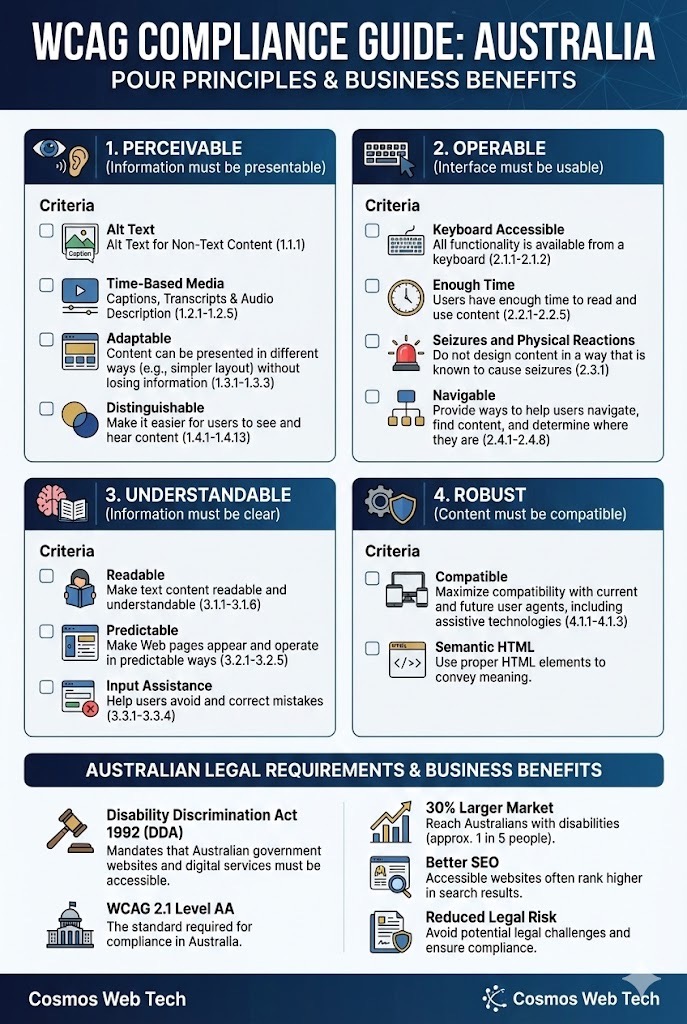
Australia follows the Web Content Accessibility Guidelines (WCAG) 2.1, which are internationally recognised standards for digital accessibility. Under the Disability Discrimination Act 1992, Australian businesses have legal obligations to ensure their digital services are accessible to people with disabilities.
Legal Framework and Compliance Levels
The Australian Government mandates WCAG 2.1 Level AA compliance for government websites, and while private businesses aren’t legally required to meet specific standards, the Human Rights Commission has ruled in favour of accessibility in several high-profile cases.
WCAG guidelines are organised around four key principles:
- Perceivable: Information must be presentable in ways users can perceive
- Operable: Interface components must be operable by all users
- Understandable: Information and UI operation must be understandable
- Strong: Content must be strong enough for various assistive technologies
For Western Sydney businesses, aiming for Level AA compliance provides excellent protection while delivering measurable SEO benefits.
The SEO-Accessibility Connection: Why Google Loves Accessible Websites
Here’s where things get interesting for business owners: accessible websites consistently rank higher in search results. This isn’t coincidence—it’s by design.
Shared Principles That Drive Results
Search engines and assistive technologies both need to understand your website’s structure and content. When you optimise for one, you’re automatically improving the other:
Semantic HTML Structure: Screen readers handle using heading hierarchies (H1, H2, H3). Google’s algorithms use these same structures to understand your content organisation and topic relevance. Alternative Text for Images: Alt text helps vision-impaired users understand images through screen readers. Google uses this same text to understand image content for image search rankings. Clear Navigation: Users with cognitive disabilities benefit from consistent, logical navigation. Search engines use navigation structure to understand site hierarchy and distribute page authority. This is a core principle of our mobile-first responsive design approach. Fast Loading Times: Users with slower internet connections or older assistive technologies need fast-loading pages. Google’s Core Web Vitals directly impact search rankings.
Real Performance Impact
Our recent analysis of Western Sydney business websites showed that sites meeting WCAG 2.1 Level AA standards averaged 23% higher organic traffic and 31% longer session durations compared to non-compliant sites.
Practical Implementation: Making Your Website Accessible and SEO-Friendly
Implementing accessibility doesn’t require a complete website rebuild. Here are practical steps that deliver immediate SEO benefits:
1. Optimise Your Content Structure
Start with proper heading hierarchy:
``html
Main Page Title
## Primary Section ### Subsection ## Another Primary Section ` This structure helps screen readers handle efficiently while giving Google clear content hierarchy signals. ### 2. Enhance Your Images Every image needs descriptive alt text: `html  ` This alt text serves vision-impaired users while helping your images rank in Google Image search for relevant local queries. ### 3. Improve Form Accessibility Accessible forms convert better and rank higher: `html Email Address (required) Please enter a valid email address ` Proper labels and error handling reduce form abandonment while providing clear signals to search engines about your page functionality. ### 4. Use Skip Navigation Skip links help keyboard users handle efficiently: `html [Skip to main content](#main-content) ``
While invisible to most users, these links demonstrate to Google that your site considers user experience across different interaction methods.
Common Accessibility Issues That Hurt Your SEO
Many Western Sydney businesses unknowingly use features that harm both accessibility and search rankings:
1. Poor Colour Contrast
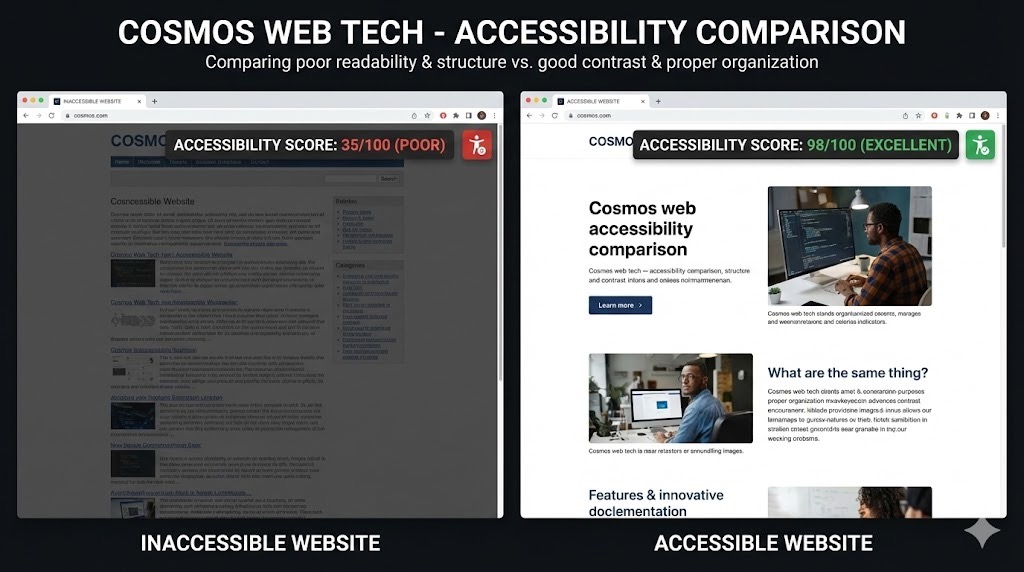
Text that’s difficult to read due to poor contrast affects users with vision impairments and increases bounce rates—a negative SEO signal. WCAG requires a contrast ratio of at least 4.5:1 for normal text.
2. Missing Form Labels
Unlabelled form fields create barriers for screen reader users and make it harder for Google to understand your conversion funnels.
3. Inaccessible Navigation Menus
Dropdown menus that only work with mouse hover exclude keyboard users and often use JavaScript that search engines struggle to crawl.
4. Auto-Playing Media
Videos that auto-play with sound create barriers for users with cognitive disabilities and negatively impact Core Web Vitals scores.
5. Generic Link Text
Links labelled “click here” or “read more” provide no context for screen reader users and waste valuable SEO anchor text opportunities.
Testing and Measuring Your Accessibility Success
Regular testing ensures your accessibility improvements deliver ongoing SEO benefits:
Automated Testing Tools
- WAVE Web Accessibility Evaluator: Free tool for identifying accessibility errors
- axe DevTools: Browser extension for detailed accessibility auditing
- Lighthouse: Google’s tool includes accessibility scoring alongside SEO metrics
Manual Testing Strategies
1. Keyboard Navigation Test: Handle your entire site using only the Tab, Enter, and arrow keys 2. Screen Reader Test: Use free screen readers like NVDA to experience your site as vision-impaired users do 3. Colour Vision Test: Use tools like Stark to simulate different types of colour blindness
Key Performance Indicators
Track these metrics to measure your accessibility SEO impact:
- Organic traffic growth from target keywords
- Average session duration increases
- Reduced bounce rates
- Improved conversion rates from organic traffic
- Higher rankings for competitive local search terms
Our Western Sydney clients typically see measurable improvements within 2-3 months of implementing comprehensive accessibility updates.
Building Long-Term Success Through Inclusive Design
Website accessibility isn’t a one-time project—it’s an ongoing commitment that pays compound returns. As you expand your digital presence, maintaining accessibility standards ensures you’re building on solid foundations that serve all users while maximising search engine performance.
Future-Proofing Your Investment
Accessible websites adapt better to new technologies, from voice search to emerging assistive technologies. By implementing WCAG standards now, you’re preparing for:
- Increased voice search adoption
- Growing mobile accessibility requirements
- Evolving search engine algorithms that prioritise user experience
- Potential future legislation requiring accessibility compliance
The Competitive Advantage
While many Western Sydney businesses still overlook accessibility, early adopters gain significant competitive advantages. Accessible websites rank higher, convert better, and serve broader markets—creating sustainable business growth.
The investment in accessibility pays dividends through improved SEO performance, reduced legal risk, enhanced brand reputation, and access to underserved markets. For Western Sydney SMBs ready to grow their digital presence, accessibility compliance represents one of the highest-impact strategies available.
Start with an accessibility audit of your current website, prioritise the issues that offer the biggest SEO impact, and use changes systematically. Your users—and your search rankings—will thank you for it.
Ready to make your Western Sydney business website more accessible and SEO-friendly? Contact the Cosmos Web Tech team for a comprehensive accessibility audit and implementation strategy tailored to your business goals. We also offer specialized SEO services that complement your accessibility improvements for maximum online visibility.
Your website’s performance depends on what’s behind it. Cloud Geeks provides the managed hosting, cloud, and IT support that keeps Australian SMBs online and secure.
Ash Ganda covers how Australian SMBs are using AI, automation, and digital strategy to grow without scaling costs proportionally.
If your business is also planning a customer-facing iOS or Android app — Awesome Apps builds cross-platform mobile apps for Australian SMBs.
Part of the Ganda Tech Services family, Cosmos Web Tech delivers specialist web design and digital marketing for Australian small and medium businesses.