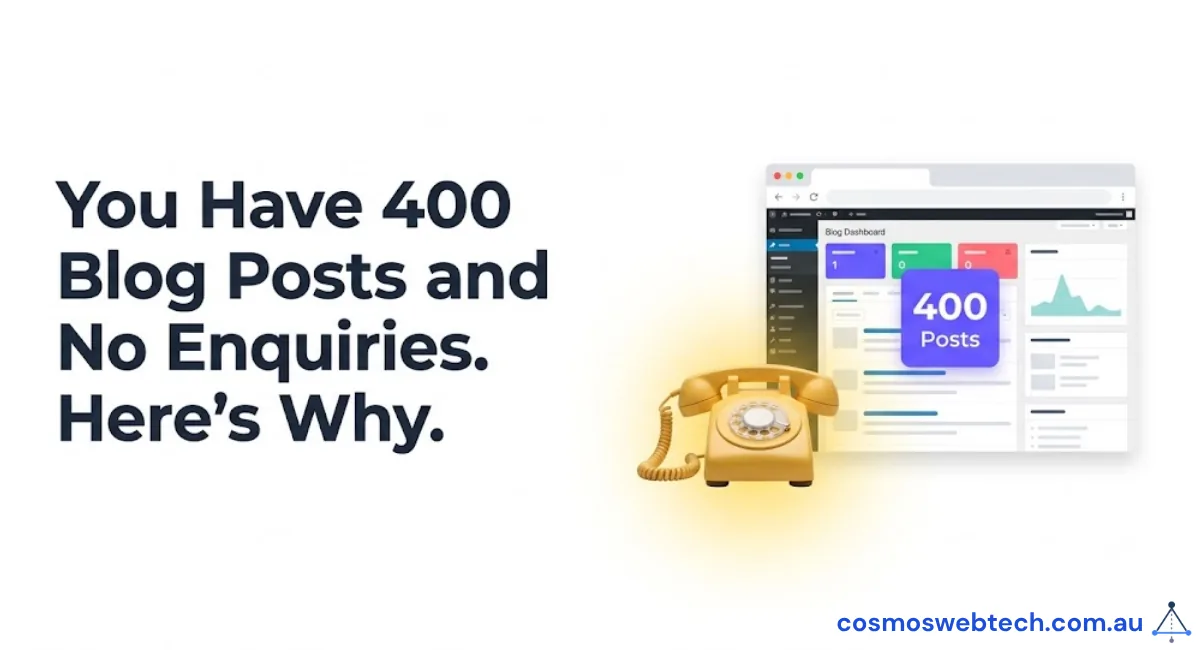
A business owner showed us a blog with just over 400 posts. Four years of work, mostly written by the owner at night. Enquiries from it: zero.
His question was “should I write more?”
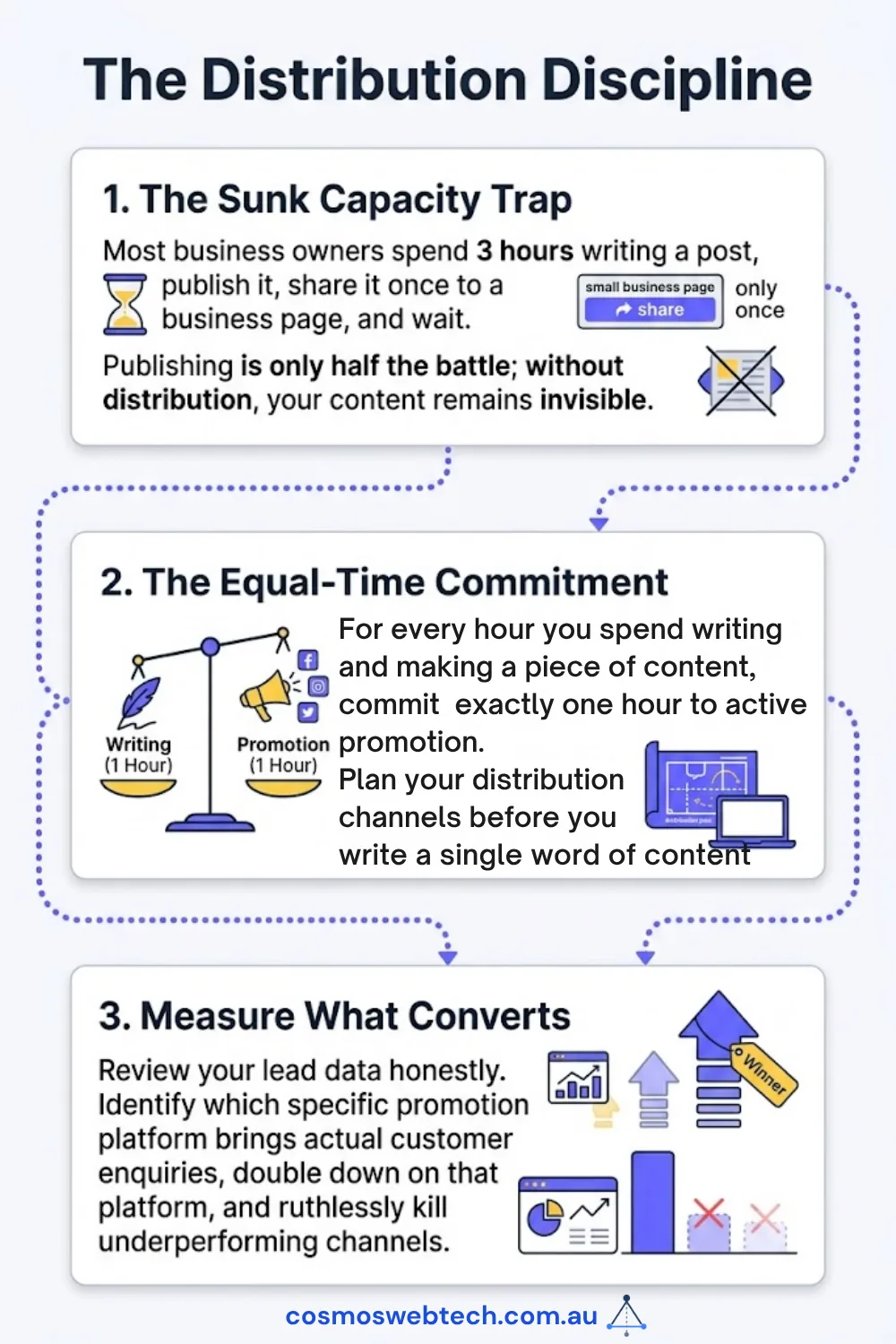
The answer was no, and not because the posts were bad. They were fine. The problem was that every one of them had been published and then abandoned — posted to the website, shared once to a business page with 200 followers, and left alone.
Publishing is not distribution. Treating them as the same thing is the single most common reason a content programme produces nothing.
The rule: distribution is half the work
Here is the discipline that fixes it. For every hour you spend making something, spend an hour getting it in front of people.
Not five minutes. Not “share it on LinkedIn”. An hour, planned before you write.
Most small business content follows this shape:
Write for three hours → publish → share once → wait → nothing happens → conclude that content marketing does not work
The version that works looks like this:
Write for three hours → publish → three hours of distribution across several weeks → measure which channel produced enquiries → do more of that one
Same post. Entirely different outcome.
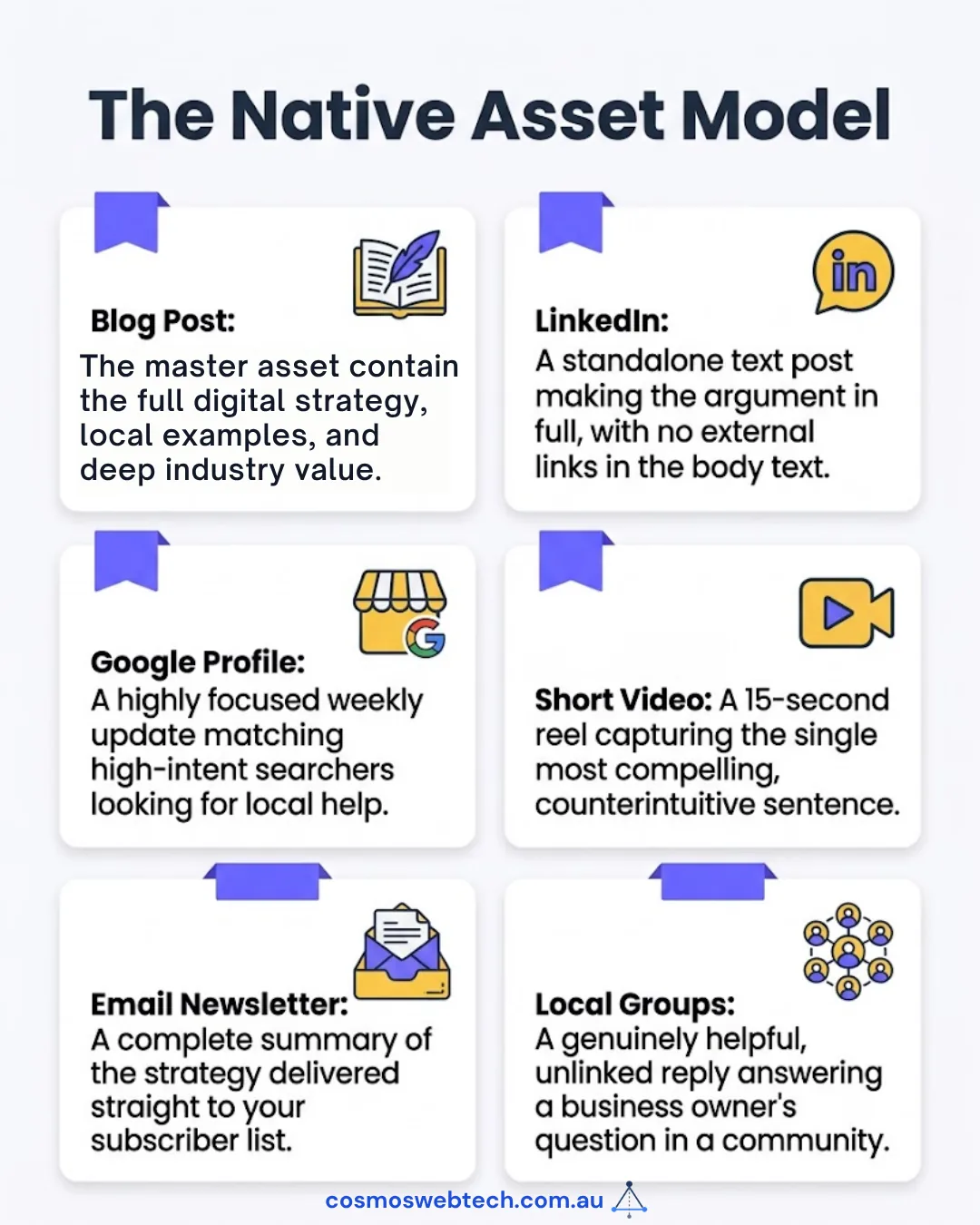
One idea, several native pieces — not one link posted six times
The instinct when you hear “distribute more” is to post the same link to six platforms. That underperforms, because every platform can tell and every audience has seen it.
The better model is one idea, several native artefacts:
| From one blog post | Make |
|---|---|
| The counterintuitive bit | A LinkedIn post that makes the argument in full, no link |
| The how-to section | A Google Business Profile post |
| The single best sentence | A short video or reel |
| The whole thing, summarised | An email to your list |
| The question it answers | A genuinely useful reply in a Facebook group |
Note what those have in common: each one delivers value without requiring a click. A LinkedIn post that is a headline plus “read more on our blog” is an ad. One that makes the point, then mentions where the detail lives, is content.
This matters mechanically as well as socially. Most social platforms reduce the reach of posts carrying external links — often substantially. Put the value in the post and the link in the first comment.
For a local business, two channels usually beat the rest
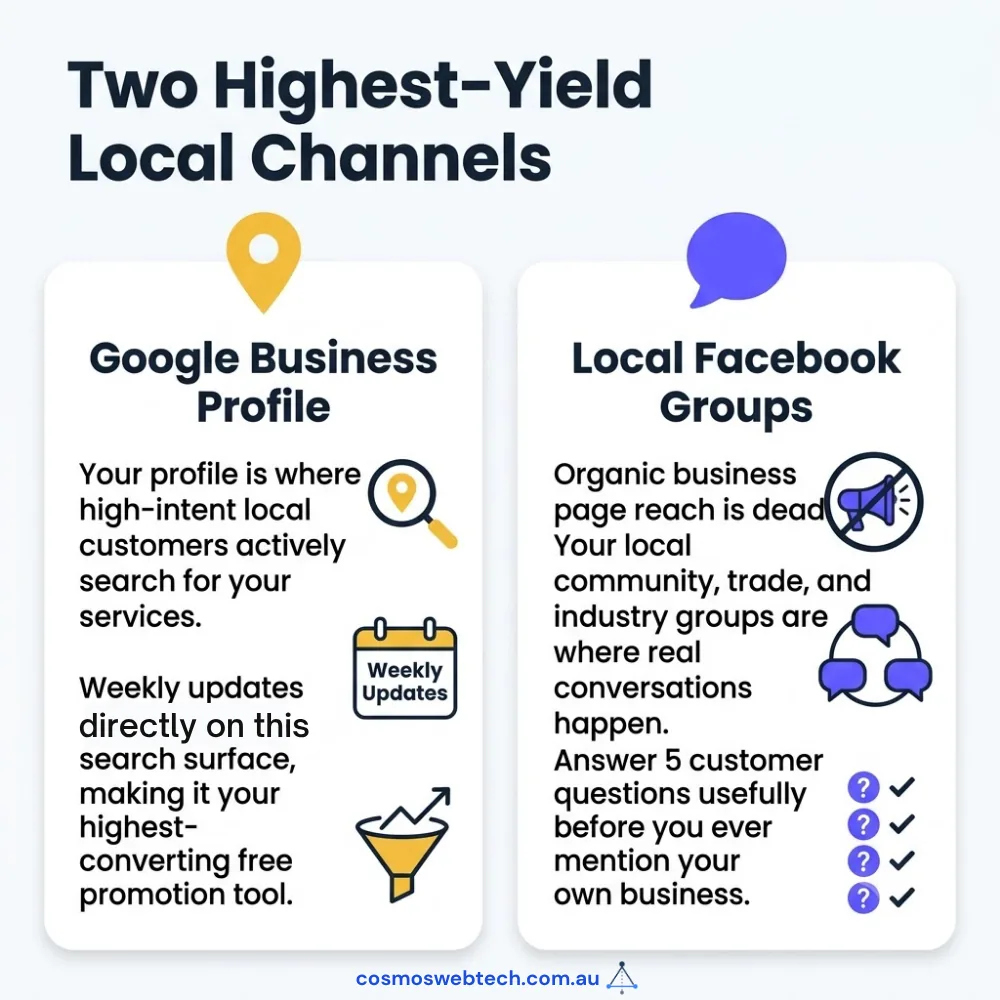
Small businesses are told to be on every platform. For a local service business, two consistently outperform:
Google Business Profile posts. Your profile is where most local customers find you. Posts appear directly in that panel, in front of someone already looking for a business like yours. Weekly, every week, regardless of whether you published a blog post — this is the highest-intent surface you have and it is free.
Facebook Groups — not your Facebook Page. Organic reach on a business Page is somewhere in the low single-digit percentages. Your local community groups, trade groups and industry groups are where the actual conversations happen. The rule is to be a member who occasionally helps, not a business that occasionally posts. Answer five questions properly before you ever mention what you do.
Everything else — Instagram, TikTok, X, a newsletter — can work, but they are the second decision. Get these two right first.
Run several channels, expect most to fail
Any single channel can stop working for reasons entirely outside your control: an algorithm change, a competitor with a bigger budget, a platform decision.
So run three or four in parallel and accept that most will underperform. That is not pessimism, it is arithmetic — you are looking for the one or two that suit your business, and you cannot know which in advance. A business relying on a single channel is one policy change from zero.
Review honestly each month. Kill what is not working rather than continuing out of sunk cost.
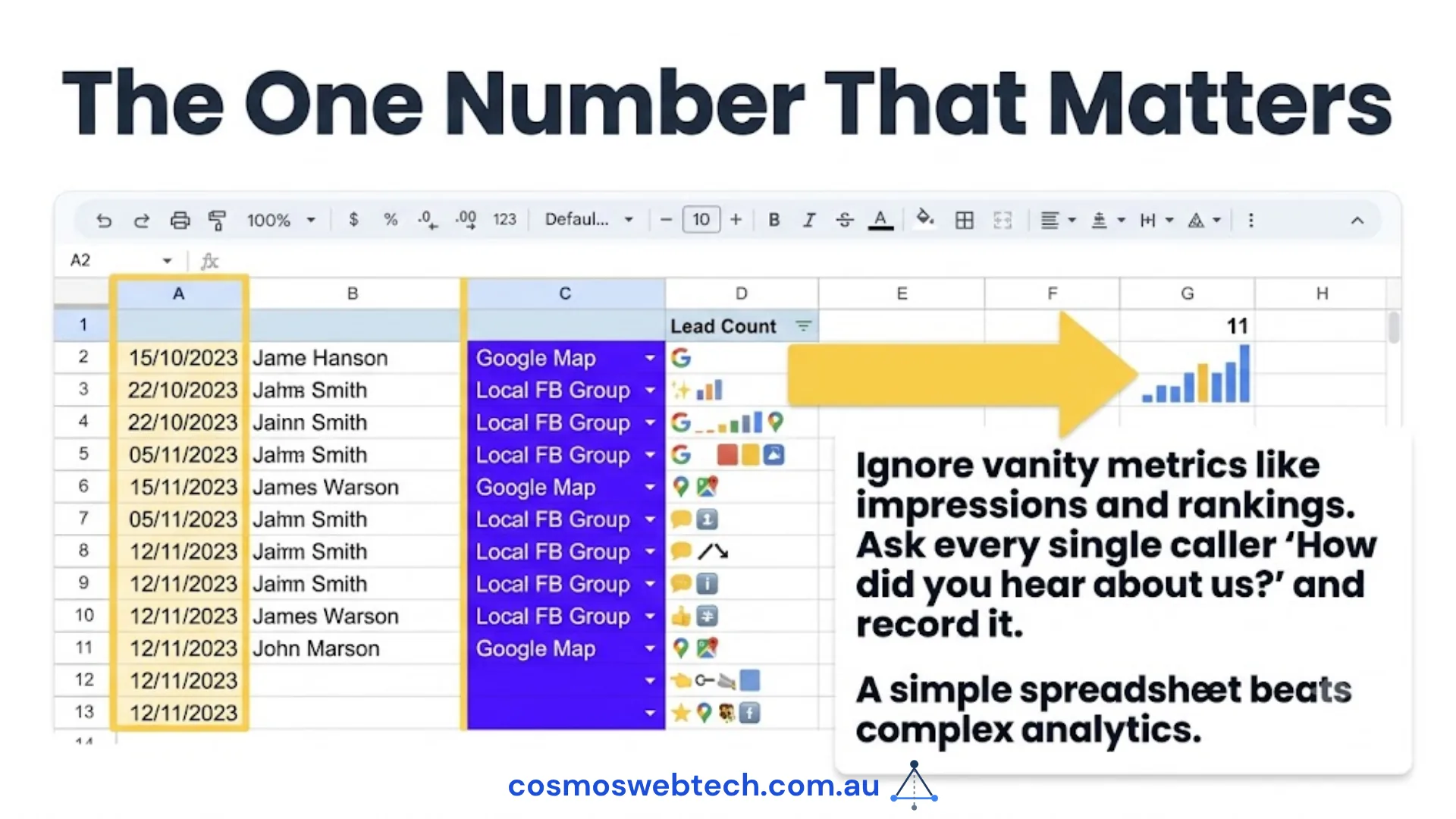
The one number that matters
Not impressions. Not followers. Not rankings.
Enquiries, by source, every month.
Ask every person who contacts you how they found you and write it down. A spreadsheet is enough. Within three months you will know which channel produces customers, and it is frequently not the one absorbing most of your effort.
Everything else is a diagnostic. Rankings explain enquiries. Impressions explain rankings. But if the enquiry number is not moving, a rising impression count is not progress — it is a nicer-looking version of the same problem.
One month, one constraint
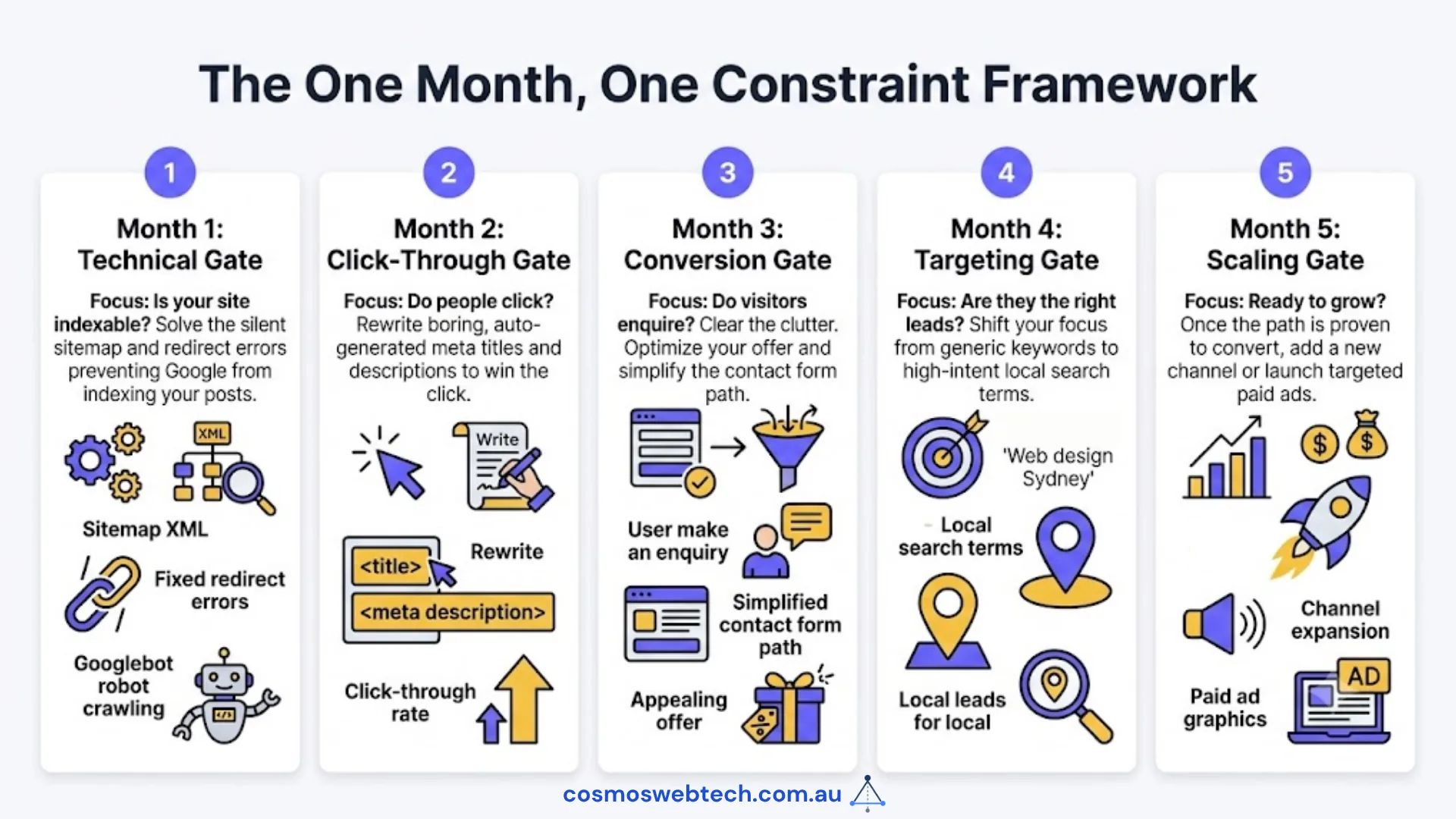
The reason most content plans get abandoned in week two is that they assume capacity nobody has. Eleven workstreams, all starting Monday.
Instead, pick one constraint per month:
| If this is true | This month’s work is |
|---|---|
| Nobody sees the site at all | Technical — is it even indexable? |
| Pages rank but nobody clicks | Rewrite titles and descriptions |
| People visit but do not enquire | The offer and the contact path |
| Enquiries come but from the wrong people | Which keywords you target |
| Everything works, just too small | Add a channel, or add paid |
One thing. Finish it. Then pick the next one.
The honest summary
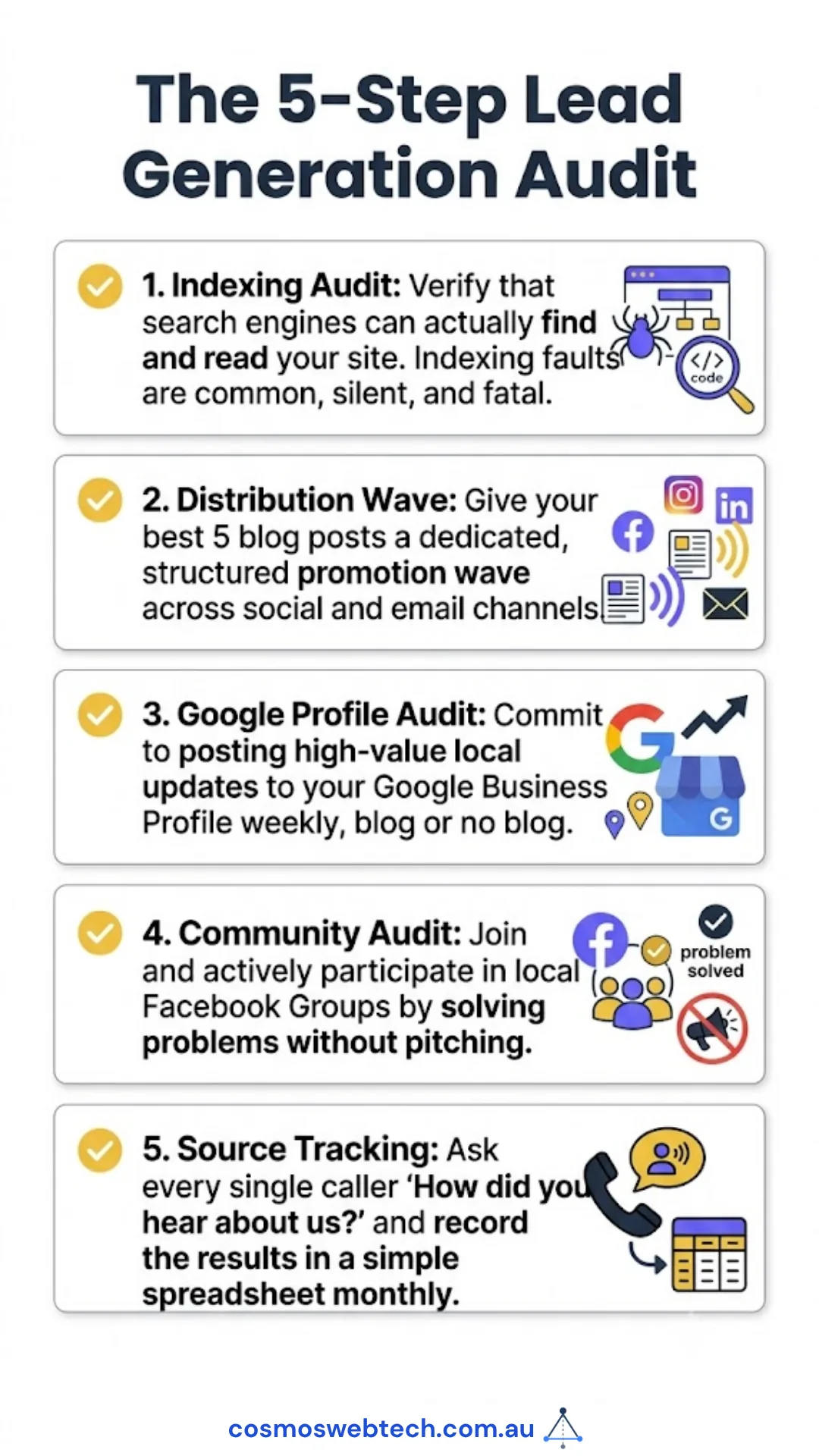
If you have hundreds of posts and no enquiries, more posts will not fix it. The work that will:
- Confirm the site can be found at all. Indexing faults are common and silent.
- Give every existing post a distribution wave, starting with your best five.
- Post to Google Business Profile weekly, blog or no blog.
- Join the local groups your customers are in and be useful in them.
- Track enquiries by source. Monthly. Written down.
- Then, once you know which channel works, write more — for that channel.
You have already done the expensive part. Four hundred posts is a genuine asset. It is just sitting where nobody is looking.
Frequently Asked Questions
How often should I publish?
Less often than you think, distributed harder than you think. One post a month that gets a real distribution wave beats four that get published and abandoned.
Should I post the blog link to my Facebook business page?
You can, but expect very little. Organic Page reach is a few percent of your followers. Your local and industry groups are where the reach is — as a participant, not an advertiser.
How do I track where enquiries come from?
Ask, and write it down. “How did you hear about us?” on every call and form. A spreadsheet with date, name and source is enough to beat most analytics setups for this specific question.
Is it worth paying for ads instead?
Once you know which offer converts — yes, paid amplifies it efficiently. Before you know that, paid just buys traffic to a page you have not yet proven converts.
How long before content marketing produces enquiries?
With distribution: months, not weeks. Without distribution: it does not, and the 400 posts above are the evidence.
Talk to us
We are at U608/8 Elizabeth Macarthur Drive, Bella Vista NSW 2153, on 0433 309 677. If you already have the posts, the conversation is usually about distribution, not writing — and it is a shorter and cheaper piece of work than starting again.
If the answer turns out to be that people cannot find your site at all — Cloud Geeks handles hosting and technical infrastructure for Australian small businesses.
Ash Ganda writes on measurement and marketing strategy, including why most reported marketing numbers describe activity rather than results.
Part of the Ganda Tech Services family, Cosmos Web Tech delivers web design and digital marketing for Australian small and medium businesses.