What Namecheap Shipped in 2026: EasyWP Upgrades, SSL Renames, and What Actually Matters for Australian Buyers
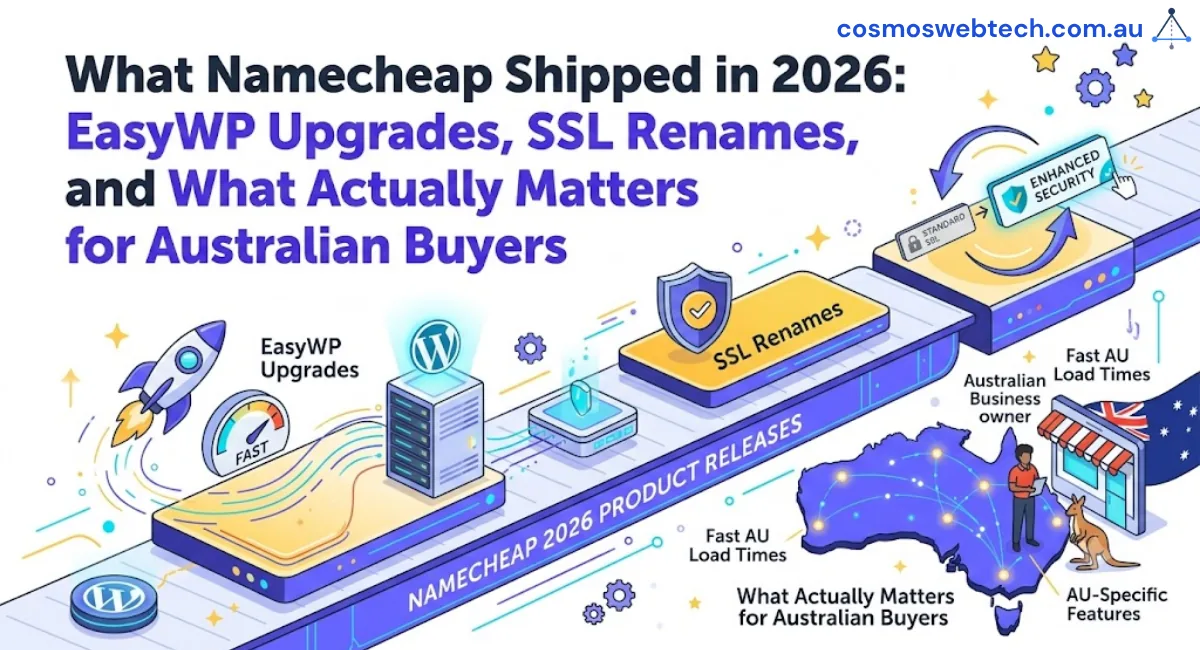
Namecheap is an American company with an American audience, and most product update announcements are written to that audience. When you are an Australian small business trying to work out whether to buy a .com, an EasyWP plan, or an SSL certificate from them, most of the marketing does not tell you the AU-relevant story.
Here is the AU-relevant summary of what Namecheap actually shipped in the first half of 2026, and which pieces are worth changing a buying decision over.
The three things that changed
1. EasyWP got closer to mainstream managed WordPress hosting
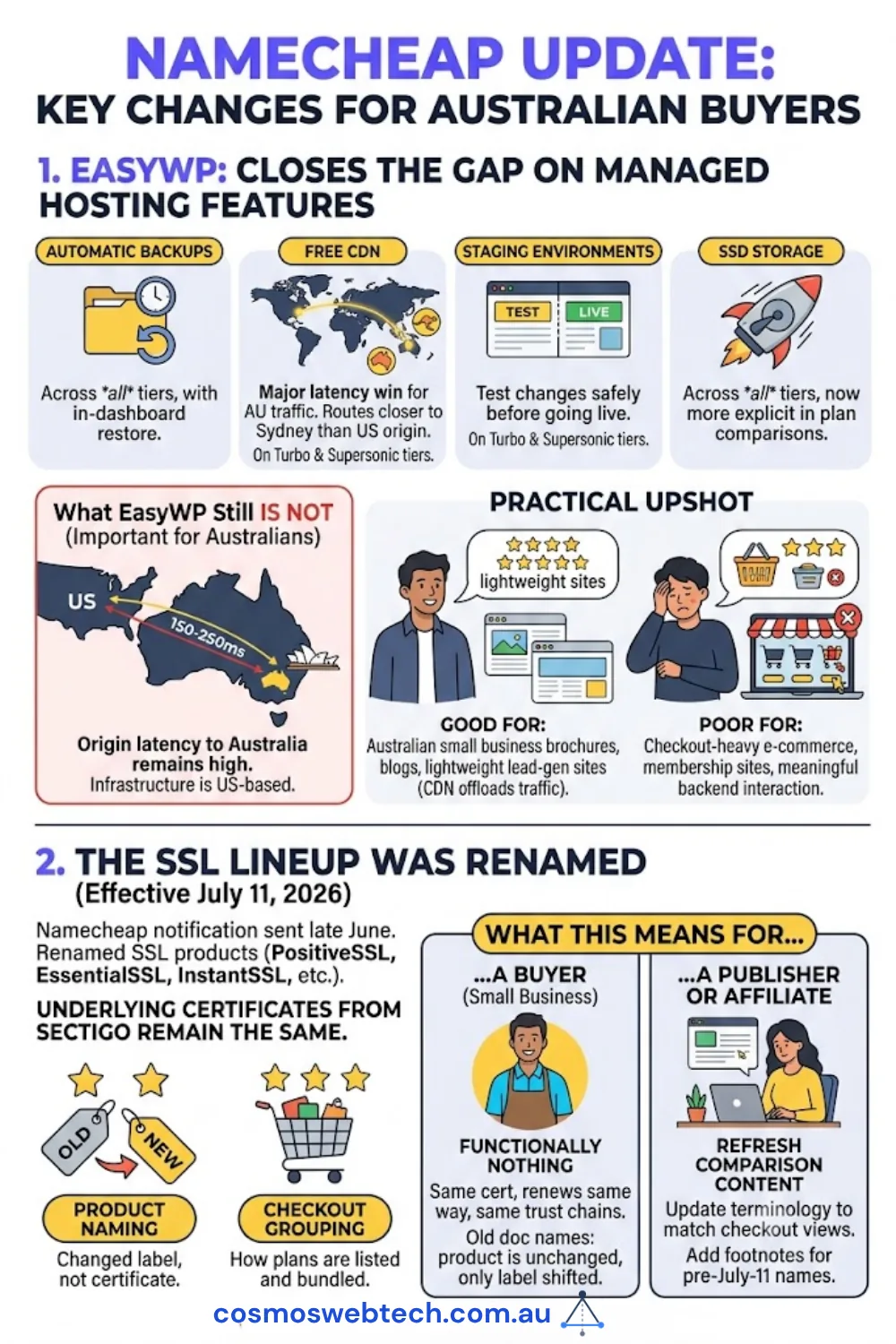
EasyWP has always been the “get a WordPress site up in five minutes for the price of shared hosting” product. Through 2025 and into 2026 it has quietly added the features that made it feel too basic to recommend for anything past a brochure site:
- Automatic backups across all tiers, with restore from within the dashboard
- Free CDN on the Turbo and Supersonic tiers (a meaningful latency win for Australian traffic since the CDN routes closer to Sydney than the origin server does)
- Staging environments on Turbo and Supersonic
- SSD storage across all tiers (this was already true but is now more explicit in the plan comparison)
What EasyWP still is not: a Sydney-region datacentre. Origin latency to Australia remains 150-250ms because the hosting infrastructure sits in the US. On a page load that is dominated by CDN-served static assets (a typical brochure site), this is fine. On a heavy WooCommerce checkout, it is a real problem.
The practical upshot: EasyWP is now a legitimate choice for Australian small business brochure sites, blogs, and lightweight lead-gen sites where CDN offloads most of the traffic. It remains a poor choice for checkout-heavy e-commerce, membership sites, or anything with meaningful backend interaction.
2. The SSL lineup was renamed (effective July 11, 2026)
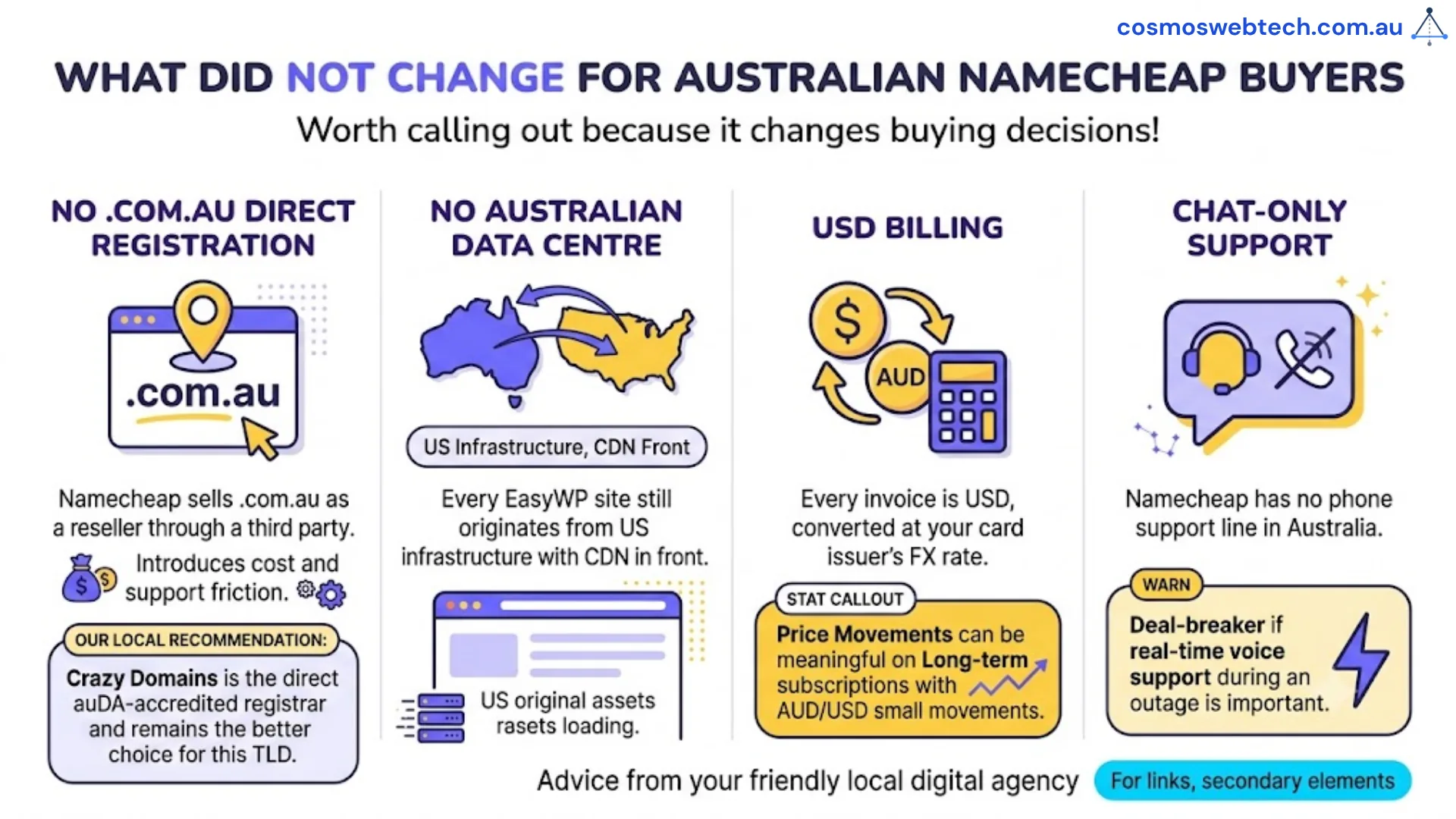
Namecheap notified affiliate partners in late June that the SSL product lineup was being renamed effective July 11, 2026. The underlying certificates - PositiveSSL, EssentialSSL, InstantSSL, etc. - remain the same certificates from the same certificate authority (Sectigo). What changed is the product naming and the way plans are grouped in the checkout flow.
What this means for a buyer: functionally, nothing. A cert you bought under the old name is the same cert; it renews the same way; the same trust chains. If you have blog posts or documentation referencing SSL products by name (like the “PositiveSSL” tier), the product itself is unchanged; only the label may have shifted.
What this means for a publisher or affiliate: if you have written comparison content referencing Namecheap SSL products by their pre-July-11 names, you may want to add a footnote or refresh the terminology so it matches what customers see at checkout.
3. Affiliate tracking terms changed in May 2026
Namecheap’s affiliate programme (via Impact.com) had two contract updates in May 2026:
- May 7: “Old tracking terms removed, EasyWP commission corrected”
- May 19: Additional contract terms revision (detail in the Impact.com publisher dashboard)
Existing tracking links (the namecheap.pxf.io/... format) continue to work. The commission structure - particularly for EasyWP referrals - was adjusted. Publishers should log into Impact.com to review the current commission table if EasyWP referrals are a meaningful revenue line.
What did NOT change
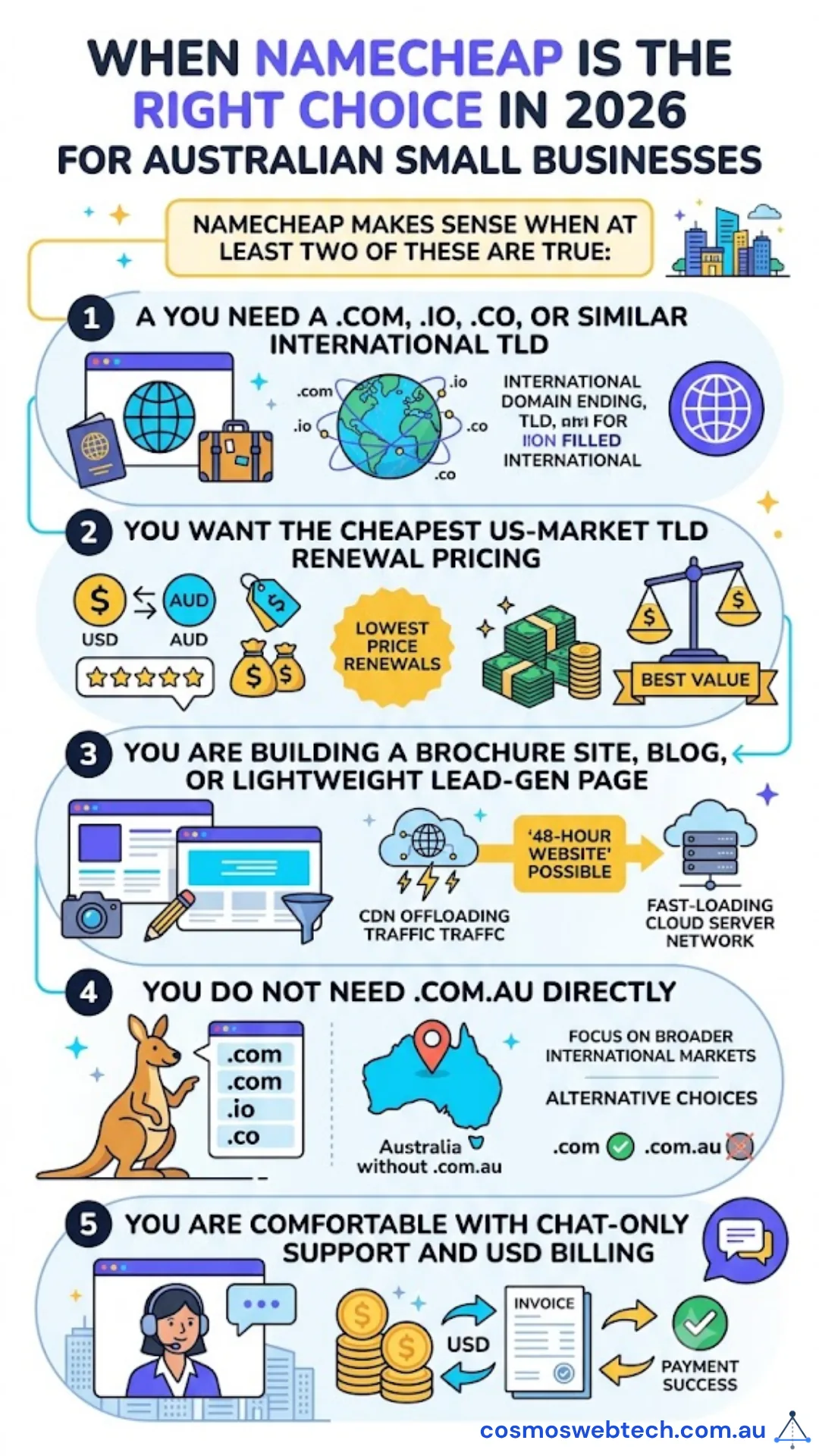
Worth calling out, because it changes buying decisions:
- No
.com.audirect registration. Namecheap sells.com.auas a reseller through a third party, which introduces cost and support friction. If a Sydney small business needs a.com.au, Crazy Domains is the direct auDA-accredited registrar and remains the better choice for that specific TLD. - No Australian data centre. Every EasyWP site still originates from US infrastructure with CDN in front.
- USD billing. Every invoice is USD, converted at your card issuer’s FX rate. For long-term subscriptions, small AUD/USD movements move the effective price meaningfully.
- Chat-only support. Namecheap has no phone support line in Australia. If real-time voice support during an outage is important, this is a deal-breaker.
When Namecheap is the right choice in 2026
For an Australian small business, Namecheap makes sense when at least two of these are true:
- You need a
.com,.io,.co, or similar international TLD - You want the cheapest US-market TLD renewal pricing
- You are building a brochure site, blog, or lightweight lead-gen page where CDN offloads most traffic
- You do not need
.com.audirectly - You are comfortable with chat-only support and USD billing
For those cases, buying is easy: register a domain or grab an EasyWP hosting plan at Namecheap.
When Crazy Domains beats Namecheap for Australian buyers
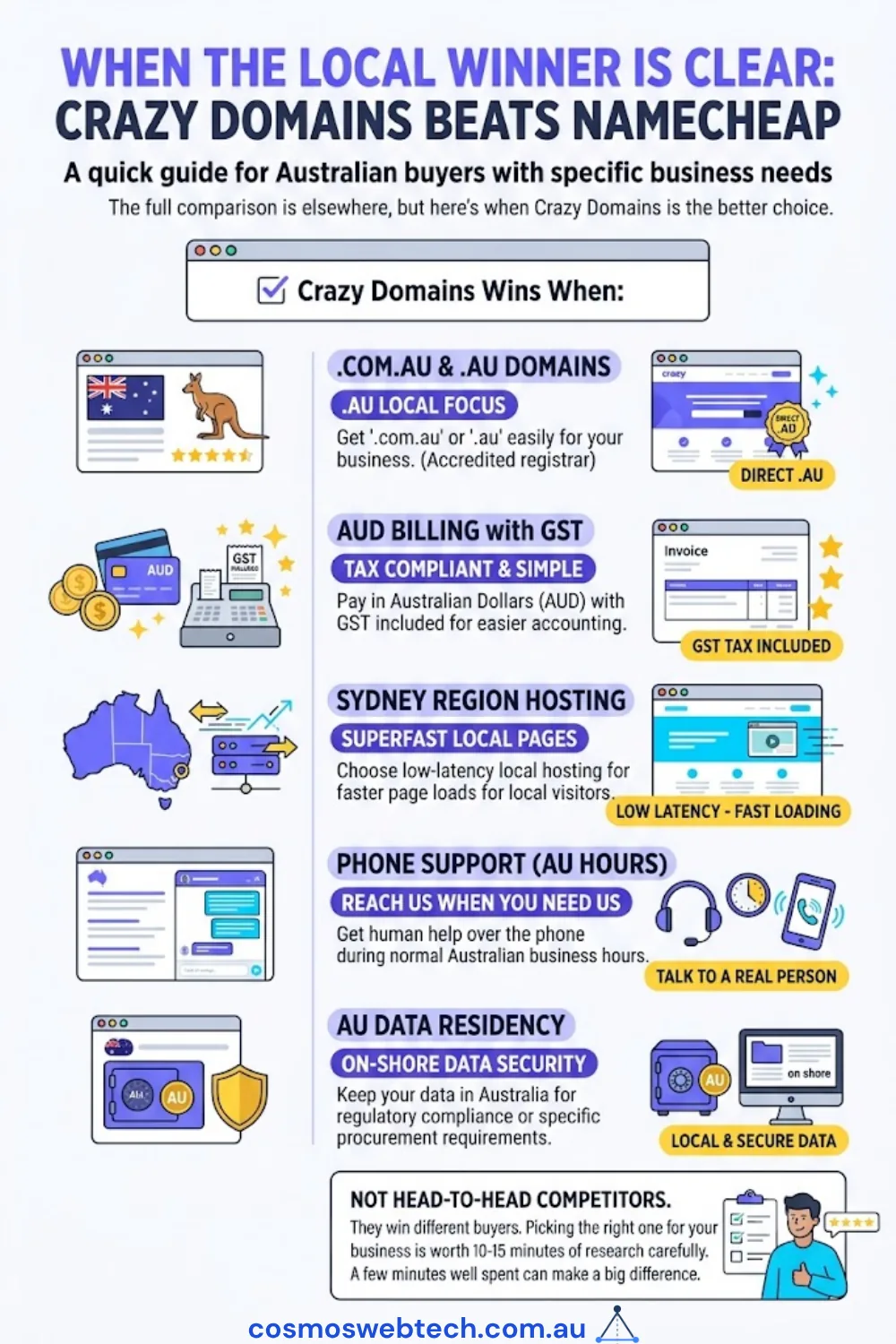
We have covered the full comparison in a separate post, but the short answer: Crazy Domains wins when the site needs a .com.au or .au, wants AUD billing with GST, needs Sydney-region hosting for low-latency origin, wants phone support in Australian business hours, or when Australian data residency is a procurement requirement.
The two are not head-to-head competitors for the same buyer - they win different buyers, and picking the right one for the specific business is worth 10-15 minutes of reading the differences carefully.
Get help
If you are trying to work out whether Namecheap, Crazy Domains, or a full managed WordPress host is the right fit for a new site - or you have inherited a site on the wrong stack and want to know if the migration is worth it - talk to our team. We help Australian small businesses map the domain-registrar and hosting choices against the actual business requirements, not the marketing.
Part of our Australian hosting and domains series. See also: Crazy Domains vs Namecheap for Australian Small Business and Kinsta and Cloudways in Australia.
For deeper technical hosting comparisons and infrastructure reviews, our sister site Cloud Geeks Insights covers managed WordPress hosts in more technical depth.
Part of the Ganda Tech Services family, Cosmos Web Tech builds and maintains high-performance WordPress and Jamstack websites for Australian small businesses.